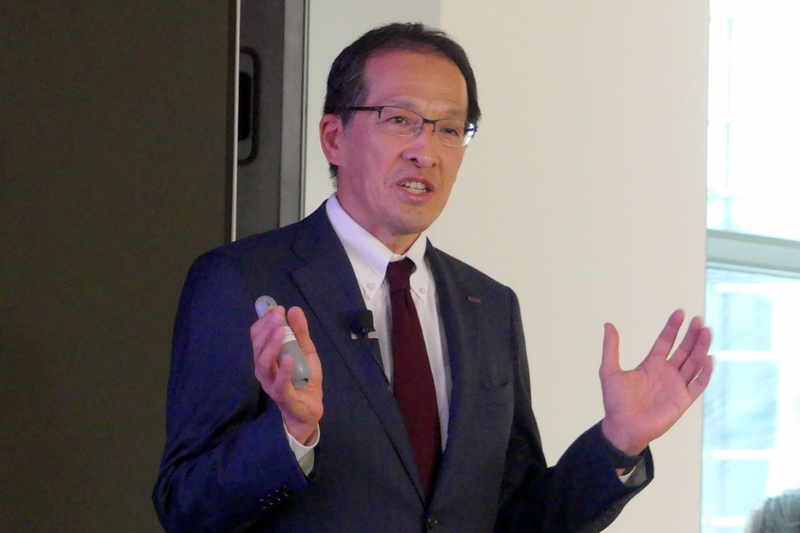
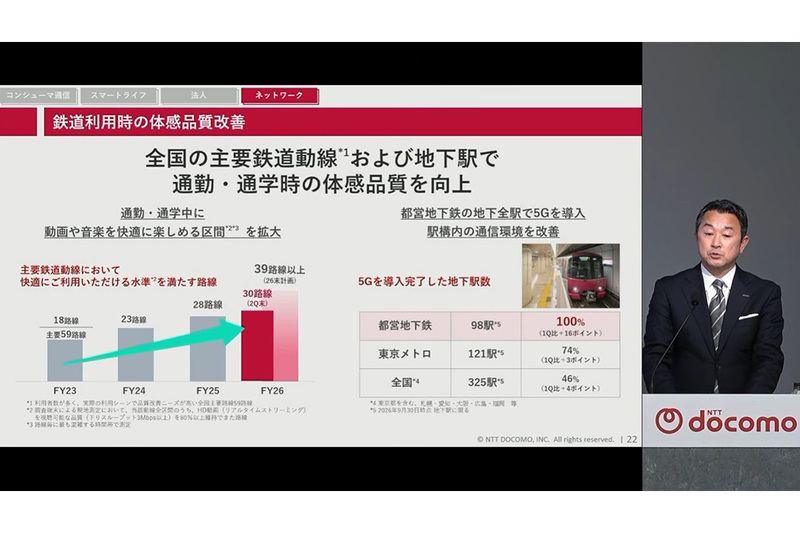
NTT Docomo held its Q2 FY2026 (July-September) financial results briefing. During the event, the company once again highlighted its network improvement initiatives, detailing efforts such as strengthening 5G base stations and deploying the latest Nokia-made base station equipment.
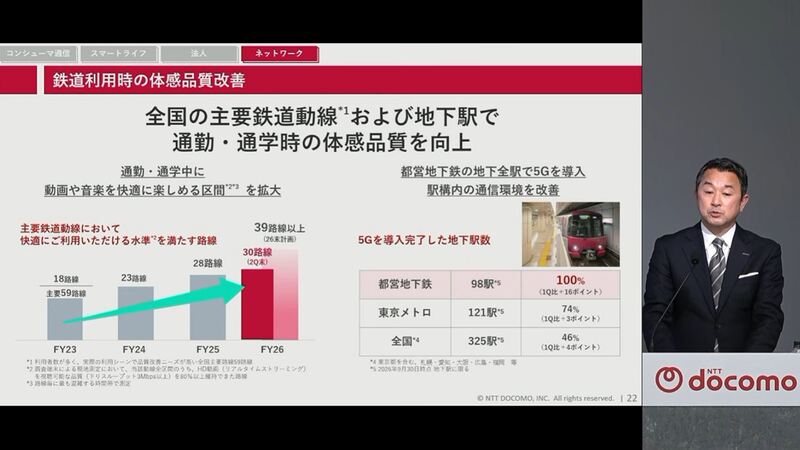
Highlighting network enhancements along railway lines and 5G deployment in Tokyo subway stations
Docomo's 5G Base Station Count Less Than Half of au/SoftBank; Prioritizing Sub-6GHz Base Stations for Capital Investment, Planning Over 10,000 Stations This Fiscal Year
The company's disadvantage against the two leading companies in network quality has been reported by third-party organizations. According to materials published by the Ministry of Internal Affairs and Communications (MIC) on October 30 (https://www.soumu.go.jp/menu_news/s-news/01kiban14_02000810.html), Docomo's 5G base station count remains at just under 60,000, roughly half of KDDI/SoftBank's approximately 120,000 stations.
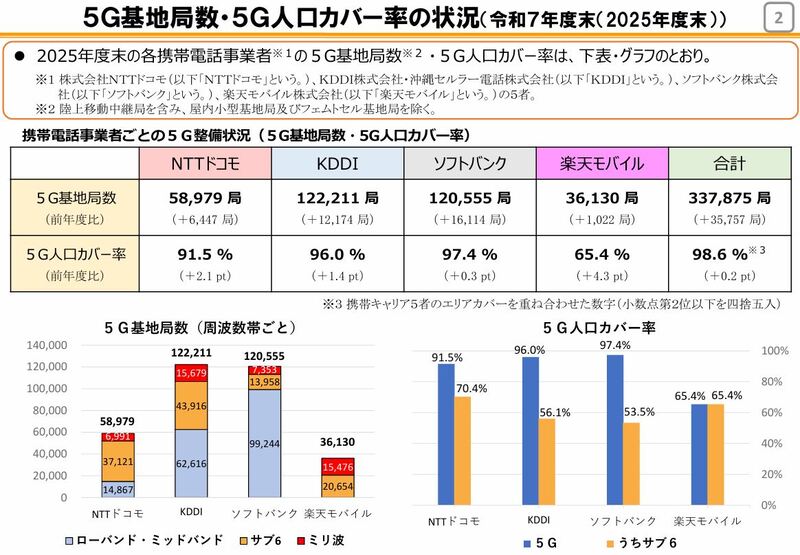
From MIC materials. While base stations using repurposed frequencies are central, it's clear that Docomo significantly lags behind the two leading companies in 5G base station count.
Regarding this, Yoshiaki Maeda, President and CEO of the company, stated, "We aim to increase the number." Indeed, the cumulative number of 5G base stations increased by approximately 7,000 in FY2025. A high pace was maintained in the first half of 2026, with 4,500 stations built. Docomo will continue with deployment to achieve its plan of over 10,000 stations within FY2026.
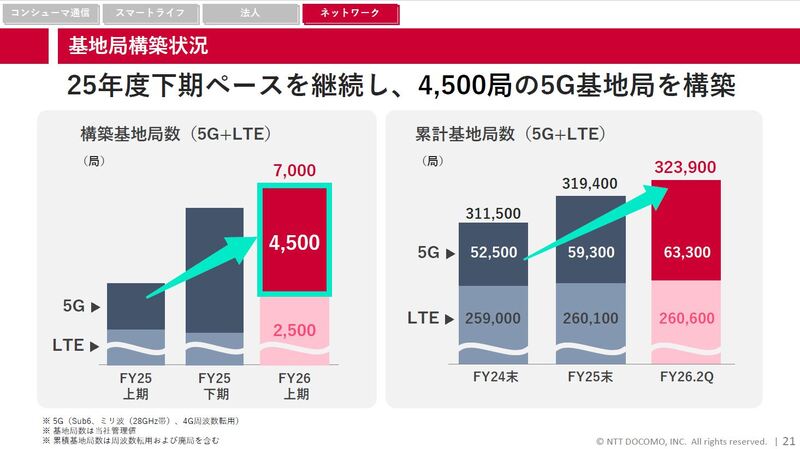
Docomo has been accelerating 5G base station construction since FY2025. The company plans to deploy over 10,000 stations this fiscal year.
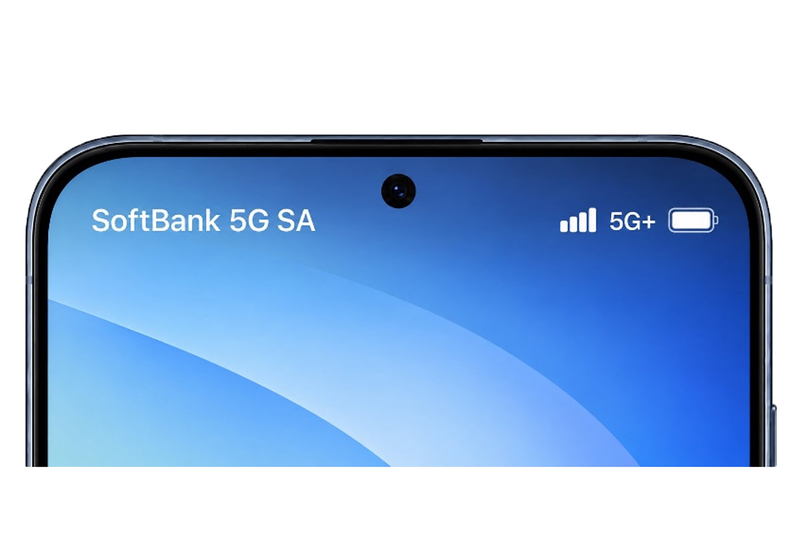
On the other hand, base station construction faces limited resources, such as external companies involved in construction, necessitating prioritized capital investment. Currently, "we are prioritizing Sub-6GHz, which can generate capacity," according to President Maeda. However, it's also necessary to promote the repurposing of 4G frequencies to expand coverage area-wide, and to advance "5G SA" (Standalone) deployment, which is essential for enhancing 5G services. While challenging to pursue simultaneously, these efforts are currently underway.
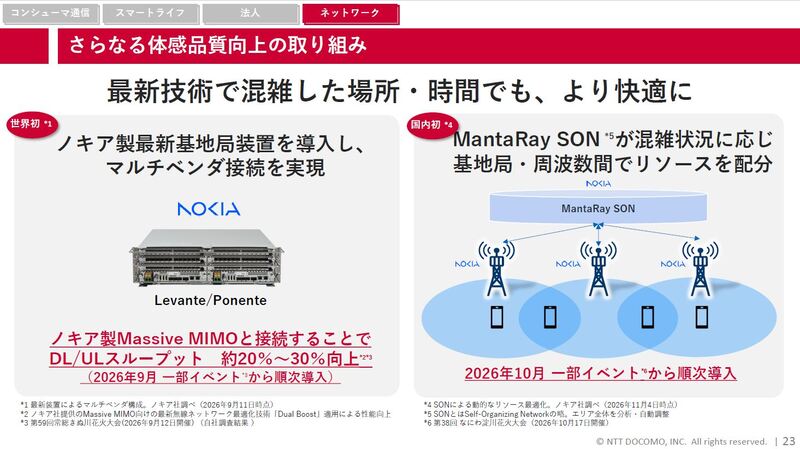
Beyond simply increasing the number of 5G base stations, Docomo is also focusing on advanced deployment. They are promoting 5G SA introduction and efficiency through replacing older equipment with newer models and expanding coverage. While repurposing 4G frequencies will also be carried out to enhance overall quality, Sub-6GHz is currently prioritized.
New iPhone Sales 'Slightly Sluggish Compared to Previous Years,' Possibly Due to Price Hikes; Docomo Aims to 'Actively Adopt' Anti-Hopping Measures
In addition, several other aspects of Docomo's current situation were discussed during the Q&A session.
First, regarding the new iPhone launched in September, it was stated that sales "might have been slightly sluggish compared to previous years," suggesting an impact from price increases. As for "anti-hopping measures," which the Ministry of Internal Affairs and Communications is considering introducing for the spring sales season next year, Docomo stated that preparations are underway, saying, "We intend to actively adopt them" and "Providing excessive benefits to customers who switch between various carriers has become a burden."