"Aiming to elevate companies' AI implementation capabilities for future growth," NTT Docomo Business held a business strategy presentation on September 28, 2026. They outlined three growth strategies and their progress: the AI-optimized "AI-Centric ICT Platform," four key focus areas, and partnering. They also revealed the roadmap towards their goal of 2.6 trillion yen in corporate sales by fiscal year 2030.
Focusing on AI Infrastructure to Enhance Companies' AI Implementation Capabilities
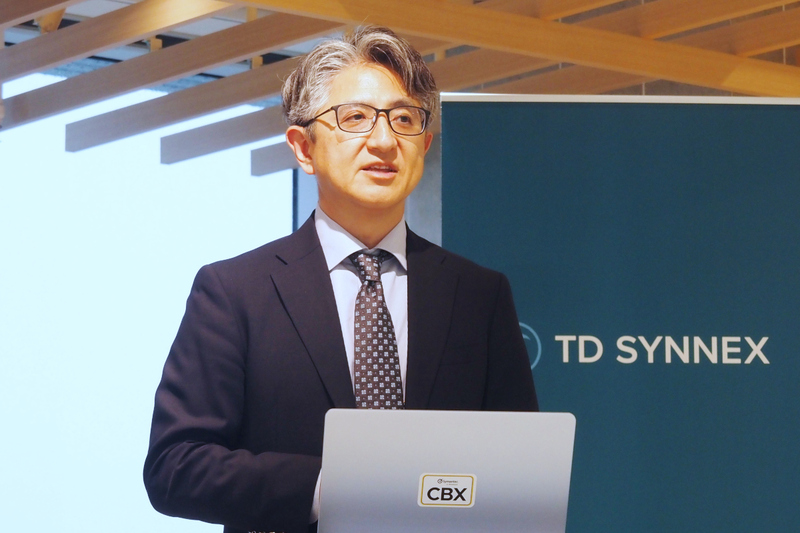
Katsushige Kojima, Representative Director, President, Executive Officer, and CEO, took the stage at NTT Docomo Business's business strategy presentation, marking the second year since the company's name change. The central theme, naturally, was AI. He explained the company's strategy and its progress in enhancing companies' AI implementation capabilities and connecting them to future growth.
During the NTT Communications era, the company primarily provided network-centric infrastructure, with growth drivers evolving from ICT to data utilization and DX. Now, with the integration of NTT Docomo's corporate business and the company's renaming to NTT Docomo Business, the new driver is "AX," which signifies a fundamental business transformation predicated on AI.
Mr. Kojima summarized the past year as "a year where expectations and anxieties regarding AI significantly heightened." While expectations for AI agents and physical AI are rising, many executives perceive security risks in continuously evolving frontier AI. Furthermore, from a geopolitical and national security perspective, the concept of "Sovereign AI," which involves retaining data and AI within a nation's own infrastructure, is gaining recognition. Amidst this, companies need to promote AX and enhance their competitiveness.
To support this AX, the core of service evolution will be the further advancement of the "AI-Centric ICT Platform," which integrates not only networking but also GPU computing, security, and managed services. Building on this, the fundamental growth strategy involves strengthening businesses in four key areas—"AI," "IoT," "Digital BPO," and "Regional/SME DX"—while also enhancing partnerships.
The NTT Docomo Group's corporate sales surpassed 2 trillion yen in the fiscal year ending March 2026. In the aforementioned four key areas, sales exceeded 300 billion yen in fiscal year 2025, with each area growing by approximately 20 billion yen year-on-year. The strategy announced for fiscal year 2026 maintains the three aforementioned growth strategies—platform, four key areas, and partnering—as its core, with efforts to strengthen each. This plan aims to expand corporate sales to 2.6 trillion yen by fiscal year 2030 and grow the key areas to a scale of 700 billion yen.
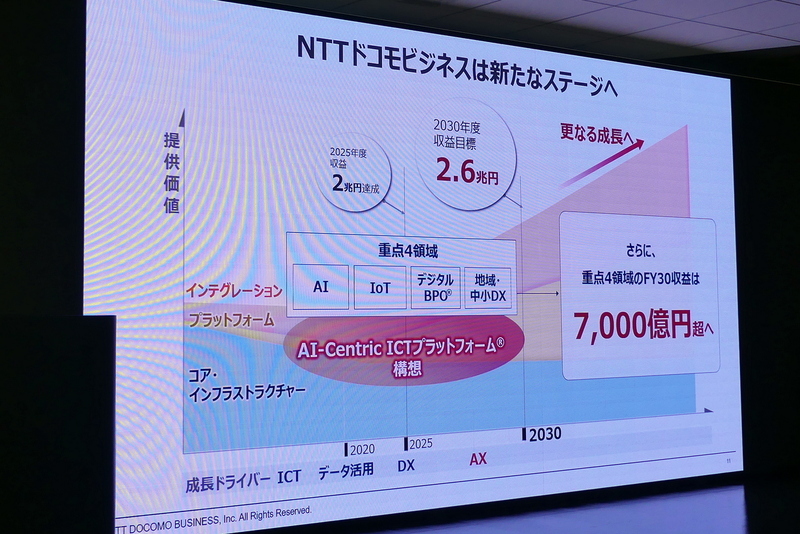
NTT Docomo Business's Growth Strategy until 2030
Full-Stack Provisioning from Computing to Network and Security
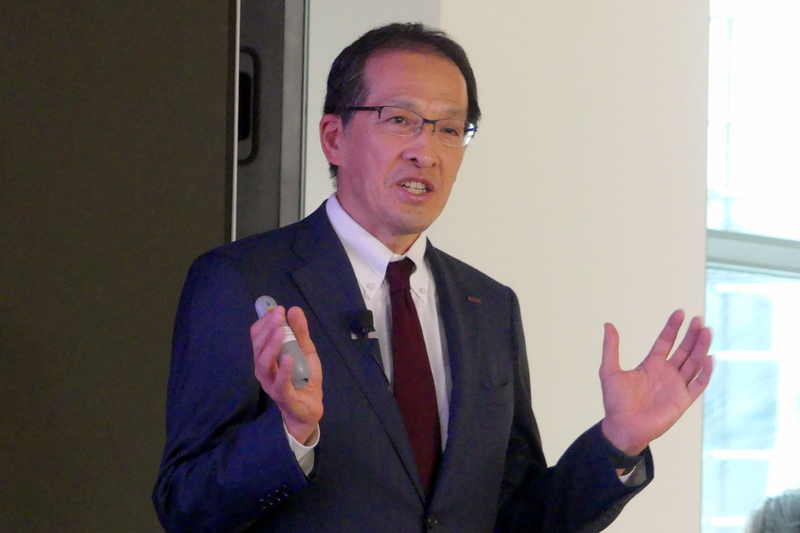
If an AI application is considered "the house itself," then AI infrastructure refers to all the facilities necessary to make the house functional. This includes foundations, electrical facilities, water supply, roads, building management, and crime/disaster prevention equipment. In this regard, the AI-Centric ICT Platform's greatest feature is its full-stack provision of computing, networking, and security—all essential for AI infrastructure. During the business strategy briefing, Toshio Kanai, Representative Director and Executive Vice President of NTT Docomo Business, introduced initiatives related to the AI-Centric ICT Platform.
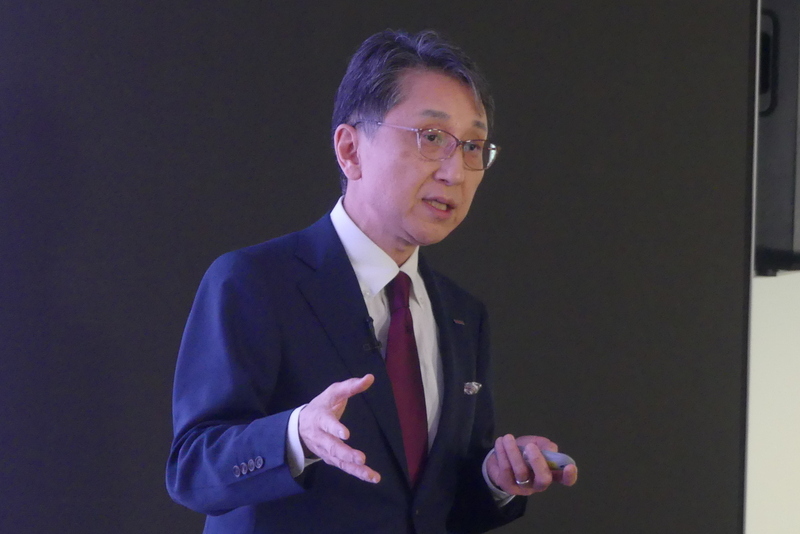
Toshio Kanai, Representative Director and Executive Vice President of NTT Docomo Business
For instance, regarding data centers that support computing—analogous to foundations and electrical facilities—the company is promoting liquid cooling in anticipation of increased power consumption. A metropolitan AI data center, standardizing liquid cooling, is scheduled for completion in Q3 FY2029. Furthermore, to swiftly meet robust AI demand, NTT Docomo Business plans to deploy containerized data centers in collaboration with Tokyo Electric Power Company Power Grid in autumn 2027. A notable point is that it will not only provide power and network services together but also feature a liquid-cooling compatible design capable of housing the latest GPUs.
Moreover, they are promoting GPU as a Service, allowing users to utilize GPUs as needed, thereby addressing the sovereign AI needs of companies wishing to securely and rapidly leverage their own data. Approximately 170 proprietary and third-party data centers are interconnected via "docomo business APN Plus powered by IOWN," a high-capacity, low-latency network based on IOWN, supporting users' AI utilization as a nationally distributed AI computing infrastructure.
Regarding networks, likened to water supply and roads, "docomo business RINK" is available for branch offices, "docomo business SIGN" for IoT and physical AI, and "docomo business APN Plus powered by IOWN" connects data centers. Key features include NaaS (Network as a Service) functionality, allowing configuration of features and bandwidth via APIs and portals, pay-as-you-go billing, and network security functions incorporating threat detection and blocking.
For managed services, AI-driven automation and acceleration are crucial, not only for ICT environment operations but also for security analysis, monitoring, and response. Specific initiatives mentioned include the provision of "FinOps" for AI infrastructure cost visualization and consulting, and AI SOC (Security Operations Center) that enables threat analysis and response to machine-speed attacks using AI.
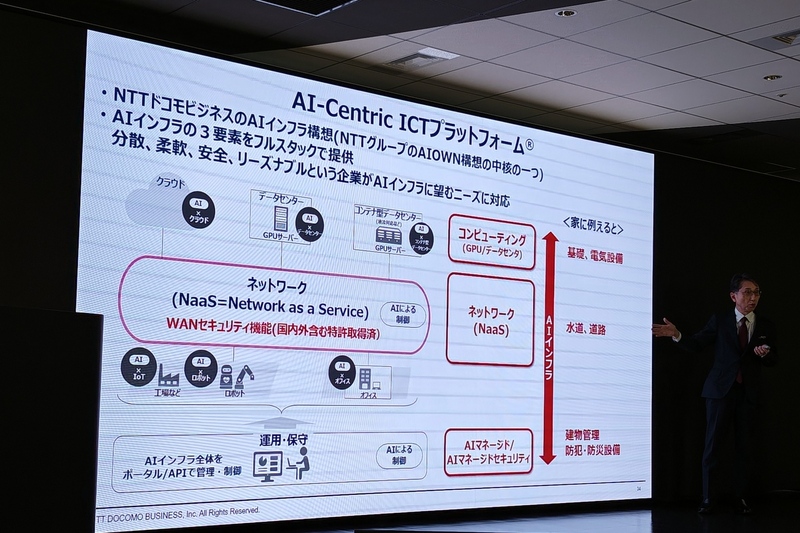
Overview of the AI-Centric ICT Platform
Services Previously Handled by SI Now Offered as a Service; AI Infrastructure Can Lower IT Costs
The AI-Centric ICT Platform, a central focus of the business strategy briefing, clearly demonstrates steady evolution towards the AI era. The key point is its adaptability to change. To respond to rapidly changing market trends and user needs, NTT Docomo Business today is not limited to in-house development but can deploy services with partners, such as with Tokyo Electric Power Company Power Grid for container data centers and EXAWIZARDS in the AI agent field.
On the other hand, a simple question arises: will companies seeking AI implementation benefits invest in LLMs, or will they invest in AI infrastructure like the AI-Centric ICT Platform? In response, Mr. Kojima stated his expectation that appropriate costs would be invested in AI infrastructure, as "many companies are currently in the phase of selecting AI token costs."
Mr. Kanai also explained, "We can inform customers that total IT costs will decrease because AI will transform services traditionally handled by SI into managed services." The challenge moving forward will be how effectively they can communicate the advantage of quickly and affordably utilizing infrastructure that can flexibly adapt to changes.
Furthermore, in the four key areas, the initiative for AX implementation personnel, branded as FDE (Forward Deployed Engineer) in the "Digital BPO" domain, struck me as uniquely different. Currently, the entire group has 14,000 AI utilization personnel, with approximately 5,000 of them operating as "FDE Light" providing community-based AI utilization support nationwide. Additionally, industry-specific FDEs, covering AX conceptualization, design, implementation, and operation, are planned to expand to a scale of 1,000 personnel by fiscal year 2027.
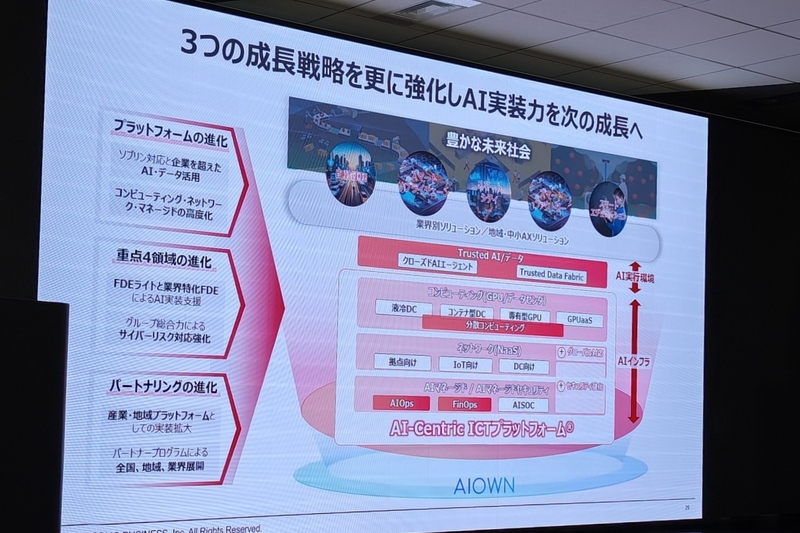
Strengthening three growth areas to enhance AI implementation capabilities
They are strengthening infrastructure and preparing accompanying personnel. While the perspectives on infrastructure and personnel differ, the goal of "enhancing companies' AI implementation capabilities" is shared. The ability to offer various measures to achieve this goal, including the aforementioned partnerships, can be considered NTT Docomo Business's current strength.