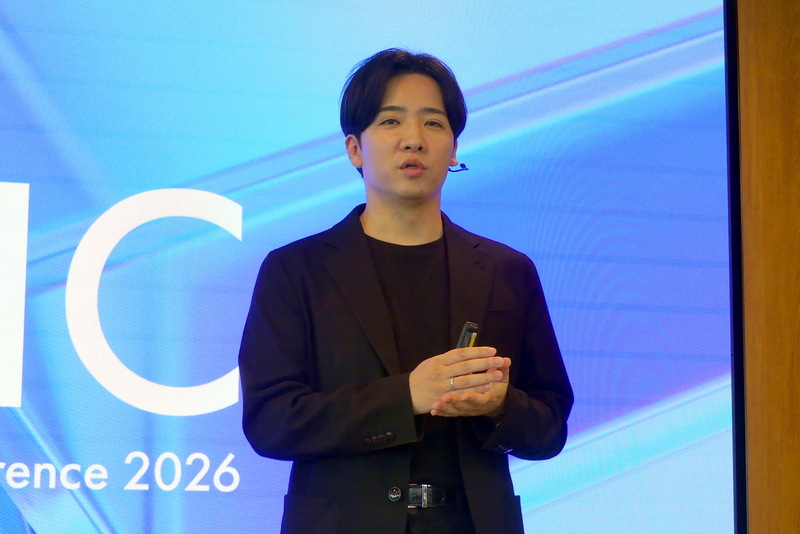
"AI is evolving rapidly, so why haven't our business operations changed?" asked Takumi Tokuchi, President and CEO of AI inside, during his keynote speech at the annual "AI inside Conference (AIIC) 2026" held on October 6, 2026. He then demonstrated a new version of "DX Suite," an AI platform designed to transform business operations, where "tasks are completed simply by giving instructions."
Businesses Aren't Changing with AI Because Humans Are Slow
AI inside is known for its AI OCR "DX Suite," adopted by 70,000 companies in Japan. What's unique about the company is its vertical integration, developing all necessary components for AI development and operation, from the AI model "PolySphere" that underpins DX Suite, to the integrated platform "Leapnet," and the hardware "AI inside Cube."
Tokuchi, who spoke at the keynote, commented, "AI is evolving rapidly, so why haven't our business operations changed? At least, mine don't seem to have changed much." While many AI companies often cite a lack of context, governance, or organizational structure as challenges to this frequently asked question, Tokuchi's answer is simpler: "Because humans are slow." He pointed out, "Our decisions are slow, and naturally, our work is slow. We're in a situation where we can't keep up with AI's capabilities."
Given this perspective, Tokuchi's solution is also straightforward: "Let AI complete the tasks." To achieve this, AI inside has prepared six AI agents and mechanisms: AI that understands documents, AI that uses organizational knowledge, AI that constructs tasks, AI that autonomously proceeds with work, a mechanism for connecting approvals, and a mechanism for recording actions. By linking these, they've created a user experience where humans don't become a bottleneck even in parts requiring judgment. This is the new DX Suite. "DX Suite is no longer just an AI OCR; it's a business foundation," Tokuchi stated.
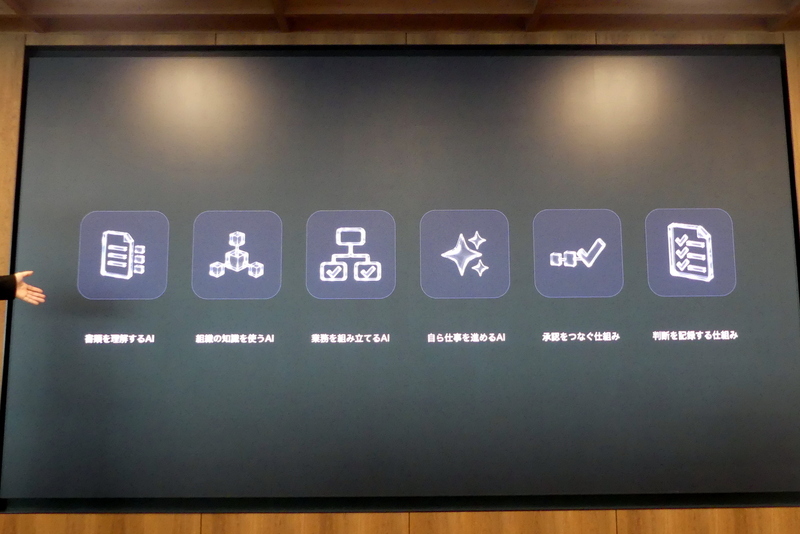
Agents and mechanisms for AI to complete tasks
Tokuchi demonstrated AI inside's own order processing workflow, from start to finish. The demo involved using a prompt to research and create an order processing workflow. After registering a purchase order, only an approval request for a partial delivery proposal would appear. Human judgment was required only at this point. If integrated with SaaS, there wouldn't even be a need to upload the purchase order. It was a world where AI autonomously researched tasks, built processes, and executed them. It became clear that when AI completes tasks, the demo itself becomes less visually striking.
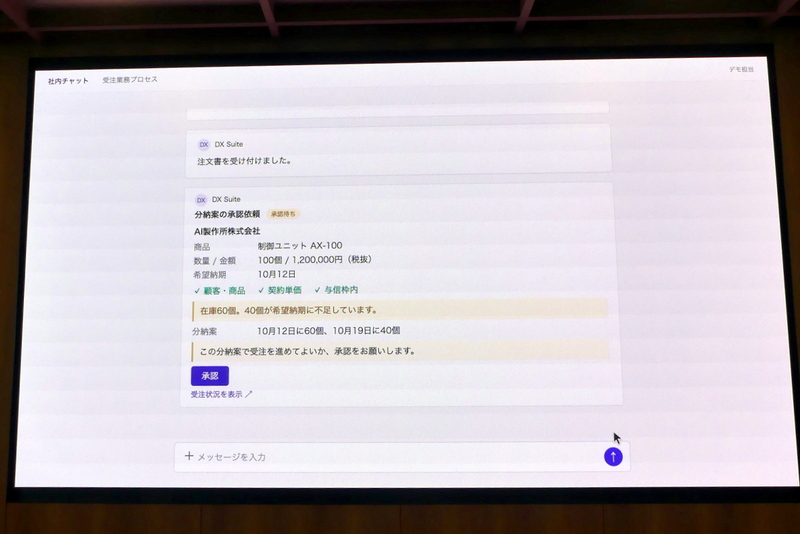
Demos now consist only of instructions and approval confirmation
Why Can AI Propose Partial Deliveries When There's a Stock Shortage in the Order Process?
Of course, while the demo is simple, the backend order processing workflow is quite complex. To handle this workflow, the aforementioned AI agents execute a sequence of steps: reading purchase orders, confirming orders, checking conditions, addressing deficiencies, human approval, and task execution.
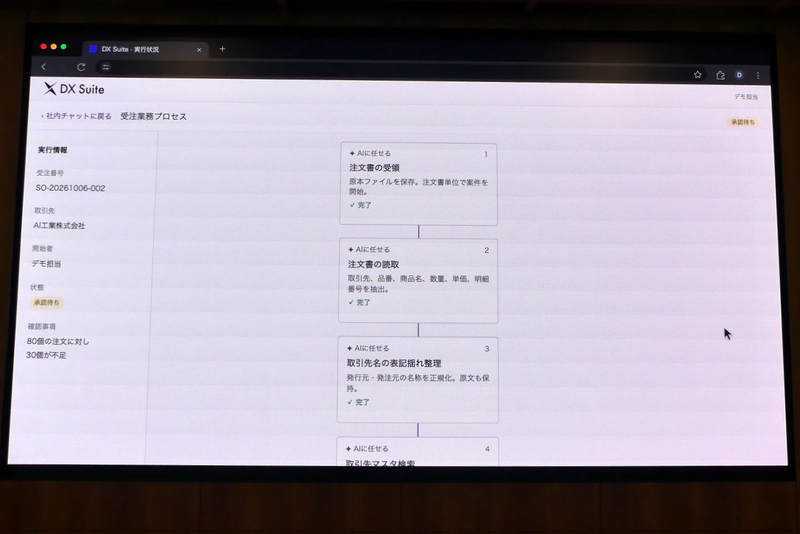
Flow operating in the order processing workflow
For example, when reading a purchase order, it doesn't just extract necessary items like model numbers, quantities, amounts, and delivery dates; it also cross-references them with internal databases. Is the client new or existing? If existing, is there a credit limit? Is there stock available? Is partial delivery possible? And so on.
Order processing becomes complex due to deficiencies and irregular situations. In this case, the deficiency was a stock shortage. However, the AI was able to propose a partial delivery because it had secured the planned delivery quantity and had read that partial delivery was possible according to the purchase order's terms. Since human judgment is required to approve the partial delivery proposal, an approval request was issued.
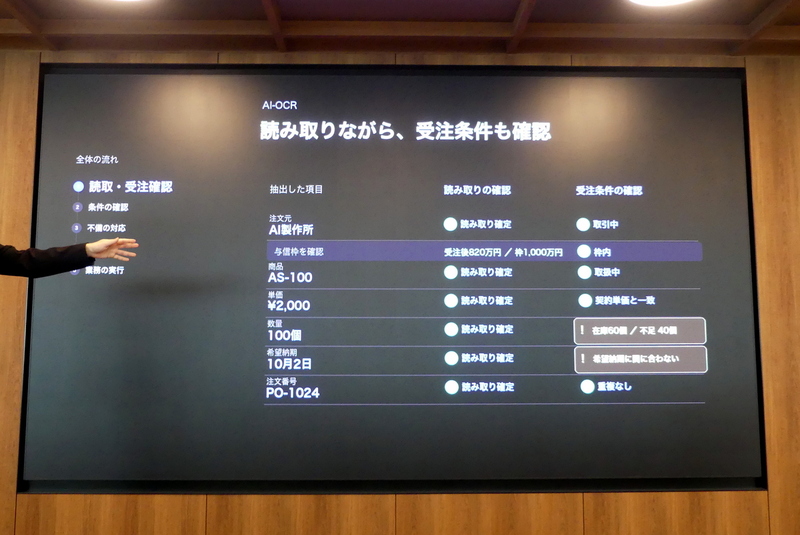
Reading and checking transaction conditions during document processing
What happens if it's a first-time purchase order with no prior transaction history? In that case, the process moves to a new client onboarding workflow. It conducts client research, including the ordering company's location, company name, anti-social checks, credit investigations using financial statements, transaction terms, and payment history, then creates a contract template. It cross-references with the company's own screening criteria and presents confirmation items and proposed revisions. It's also possible for the system to check 300 client accounts in parallel as an inventory, with humans only reviewing those that require confirmation.
This level of appropriate business analysis is made possible by the company's proprietary technology called "Engram." Engram is a harness + context DB built on a different philosophy than RAG. It can efficiently extract the truly necessary knowledge and value to provide for generating answers. This efficiency is also key to solving the significant challenge of token consumption in current AI applications.
Non-RAG "Engram" Extracts Necessary Knowledge Without Consuming Tokens
For a company to complete a transaction, various documents are required: quotes, proposals, contracts, invoices, meeting minutes, specifications, etc. Tokuchi stated that when he created these six documents, the token consumption was 4,607. If the closing rate is 10%, it would be 45,994 tokens per successful deal, and 45,994,000 tokens for 1,000 successful deals.
Now, if you want to ask about specific quote conditions for company A from these tokens, even using the cheapest LLM, it would cost ¥1,388 per question. This means if 100 employees ask 10 questions daily, it would cost approximately ¥1.38 million per day. Even with a high cache hit rate, it would still be ¥312,000 per day. Tokuchi questioned, "Can you really pay ¥300,000 a day just to answer those questions? It's clearly unreasonable."
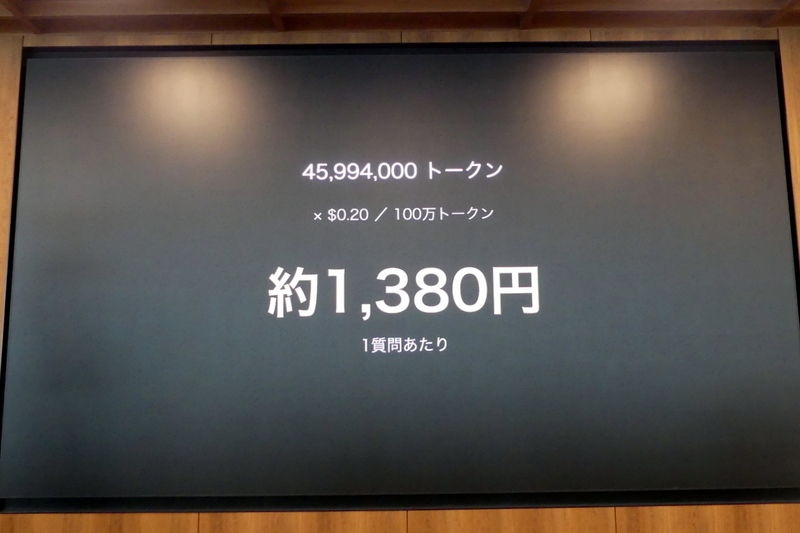
1,380 yen per question. Calculation shows 1.38 million yen per day for 100 people.
Naturally, one would think, "Can we extract only the necessary knowledge with as few tokens as possible?" RAG attempts this by targeting only the relevant parts from vast amounts of data. However, Tokuchi's research showed that even searching 5 or 50 locations didn't exceed 70% accuracy; it required searching up to the top 200 to approach 100%. Aiming for about 90% accuracy with RAG would reduce the cost to ¥187 per question, but that's still high.
In contrast, AI inside's Engram discerns truly necessary knowledge without using tokens. If you ask, "What is the maximum lodging expense for next week's business trip?" it can narrow down to the business travel expense regulations, lodging expense limits, and approval conditions. As a result, token consumption is overwhelmingly lower than RAG, costing only ¥4.1 per question. The trick is that lower token consumption allows it to read all necessary regulations and generate business flows, leading to higher accuracy.
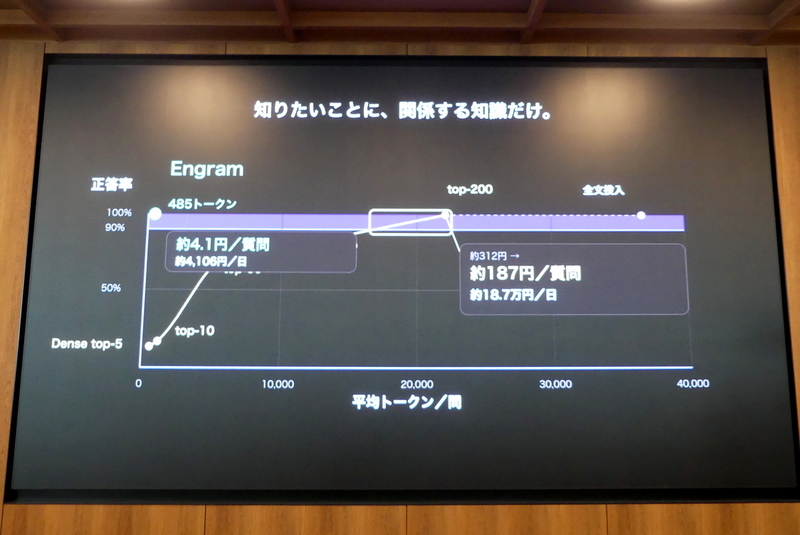
Engram achieves high accuracy while suppressing token consumption
Tokuchi, having explained all this, appealed, "I've talked about complex business tasks until now, but let's stop these discussions. With the new DX Suite, operations will run automatically with great ease, and your company will be better tomorrow than it is today." The new version of DX Suite will be available starting in November.
Focusing on AI Task Completion Rate: A Step Forward in Building an AI Factory
DX Suite is evolving from an AI OCR into an integrated AI business platform. In the first half of the keynote, the latest trends and new announcements for each component supporting DX Suite were also unveiled.
The company began developing AI models based on LLM technology in 2019, before the term "generative AI" became mainstream. In 2024, they released the first version of PolySphere, which covered the reading of unstructured documents. Since then, AI inside has accelerated its development speed, challenging how far AI can complete tasks.
In 2025, they released Version 2, which supported customization for each company. In 2026, Version 3, which automated learning itself, was released, followed by Version 4, which improved accuracy, just three months later. Cumulatively, AI can now replace 16 billion tasks, achieving an average AI task completion rate of 99.51%. Tokuchi emphasized, "With Version 4, even the lower end of the average reached 91%, surpassing human double-checking."
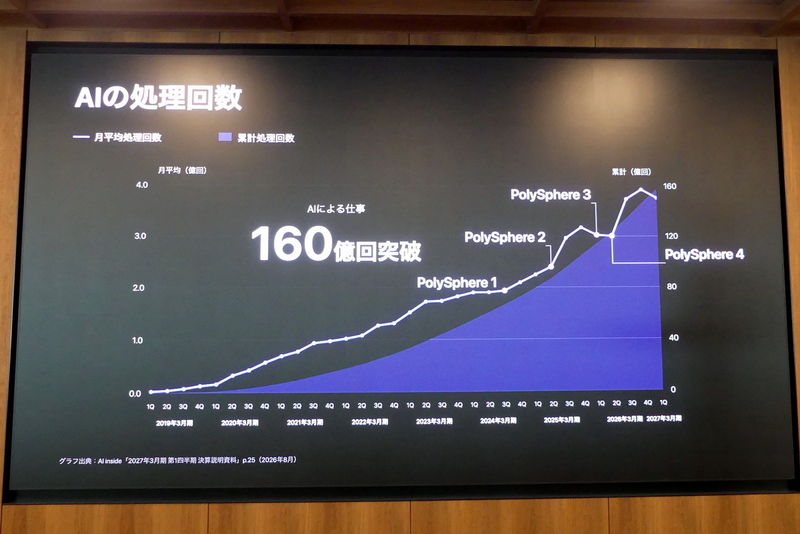
AI can now handle 16 billion tasks
In terms of hardware, the company has deployed "AI inside Cube," an AI computer dedicated to AI inference. In June 2026, they announced "AI inside Cube Atlas," and this time, a lineup including 1x, 2x, 8x, 16x, and 192x was prepared to match computational power and processing scale. Tokuchi asserted, "It can autonomously operate AI-OCR, generative AI platforms, large models, and powerful models."
The company has also launched a concept called "Sovereign Grid," which aims to transform existing data centers into AI Factories based on AI inside Cube and Leapnet. This time, the signing of a basic agreement for a business alliance and joint venture consideration with Hashimoto Holdings, a Shizuoka Prefecture-based company with multiple construction firms, was announced, marking the full-scale commercialization of the "AI Factory." Tokuchi stated, "Currently, AI data centers in Japan cannot even compare to those in other countries. We want to break through this situation."
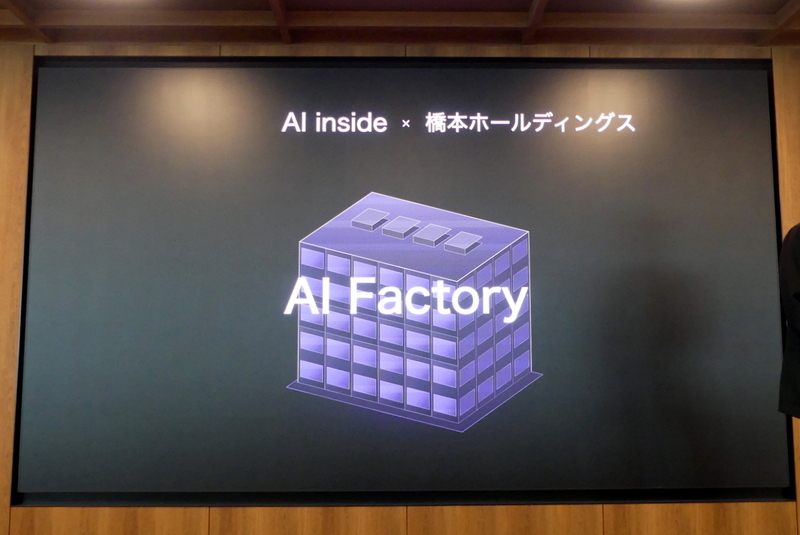
Partnership with Hashimoto Holdings to realize AI Factory