
Notion Labs Japan, provider of the AI workspace "Notion," held a media roundtable on October 1, 2026. CEO Ivan Zhao, CTO Max Schoening, and Tomo Aoki, who was appointed General Manager of the Japanese subsidiary in August, took the stage to explain their focus on the context layer in the AI domain and their challenges and initiatives in the enterprise market.
AI Utilization Remains Limited to Personal Use: Barriers are Context and Organizational Issues
The media roundtable began with a video from the "Think Together" campaign, themed around AI and human co-creation. Notion CEO Ivan Zhao, who visits Japan annually, took the stage to discuss the current state and challenges of knowledge work with AI.
Notion is known as a versatile app usable for notes, task management, wikis, databases, and more. Currently, with AI integrated into its service, it's used across various sectors, from startups to enterprises, as a "tool for collaborative work with AI." Its user base, which was around 1 million in 2020, grew 100-fold in four years, surpassing 100 million in July 2024.
So, how is AI Transformation (AX) progressing on the user enterprise side? Zhao broke down AI utilization into four phases: Level 1, using AI as a thinking partner; Level 2, using AI agents as assistants; Level 3, co-creating with autonomous AI as teammates; and Level 4, using AI at the company's OS level. He then pointed out that "many companies' AI usage is still limited to personal use."
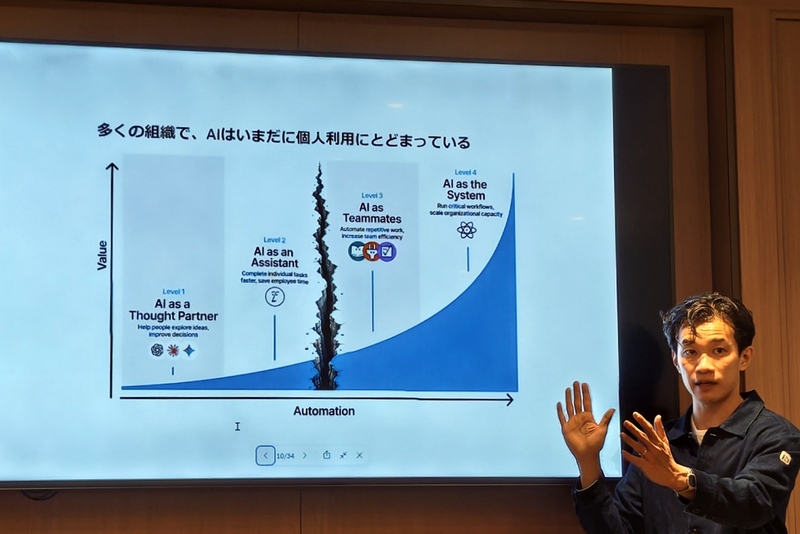
A wall exists between Level 2 and Level 3
Looking at survey data, Level 1 organizations account for 57%, Level 2 for 31%, while Level 3 is only 10% and Level 4 is 2%. This indicates a significant barrier to progressing from Level 2 to Level 3. The background to this, he explained, lies in "context fragmentation" and "organizational culture issues."
Three Reasons Why Notion Excels in the Context Layer
The former, context fragmentation, is caused by tools that cannot provide appropriate context to AI and by dispersed data, necessitating an integrated context foundation. In this regard, Notion provides an AI context layer that offers governance while integrating with various tools via MCP.
Notion recognizes that the current AI tool market is hot in the LLM and agent domains. In contrast, Notion focuses on the context layer, which enables collaboration, context, and governance. Zhao stated, "Notion's strategy is to excel in the context layer, which unlocks automation and paves the way to Level 3."
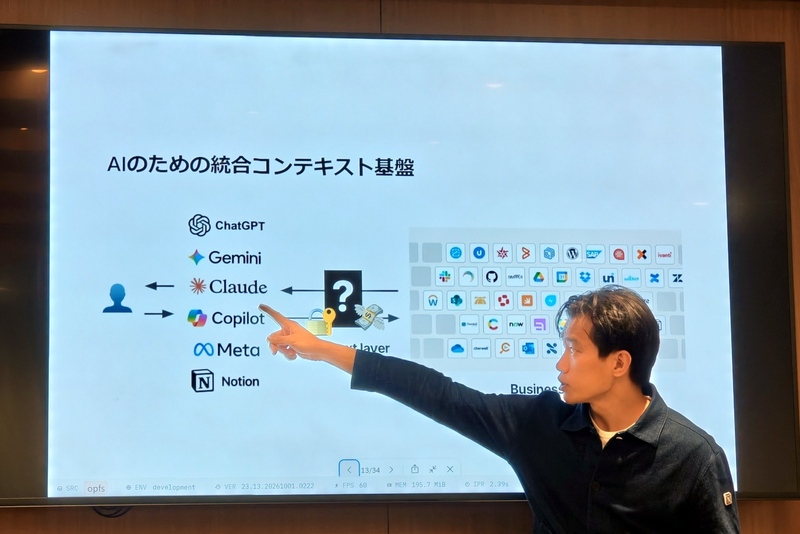
Notion's strategy to focus on the context layer
According to Zhao, Notion's strengths and the significance of its focus on the context layer are threefold: First, due to Notion's application characteristics, it has refined its data store to be a container for unstructured data. Second, it can eliminate vendor lock-in by being decoupled from LLM models. Third, Notion itself has a rapid pace of innovation and boldly challenges architectural refreshes.
The latter, organizational culture issues, require a change in users' mindsets, assuming AI. Indeed, within Notion's own organization, there has been a significant shift from a "marching band mode," which emphasized discipline for overall optimization, to a "jazz mode," which values individual improvisation and challenge. Zhao commented, "Shifting to a jazz mode that can adapt to change is sometimes tough. It took us three years as well."
Expanding Use in the Enterprise Sector: Cases from NEC and Keio University Unveiled
Currently, a major driver of Notion's growth is the enterprise sector. As of August 2026, the Annual Recurring Revenue (ARR) in the enterprise sector grew by 169%. Two-thirds of this ARR growth is attributed to AI involvement.
Especially in enterprises where usage is expanding, transitioning agents from experimental use to company-wide deployment presents several challenges. These include: portability issues for using agents, skills, and workflows across different models and systems; governance issues for properly controlling permissions, data access, and tokens; and return on investment (ROI) issues for visualizing agent activities and understanding whether used tokens are generating value.
Notion CTO Max Schoening stated, "To overcome these challenges, the key will be how to standardize workflows," and he promotes the library-fication of skills and tasks. Furthermore, he explained that Notion provides a foundation for expanding AI agent-driven operations across the entire organization while maintaining connections with people, context, and decision-making.
In the rapidly growing Japanese market, enterprise use cases are reportedly ahead of global trends. One example cited was NEC, which consolidates nearly 500 corporate IT department projects into a single workspace. Project plans, tasks, meeting minutes, and decisions are gathered by AI into a dashboard, allowing management and on-site teams to constantly check the latest status.
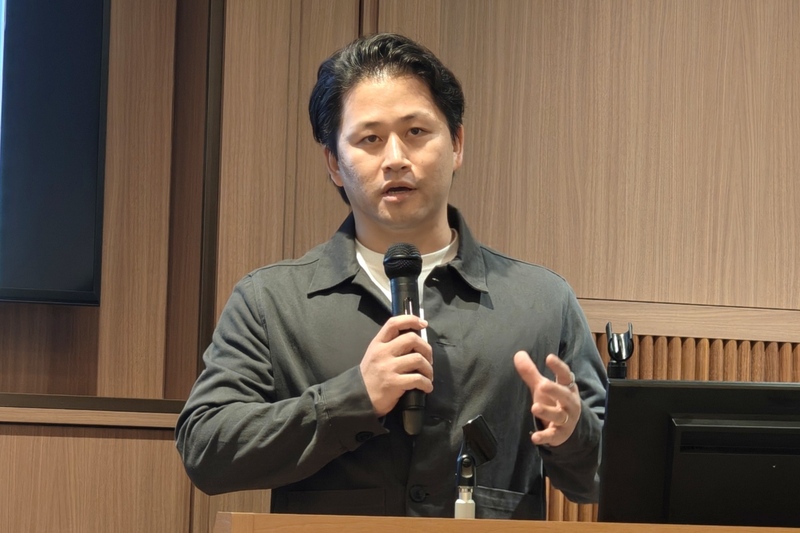
Notion Labs Japan General Manager Tomo Aoki explained the Japanese market
Furthermore, Keio University, which aims to become one of the world's leading AI campuses by consolidating 168 years of knowledge, has all faculty and staff across its campuses using Notion. Within 90 days of implementation, 80% of faculty and staff used Notion, executing 250,000 AI actions. To achieve this, Keio University and Notion formed a joint implementation team to design workspaces, build training programs, and construct a reliable context layer to optimize policies, procedures, research, and daily operations for AI.
Additionally, on the same day, Notion announced the completion of its ISMAP (Information system Security Management and Assessment Program) registration. By clearing the security and governance requirements stipulated by ISMAP, Notion is expected to accelerate its use in public institutions and the enterprise sector. Tomo Aoki, General Manager of Notion Labs Japan, stated his aspirations: "While many players are currently focusing on agents, Notion will concentrate on context development and rapidly grow its enterprise business."