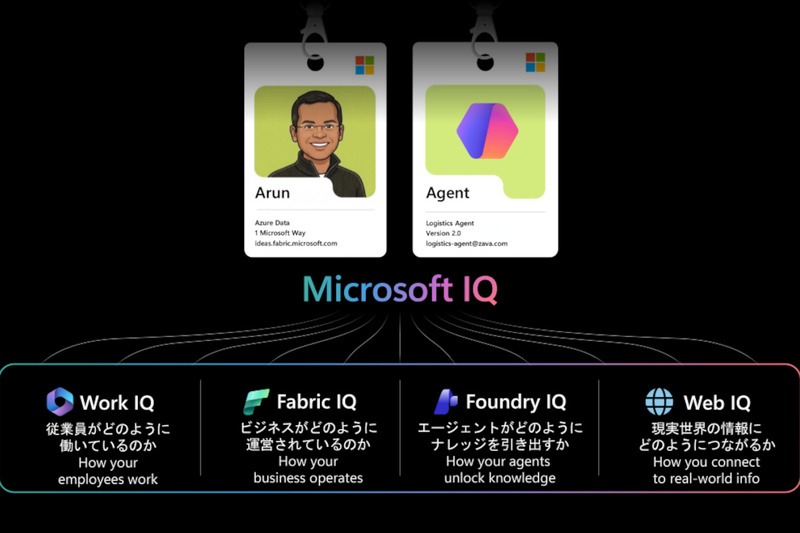
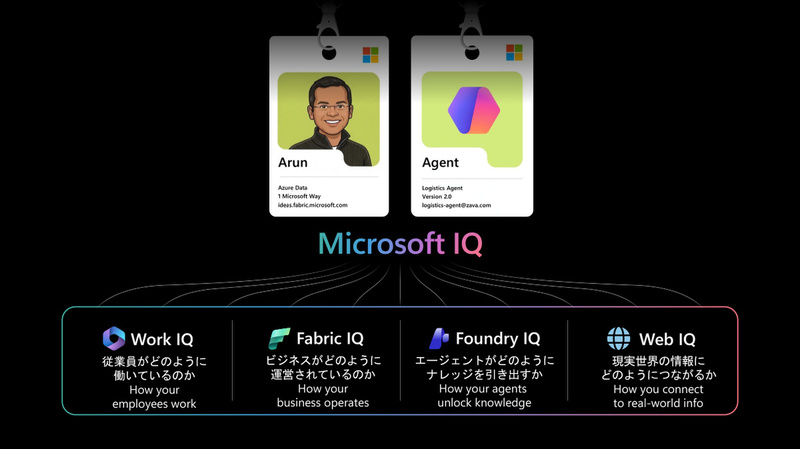
*Microsoft IQ provides agents with company-specific context, comprising "Four IQs."
"We believe that the next wave of AI will be driven not by 'better models' but by 'better context.'"
Microsoft IQ, which became generally available in June, is positioned as a "context platform" that helps AI agents achieve high productivity within enterprises. Arun Ulag, a Microsoft executive, states that establishing such a high-quality context foundation holds the key to generating next-generation business value through AI.
What exactly is Microsoft IQ, and how does it help improve the productivity of AI agents? Ulag explains.

*Arun Ulag, EVP, Azure Data at Microsoft
The 'Context' Necessary for Improving AI Agent Productivity
Microsoft IQ is a knowledge base for AI agents, announced at "Microsoft Ignite" last November and made generally available at "Microsoft Build" this June. It can be accessed via API by Microsoft's agent platforms such as "Microsoft Foundry (formerly Azure AI Foundry)," "Microsoft 365 Copilot," "Copilot Studio," and "GitHub Copilot," or by third-party agent platforms, to obtain context.
The genesis of Microsoft IQ stems from the question: "How can AI agents be made as trustworthy and productive as human employees?"
While various AI companies continue to compete in improving model performance, no matter how advanced a model becomes, it alone cannot enable productivity comparable to that of an employee. This is because AI lacks the background knowledge for the task—that is, the context. Ulag describes it as similar to "new employee onboarding."
"When you welcome a new employee to the company, you explain the company's situation and the background of their work. For example, you need to teach a wide range of context, such as the company's business strategy, revenue stage, supply chain status, who the manager is in this team, and who collaborates with whom."
Similarly, without teaching agents the "company-specific context" that forms the premise of their work, even highly advanced models cannot make appropriate judgments or perform tasks effectively.
"Everything every employee should know, every agent working alongside them should also know. And that's what Microsoft IQ delivers."
The "Four IQs" Comprising Microsoft IQ: Company-Specific Organization, Business Status, Rules...
Microsoft IQ is composed of four distinct IQs. Each of these four IQs provides different types of context to agents. Here are excerpts from Ulag's explanation:
■Work IQ: How employees work By analyzing Microsoft 365 usage and documents with Microsoft 365 Copilot, it provides agents with context via API, such as who collaborates with whom, who reports to whom, what discussions are taking place, and what documents are being created. The analysis targets Office documents, Outlook emails, Teams chats, and other content.
■Fabric IQ: How business is run It centralizes distributed business data assets within the company into Microsoft Fabric's "OneLake (unified data lake)" and provides them as semantic models, enabling agents to grasp the specific business situation. It can integrate data not only from Azure but also from AWS and Google Cloud, as well as data platforms like Databricks, Snowflake, Oracle, and Teradata.
■Foundry IQ: How agents extract knowledge For example, it builds and provides agents with a company-specific knowledge base from project reports, work procedures, technical manuals, case studies, regulatory documents, and more. This allows agents to understand the organization's structure, rules, and company-specific nuances.
■Web IQ: How to connect to real-world information It can incorporate information obtained from specific websites into the knowledge base. This enables agents to perform inference processing based on the latest data from the internet.
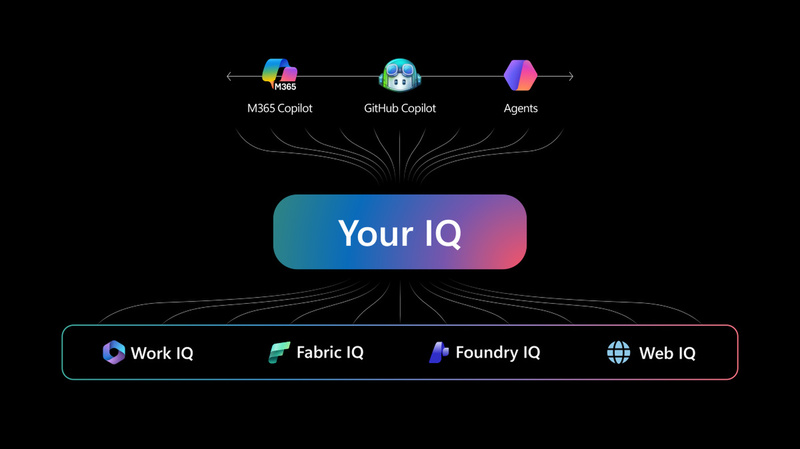
*Providing agents with a "company-specific IQ" that integrates the "Four IQs."
"[This layer] transforms enterprise-specific context into intelligence that agents can leverage, supporting large-scale decision-making and actions."
A crucial point here is that a different Microsoft IQ is formed for each adopting company. Ulag emphasized this point with the phrase "Your IQ."
"While the four IQs are realized through Microsoft's product suite, what's important is that your IQ—that is, 'Your IQ'—is your company's own intellectual property. This creates unique value for each customer, enabling agents to deliver powerful results."
Microsoft IQ is offered on a pay-as-you-go model, and its cost is said to be economical. For example, in the case of Work IQ, it is more cost-efficient than customers themselves extracting information from Microsoft 365 APIs and querying it, as Work IQ provides pre-cleaned data.
He also mentioned that for agent token costs, providing models with context pre-organized by Microsoft IQ improves processing efficiency and allows for cost reduction.
Company-Specific IQ is Important Intellectual Property, Requiring Governance and Security
Microsoft IQ is configured as a single platform that provides context to external agents. As mentioned, both Microsoft-made agents and third-party agents can obtain context by connecting to Microsoft IQ via API.
Another benefit of platformization is "governance." While flexibly providing knowledge to agents, it is essential to manage and protect "company-specific intellectual property" from leakage. Furthermore, it is important to be able to manage agents by granting them the minimum necessary access rights.
On this point, Ulag explains that Microsoft IQ has governance and permission management features built into the platform from the outset, allowing for rapid agent deployment while properly protecting intellectual property.
A use case at SCSK was introduced as an example of Microsoft IQ's application.
SCSK utilizes Microsoft Fabric and Fabric IQ to consolidate business data into an integrated platform, enabling timely understanding of overall company business performance and leading to faster decision-making.
"Traditionally, such business data was scattered across numerous data sources, such as weekly reports, monthly reports, and spreadsheets. Therefore, understanding the causes of changes in business performance, for example, required manually referencing and analyzing multiple reports and systems, which was time-consuming."
Furthermore, by allowing AI to reference business data through Fabric IQ, SCSK has been able to identify newly emerging problems and their causes earlier. What previously took several days to detect signs of performance decline can now be detected by the next business day, and the effort for root cause analysis has been "reduced by 50%."
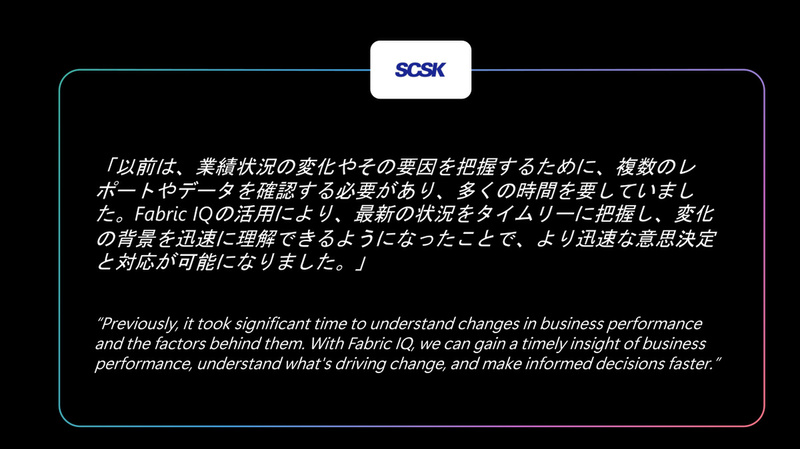
*SCSK's endorsement comment for Fabric IQ
Ulag also demonstrated a use case. The demo involved Microsoft 365 Copilot's Cowork agent analyzing premium customers at high risk of churn using customer data stored in Microsoft Fabric, and then identifying those with high churn risk (who should be prioritized for action).
"With Cowork, you can connect to Fabric IQ with a single toggle switch. It analyzes customer data integrated into OneLake, organizing priority levels, metric values, and sources. Materials proposing churn prevention actions can also be prepared in just a few minutes."
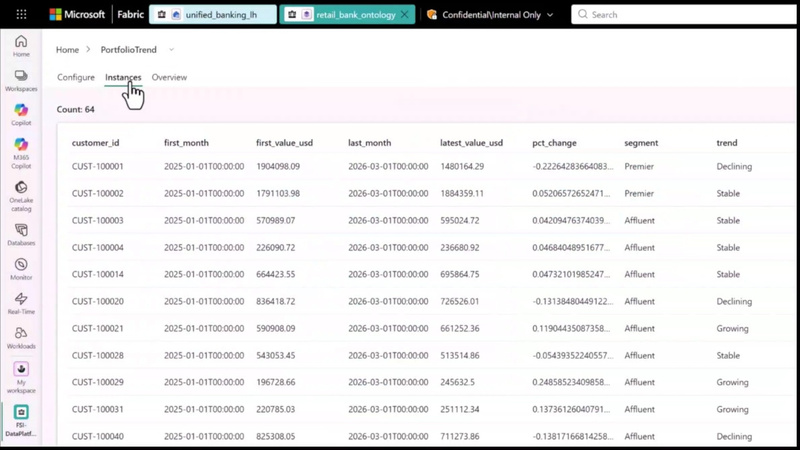
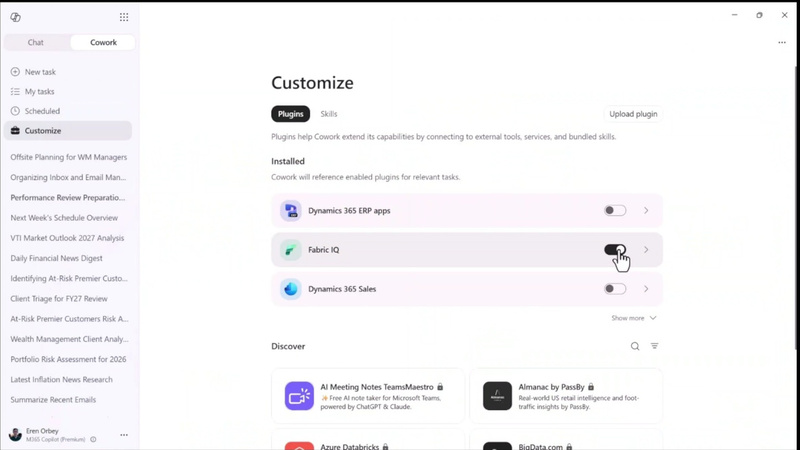
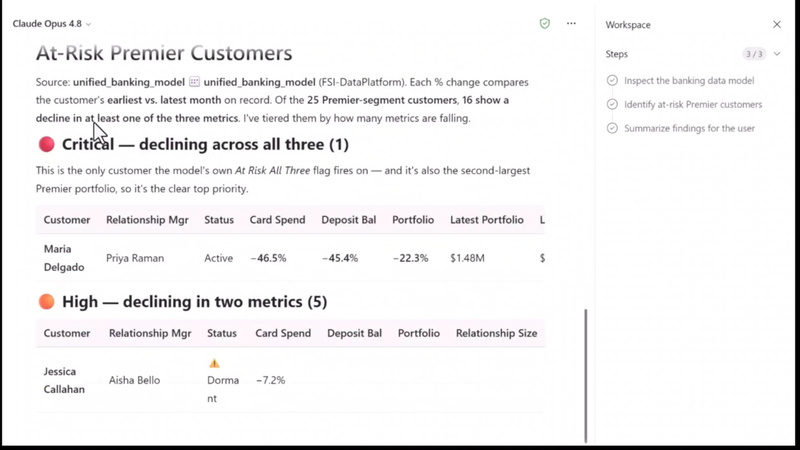
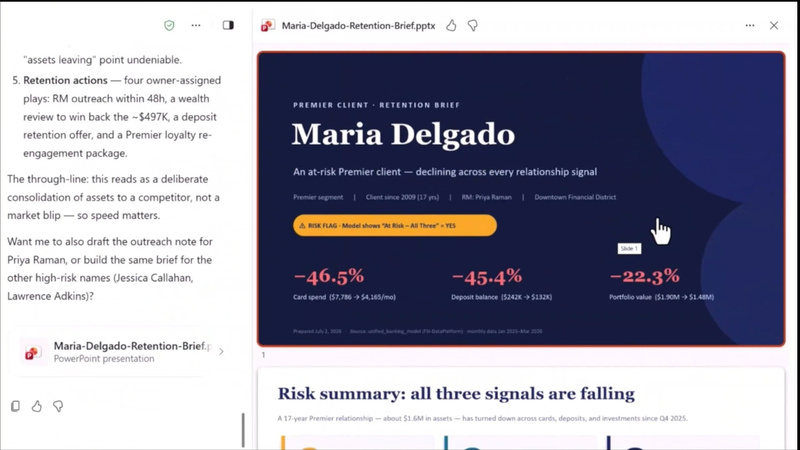
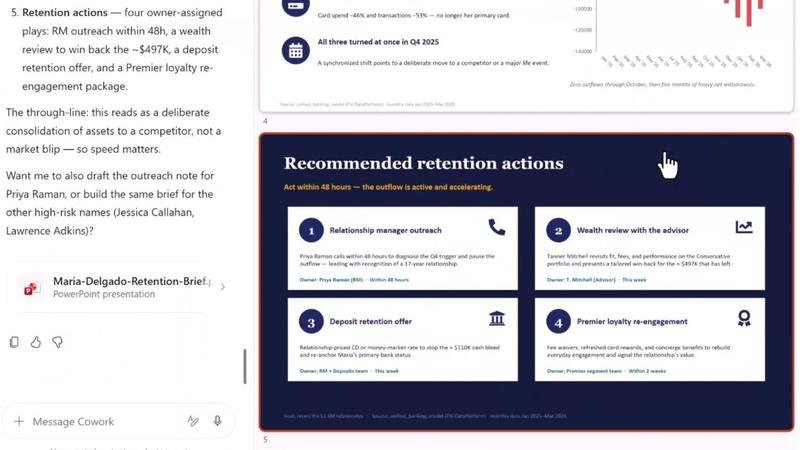
*From the demo screen. By enabling Fabric IQ, Copilot Cowork automatically performed customer analysis and document creation based on data in Fabric.