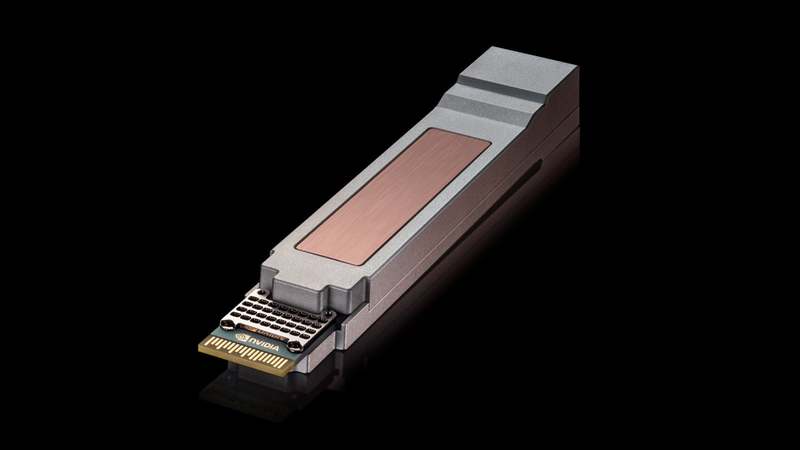
NVIDIA and Cisco have announced a new pluggable optical module form factor, "Ultra-Dense Small Form Factor Pluggable (USFP)," for next-generation AI factories. Unveiled in Santa Clara, California, this high-density optical module is designed to allow AI infrastructure builders to scale computing without increasing their network footprint. It is expected to be deployed as a multi-vendor ecosystem, with TE Connectivity and Amphenol joining in the future.
USFP is designed to be the first module to support 400Gb/s electrical signals per lane, envisioning a maximum capacity of 12.8Tb/s. Compared to conventional 200Gb/s-class pluggable modules per lane, it is said to improve bandwidth density by 4x and power efficiency by approximately 1.3x. A significant advantage is its ability to increase the number of connections supported per switch while minimizing additional network layers and reducing the overall power consumption of the AI fabric.
In terms of design, it features 16 full-duplex lanes within a footprint equivalent to OSFP, supporting both switches and SuperNICs. Future expansion to 32 lanes or more is also anticipated. Furthermore, it adopts a 2D array connector and a two-stage insertion method, a structure that enhances signal quality while suppressing contact wear. It can handle heat dissipation of up to 100 watts without incorporating a separate dedicated cooling circuit, thereby reducing the complexity of switch design.
NVIDIA and Cisco plan to establish open industry specifications for USFP through a community-driven, multi-source project in the future.