
While OpenAI and Anthropic have been prominent in the AI model competition, Meta has suddenly strengthened its presence. On October 12, Meta announced "Muse Wonder" and "Muse Wonder Full," frontier models designed for AI agents. It unveiled claimed benchmark results that surpass the top models of Claude and GPT.
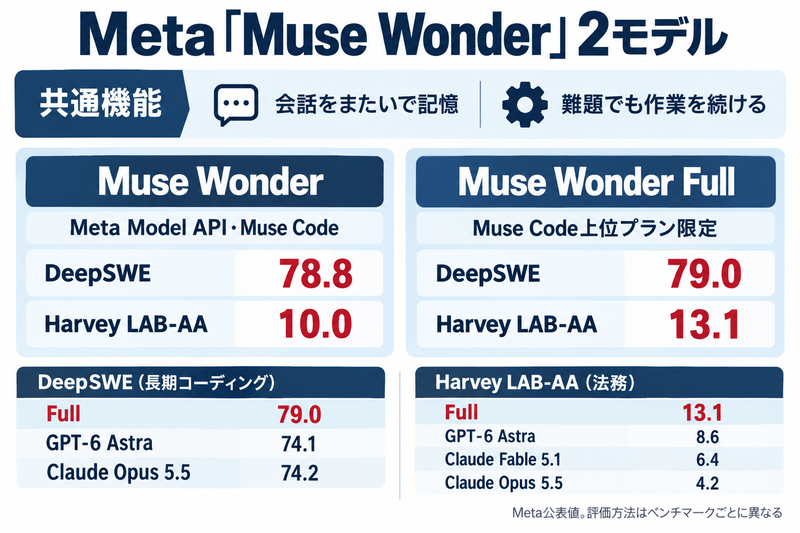
In Meta's comparisons, Muse Wonder Full scored 79.0 and Muse Wonder scored 78.8 on DeepSWE 1.1, which measures long-term software development capabilities. GPT-6 Astra scored 74.1, and Claude Opus 5.5 scored 74.2. On Harvey LAB-AA, which involves reading legal documents and producing practical deliverables, Full achieved 13.1, surpassing GPT-6 Astra's 8.6, Claude Fable 5.1's 6.4, and Claude Opus 5.5's 4.2.
However, the models show varying strengths and weaknesses across different domains; for instance, on HealthBench Pro in the healthcare sector, Full scored 62.3, falling short of GPT-6 Astra's 65.3 and Claude Opus 5.5's 65.6.
Both models share two new features: "Active Memory," which remembers important information across conversations, and "Active Focus," which continues difficult tasks by trying different approaches. The main differences lie in performance and availability. While Muse Wonder is available via the Meta Model API and Muse Code, the more powerful Muse Wonder Full is intended for higher-tier Muse Code plans and is not offered through an API. Meta explains that Full, with its larger and more powerful foundational model, is more adaptable to challenges not anticipated during training.
Meta states that it has revamped its AI development system over 14 months and trained the new models in its gigawatt-scale data center, "Prometheus." This marks Meta's entry into the frontier model competition, which previously seemed dominated by OpenAI and Anthropic, by making a strong showing on benchmarks.