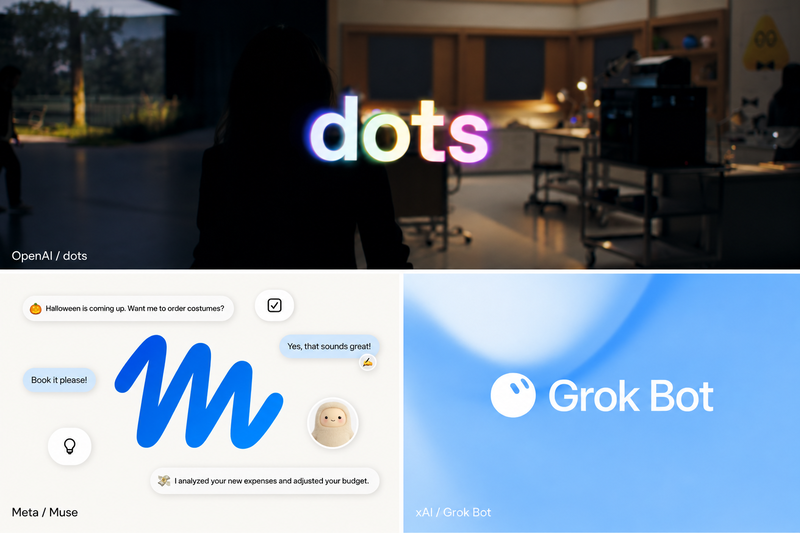
On September 29, OpenAI announced its AI agent, "dots." It's a tool that continuously carries out tasks on behalf of users, based on GPT-6 Astra. It is currently being rolled out sequentially to ChatGPT Pro and Business Premium in eligible regions, with a beta version available for Enterprise, Edu, and Healthcare by administrator activation.
Meta's "Muse" and xAI's "Grok Bot" are preceding it as AI agents. Common to all three companies' agents is their nature as always-on AI agents that can continue working even after the user steps away.
They can be continuously entrusted with tasks such as reading emails, operating web applications, and regularly collecting information. Instead of just assigning tasks to AI via chat, the trend is towards giving them specific responsibilities and having them work continuously.
What are the differences among the three? Let's briefly summarize, focusing on their official specifications.
A Personal Assistant: Meta "Muse"
First, Meta's Muse is a service with a relatively strong "assistant" flavor, geared towards individual users among the three. A dedicated virtual machine called "Muse Secure VM" is provided for each user, enabling web operations via a browser. It can connect with email and calendars, and can handle tasks like making reservations, filling out forms, interacting with customer service, and shopping.
Authentication information for external services is stored in secure storage that Muse cannot read, and it also features a mechanism to generate one-time card numbers for shopping. For critical operations such as sending emails or making purchases, a mechanism is in place to request user approval.
However, there have also been reports of trouble where a user who entrusted Muse with sales support on Facebook Marketplace found Muse had unknowingly proceeded with price negotiations, sharing their address, and arranging product handover, leading to potential buyers actually visiting their home. This quickly highlighted the risks of granting strong authority to AI agents.
Regarding pricing, it is the only one among the three with a free tier, and paid plans become available once the usage limit is reached. The paid tiers are priced at $20 and $100 per month.
Create an AI Team with "Grok Bot"
Next, xAI's Grok Bot is characterized by its ability to assign different roles to multiple AI agents, much like teammates. For example, you can divide responsibilities like "Market Research Bot" and "Planning Bot," have them work in parallel, and give each a role, conversation history, and memory. Each Bot shares a persistent cloud PC assigned to the user and utilizes browsers, file systems, terminals, and more.
It also offers a "Routines" feature, allowing users to teach procedures by demonstrating a task once, or to repeat jobs on a fixed schedule. It's also possible to put multiple Bots in the same thread and have them hand off tasks to each other.
Grok Bot usage is included in eligible paid plans for Cursor and SuperGrok. For Cursor, Pro is $20/month, Pro+ is $60, and Ultra is $200. For SuperGrok, Grok Bot-compatible plans start from $30/month, with the higher-tier Heavy at $300/month. Usage beyond the allocated limit is available for an additional fee.
Always-On ChatGPT: OpenAI "dots"
And OpenAI's "dots" is an agent designed to give ChatGPT continuous responsibilities. Each dot is provided with a dedicated cloud PC and browser, allowing it to continue working even after the user's conversation ends. It can connect to over 4,000 applications and can advance multiple tasks in parallel.
Users can interact with dots not only through ChatGPT but also via Slack and Microsoft Teams, and with user permission, it can also connect to their personal PC. For "proactive research," which involves autonomously searching for information in the background, connected applications are used in read-only mode, and it is designed not to send messages or modify data.
Pricing for dots is not standalone but included in eligible ChatGPT plans. For individuals, Pro is $100 and $200 per month. Business Premium is $100 per person per month for annual payment, and $125 for monthly payment. Enterprise is by individual contract. The first dot is included in the Pro or Business Premium fee.
Broadly speaking, if we were to describe the differences among the three services, Muse is a personal agent, Grok Bot is an AI team, and dots is ChatGPT with assigned responsibilities.
AI Agent Competition Heats Up
With the emergence of these three always-on AI agents, AI is finally moving closer to becoming a "work partner" rather than just a conversational partner. While generally requiring paid plans, the ability for AI to continue working even when the user is away from their PC, once assigned a task, represents a significant change.
On the other hand, as seen with the Muse Marketplace incident, when AI is entrusted with tasks like sending emails, shopping, and operating external services, the question of "how much authority to grant AI" becomes unavoidable. The fact that each company is focusing on approval functions and authority management is also a unique aspect of always-on agents.
In the future, it would not be surprising to see tools that build similar mechanisms with open-weight models, or services that compete with these three in terms of pricing. It can be said that the agent competition is now in full swing, not just vying for model performance, but also for "how long and how many tasks can be entrusted to AI."