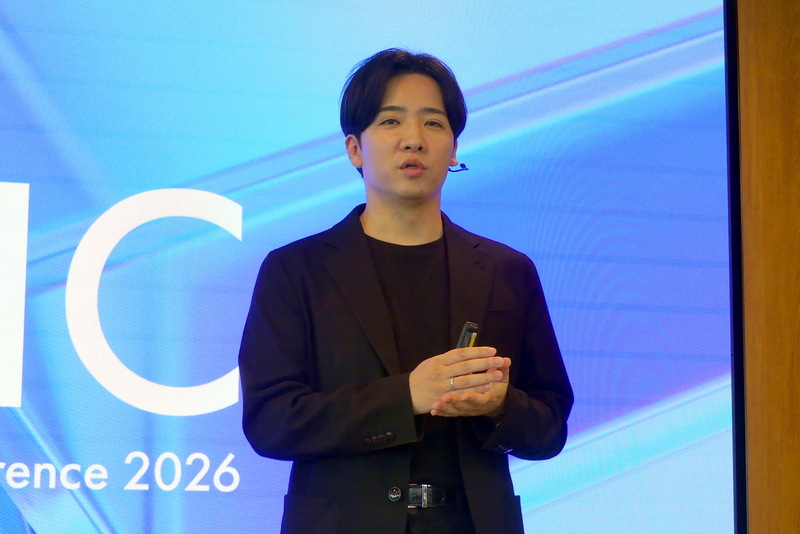
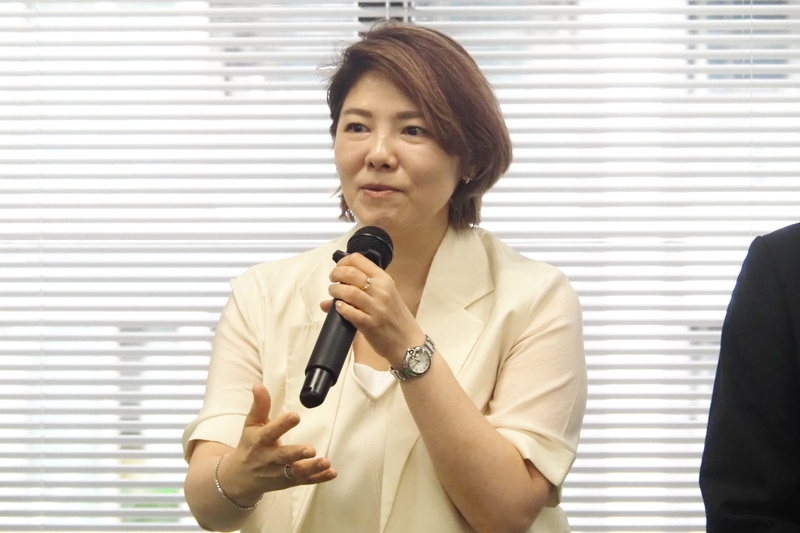
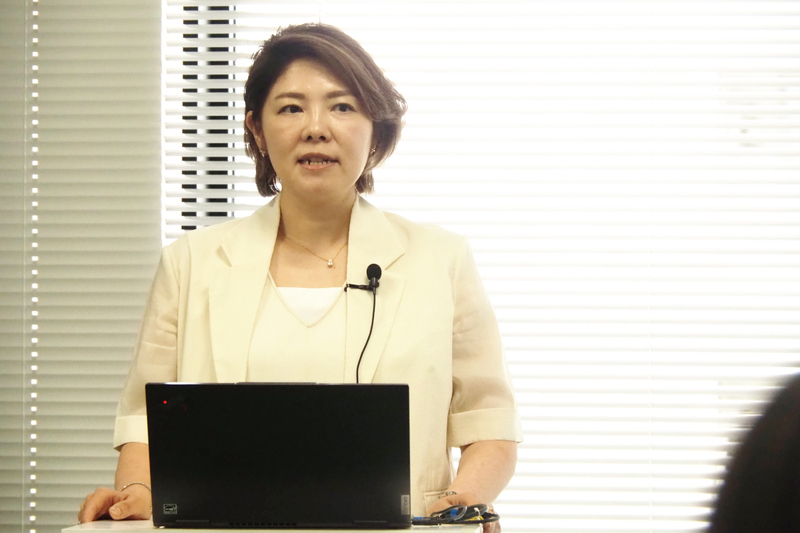
"What is demanded in the AI data center market is not just product performance, but the ability to integrate and execute data center construction projects from start to finish. That is the biggest reason Schneider is changing its business structure this time," says Ryoko Aoyagi of Schneider Electric.
Schneider Electric Japan has announced the establishment of a new organizational structure to consistently support the entire lifecycle of AI data centers. Rather than a 'siloed' approach by product, the company aims to provide optimal solutions by linking related business units, from data center conception and design to construction and operation.
At the company's business strategy briefing on September 3, 2026, the background behind establishing the new organizational structure was explained, including changes occurring in data centers in the AI era and challenges unique to the Japanese market.
The company also revealed a business goal to maintain a CAGR (Compound Annual Growth Rate) of over 30% in its domestic data center-related business from 2025 to 2030, expanding its business scale to approximately double its current size.
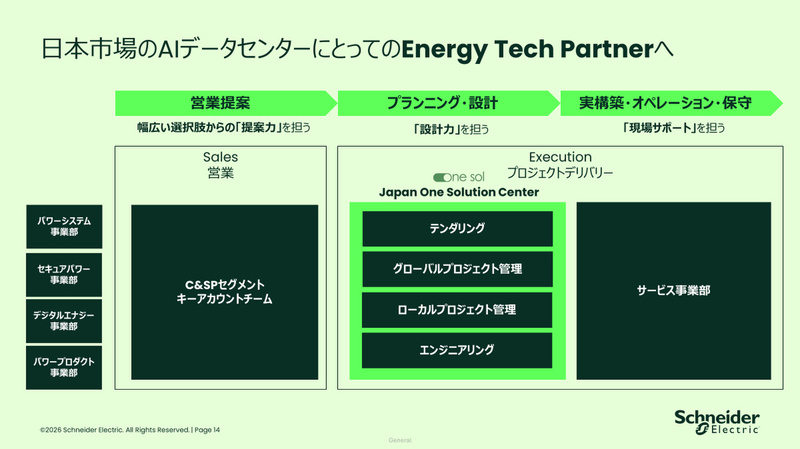
Overview of the newly announced organizational structure. It will consistently support the entire lifecycle of AI data centers, from conception and design to construction and operation.
New Organizational Structure to Support the Entire AI Data Center Lifecycle
The organizational structure announced by Schneider this time is designed to consistently support customer companies such as hyperscalers, cloud providers, and service providers, from the conception and design of AI data centers to their construction and operation. Regarding the background of establishing this new structure, Ms. Aoyagi stated:
"The power and cooling facilities that support AI data centers, and the engineering capabilities to realize large-scale projects, are becoming increasingly important. While also considering challenges unique to Japan, we aim to achieve what was not possible with the conventional structure through this new one, to realize AI data centers more quickly and reliably."
Specifically, three organizations will seamlessly collaborate to support customer AI data center projects: the "Cloud & Service Provider (C&SP) Segment Key Account Team," responsible for sales proposals tailored to customer requirements and situations; the "Japan One Solution Center," responsible for estimation, design, and project management; and the "Service Business Unit," responsible for on-site construction, operations, and maintenance.
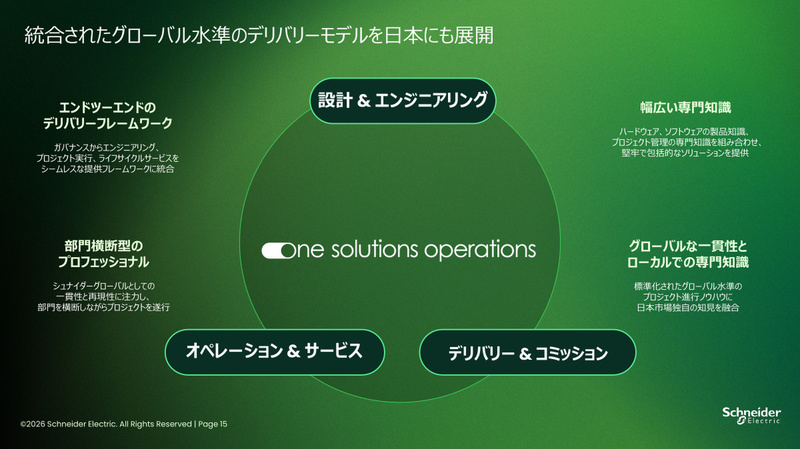
Experts from each business unit will collaborate to support projects.
Ms. Aoyagi explained that "what changes with the new structure is not the organizational chart, but how customer projects are executed." This means that existing business units tied to product categories will not be changed; instead, customer projects will be executed in a cross-departmental manner.
"By integrating sales, design, project execution, and service, we create a system where contact points, design responsibilities, and on-site execution responsibilities are not fragmented. We will first grasp the entire project, then work backward from its requirements to combine the necessary products, design, project management, and on-site services," said Ms. Aoyagi.
The One Solution Center is an organization that Schneider is establishing globally, and it is now being newly established in Japan as well. Globally, approximately 4,300 people belong to it, and it is currently executing over 14,000 projects. In Japan, it will start with a scale of approximately 50 people.
One of the purposes of establishing the One Solution Center is to reflect knowledge gained from overseas through its global network into Japanese projects. For example, when an overseas hyperscaler constructs an AI data center in Japan, it is envisioned that One Solution Center members from other countries with prior construction experience will participate and provide expertise.
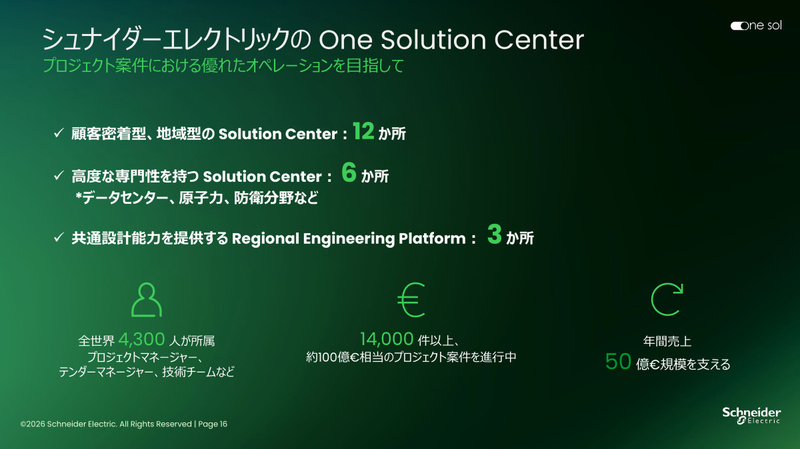
A highly specialized One Solution Center will also be newly established in Japan.
Conventional Wisdom and Methods Are Insufficient for AI Data Center Construction and Operation
Schneider has been developing its data center business (UPS, cooling systems, etc.) for approximately 20 years since the acquisition of APC in 2007. The background necessitating the strengthening of the organizational structure this time lies in the unique characteristics of AI data centers.
Ms. Aoyagi explained by citing the evolution of data centers in Japan. From computer rooms in the 1970s to recent cloud (hyperscale) data centers, the main change was the "expansion of quantity," such as the number of servers and communication capacity. In contrast, in the AI era, the core objective has become high-density GPU implementation, leading to massive power consumption and heat generation.
"In other words, the advent of AI is causing a transformation of the data center architecture itself, and the central challenges in data center design have become 'power' and 'cooling,'" said Ms. Aoyagi.
Indeed, while conventional hyperscale data centers typically had power capacities of tens of MW to 100 megawatts (MW) per building, the AI era has seen an expansion to large-scale campuses of 1 gigawatt (GW) and 5 gigawatts. A 5-gigawatt data center campus is equivalent to 50 conventional data center buildings and is comparable to the annual electricity demand of a city with a population of 1 million.
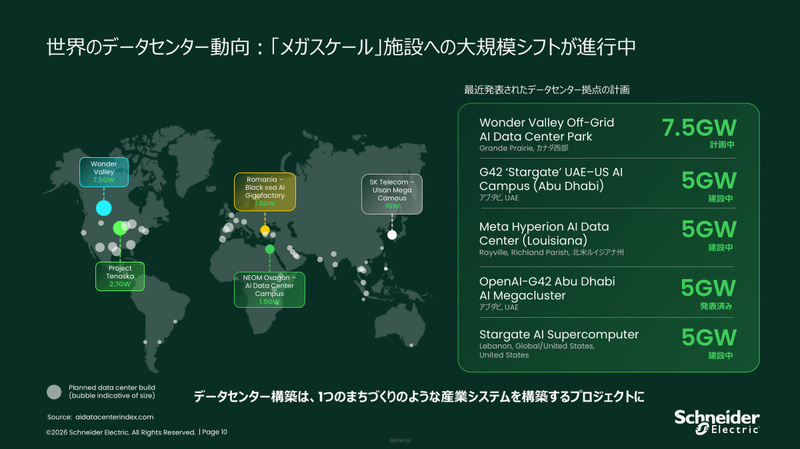
The construction of "gigawatt-class" AI data centers is rapidly increasing worldwide.
Therefore, Ms. Aoyagi points out that AI data center design requires integrated planning that encompasses not just the building itself, but also power sources, power systems, cooling facilities, energy storage systems, and the personnel supporting operations. On the other hand, with the rapid expansion of AI demand, a sense of "speed" is also required for AI data center construction, posing the challenge of ensuring smooth procurement of various equipment.
"In AI data centers, design, supply chain, construction, and operation are interdependent. Therefore, if responsibilities are different or fragmented for each process, the optimization of the entire project will be hindered," said Ms. Aoyagi.
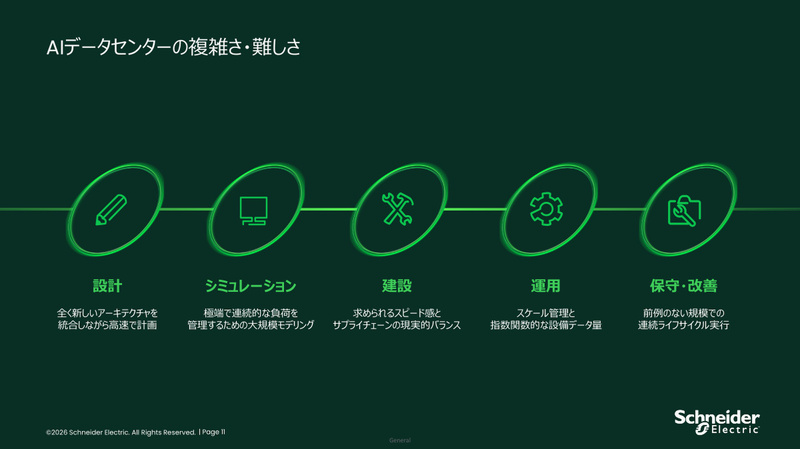
It is pointed out that conventional wisdom and methods are insufficient for AI data center construction and operation.
In addition, Japan's unique circumstances must also be considered regarding power. These include grid connection and transmission/distribution capacity constraints, regional differences in 50/60 Hz frequencies, and adaptation to various business customs. It is necessary to implement technologies being standardized overseas while maintaining consistency with Japanese regulations and existing facilities.
Against this background, Schneider established this new structure specialized in supporting AI data center construction. Ms. Aoyagi emphasized its intention, stating, "We needed a system that responsibly connects from the conception to the operation of AI data centers, rather than a conventional system divided by product or process."
At the same briefing, Hiroki Hara, who leads the C&SP segment, and Keisuke Nakamura, Vice President of the Service Business Unit, also took the stage.
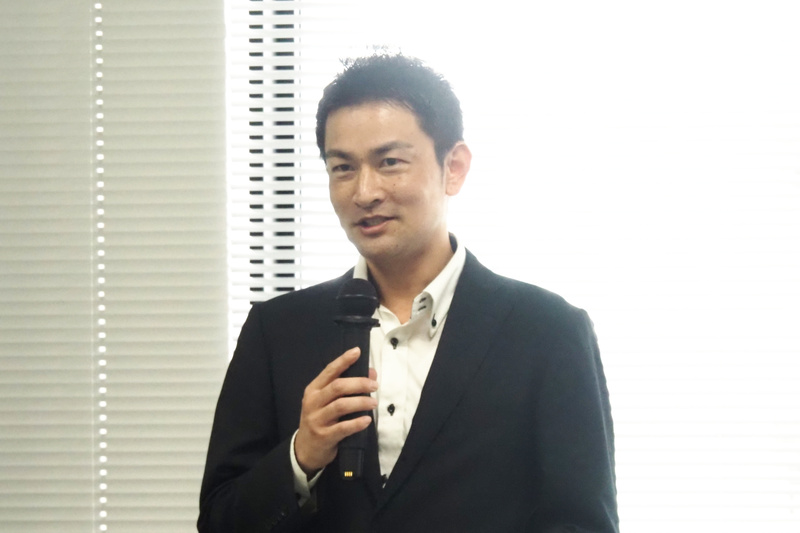
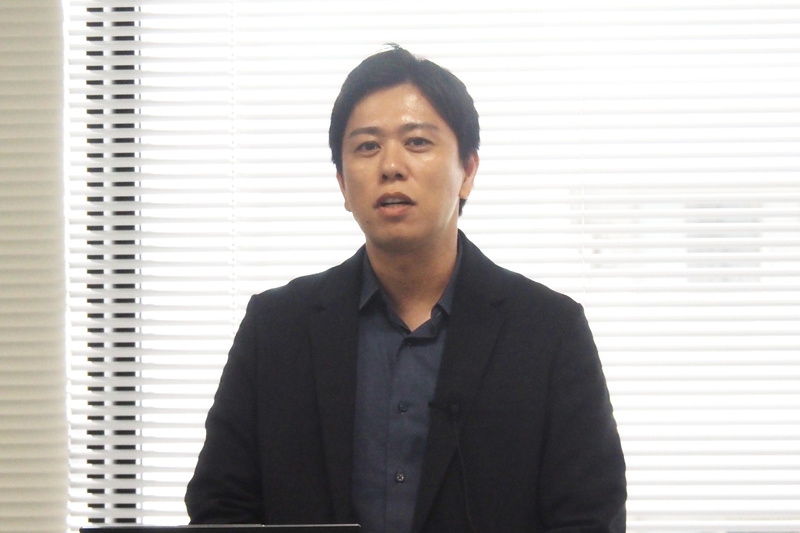
Hiroki Hara, Head of C&SP Segment and Power Systems Business Unit, Schneider Electric, and Keisuke Nakamura, Vice President of the Service Business Unit, Schneider Electric.
The C&SP segment, where Mr. Hara serves as the business lead, handles business primarily focused on data center projects for overseas hyperscalers and major Japanese telecommunications carriers. Mr. Hara also concurrently serves as the head of the Power Systems Business Unit, which handles high-voltage power equipment, but the C&SP segment will propose solutions to customers across product categories and business units.
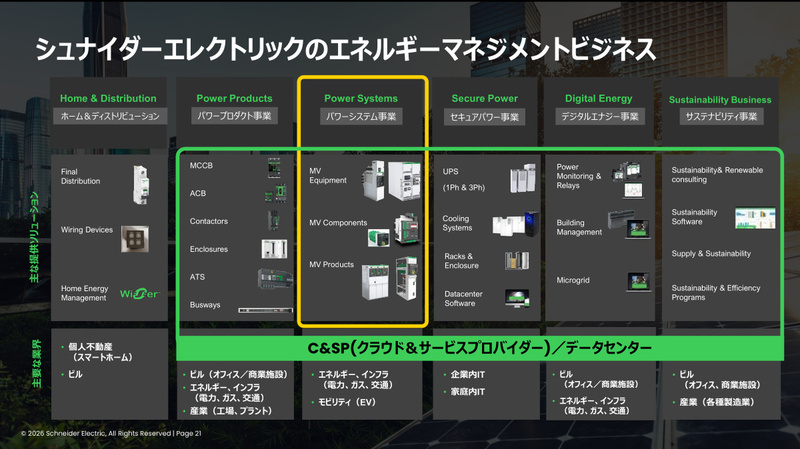
While business units are divided by product categories such as low-voltage, medium/high-voltage, IT/server peripherals, and energy management, the C&SP segment will propose optimal solutions to customers across these categories.
Mr. Hara introduced topics such as the trend of "800VDC (800-volt direct current) power supply," a next-generation power infrastructure trend for data centers, and liquid cooling solutions from Motivair, which Schneider acquired in 2025.
Support for 800VDC power supply has become an indispensable initiative for the future of AI data centers, where power demand per rack is rapidly increasing. Mr. Hara explained that the transition to 800VDC power supply will begin with a sidecar approach that supports rack-by-rack while utilizing existing equipment, gradually shifting towards more centralized and large-scale deployments.
In line with this trend, Schneider will also introduce 800VDC solutions. According to the development roadmap, sidecar-based solutions are planned for release in 2027, with subsequent support for more centralized approaches.
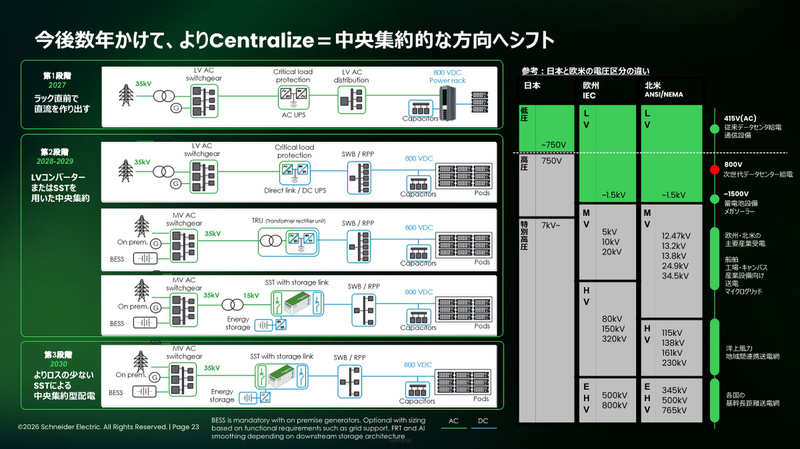
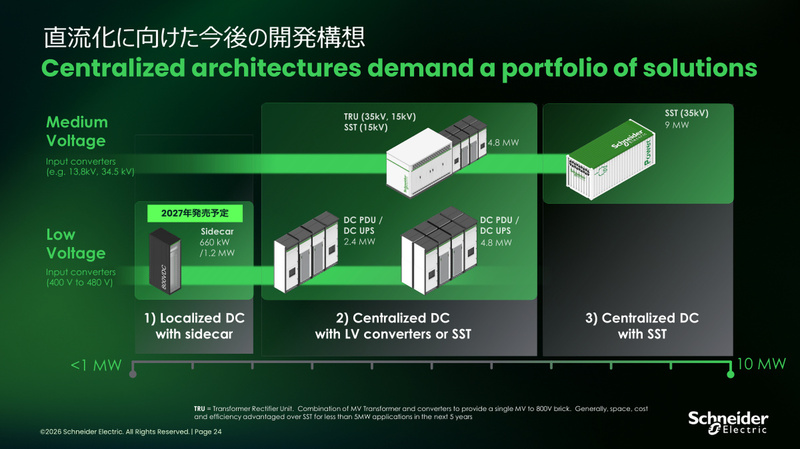
800VDC (800-volt direct current) power supply is being considered and adopted primarily by hyperscalers, and Schneider plans to provide corresponding solutions.
Liquid cooling will also become essential infrastructure for future AI data centers. With the acquisition of Motivair, Schneider now has a comprehensive portfolio covering all aspects of data centers, from outdoor chillers to indoor chilled water control systems, CDUs, cold plates, and rear-door cooling units.
Mr. Hara revealed that demand for liquid cooling systems is strong even in Japan, and the growth target of "5 times year-on-year" for this year has already been achieved in the first half.
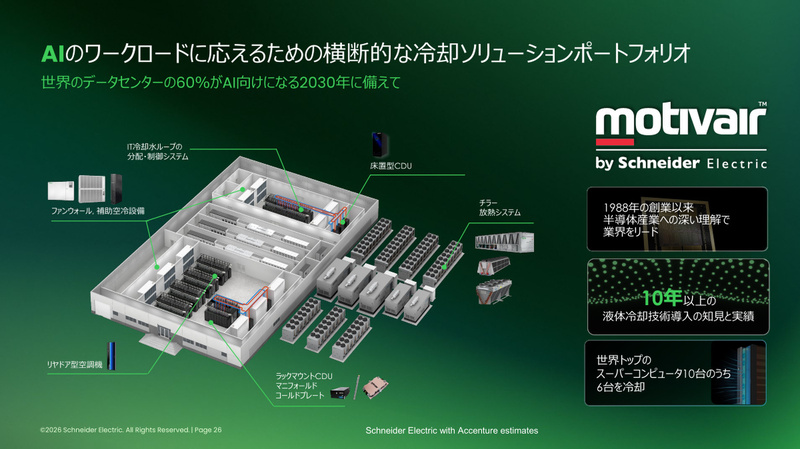
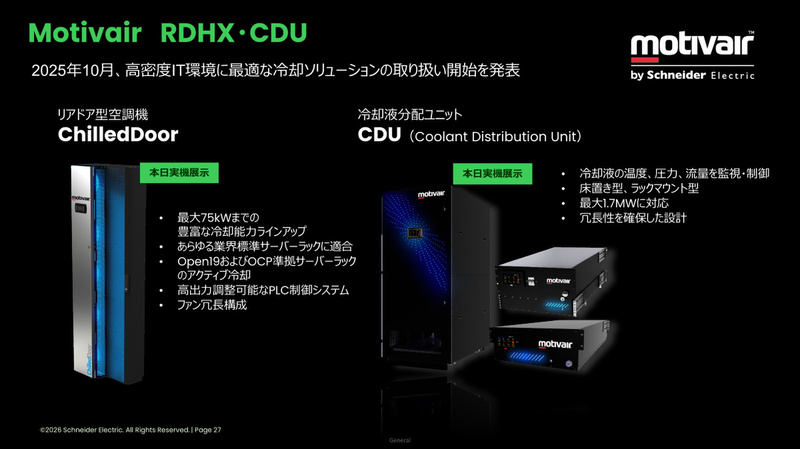
With the acquisition of Motivair, Schneider has significantly expanded its liquid cooling solution portfolio.
Initiatives to Prevent "Data Center Value Depreciation" Due to Long-Term Operation
Keisuke Nakamura, Vice President of the Service Business Unit, introduced the role of the Service Business Unit in supporting the entire AI data center lifecycle, divided into three steps: "Construction and Startup," "Operational Support and Monitoring Assistance," and "Continuous Improvement, Expansion, Diagnosis, and Evaluation."
First, in the "Construction and Startup" phase, it is required to realize construction work several times that of conventional data centers within the same construction period. In response to the need for shorter construction periods, Schneider is deploying factory-assembled (prefabricated) solutions, known as containerized or skid-mounted. However, commissioning (operational verification) after on-site installation becomes a major challenge with this method.
To address this, the Service Business Unit dispatches engineers from the design, factory production, and inspection stages to understand the system's content and has established a work system to confirm on-site commissioning procedures.
In the subsequent "Operational Support and Monitoring Assistance" phase, the company announced a policy to expand its "nationwide 4-hour on-site support," which has been provided nationwide for UPS (Uninterruptible Power Supply) and air conditioning units, to include liquid cooling equipment, power reception and distribution equipment, and software products. Mr. Nakamura stated that by expanding its network of nationwide partner companies entrusted with support operations and strengthening its own bases and increasing engineers, it "aims for a system with 1.5 times the conventional acceptance capacity." In March of this year, a service base for data centers in Western Japan was opened in Osaka.
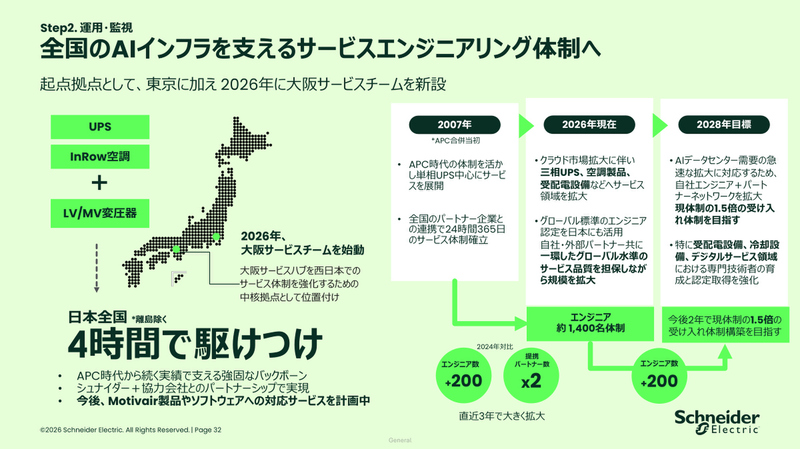
The company plans to expand the scope of its "nationwide 4-hour on-site support," which has been provided for UPS and air conditioning units.
The final "Continuous Improvement, Expansion, Diagnosis, and Evaluation" phase involves support during long-term operation. It was explained that not only stably maintaining operations but also enabling updates to the latest equipment while operating can prevent the depreciation of AI data center value.
"A customer who is a data center operator once said, 'A data center is a financial asset.' Just like rental properties, if a data center ages and falls behind the latest equipment, rents may decrease, or tenants may decline," said Mr. Nakamura.
Schneider provides "etap" software for digital twin construction. Mr. Nakamura explained that by using this to prepare a digital twin of the data center and enabling simulations of equipment updates and new equipment introductions, safe equipment optimization and expansion can be achieved.
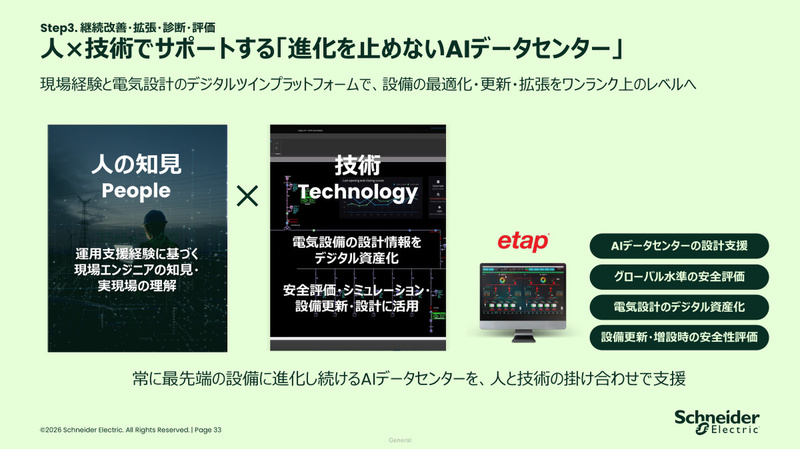
The aim is to continuously evolve AI data centers and enhance their value.
By providing end-to-end solutions for the AI data center market, Schneider Electric Japan aims to maintain an average annual growth rate of over 30% until 2030, growing to approximately double its current size by 2030. Ms. Aoyagi explained that "achieving the 2026 target is already in sight," with sales of liquid cooling solutions and high-voltage power distribution equipment driving growth.