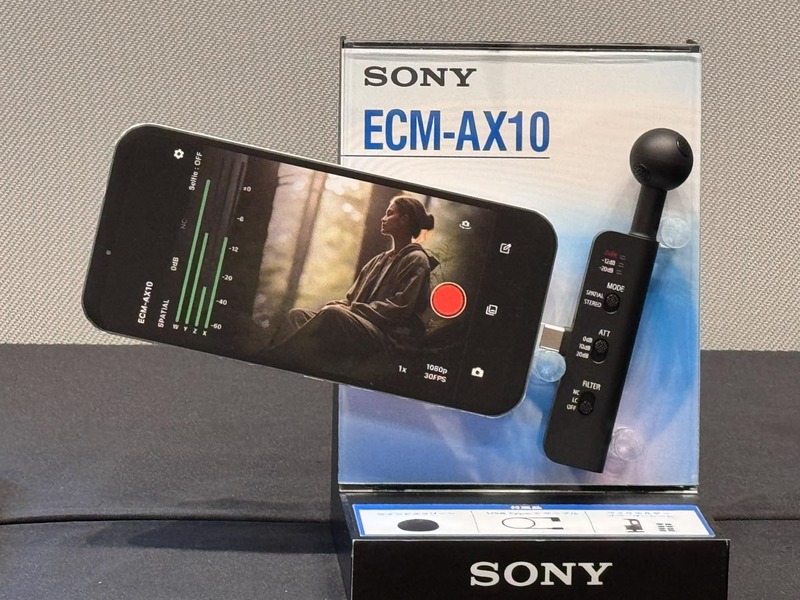
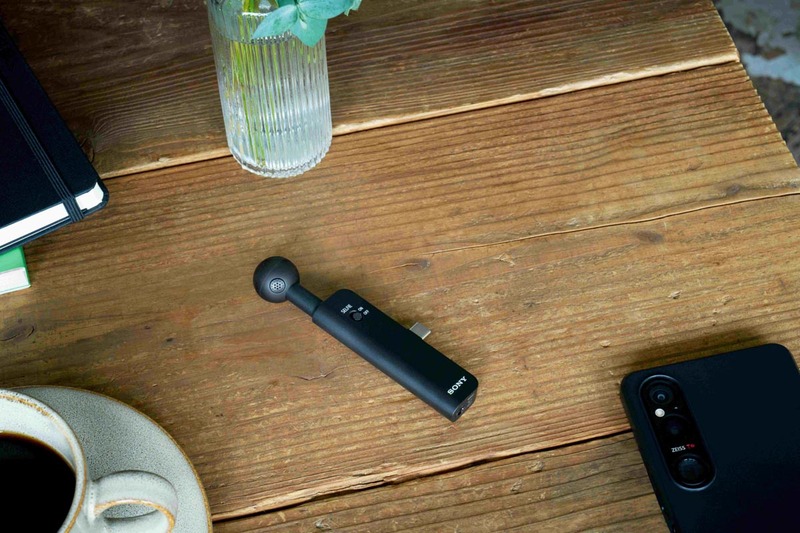
On October 9th, Sony announced the "ECM-AX10," a recording microphone that can capture spatial audio (immersive audio) with smartphones. The price is open, and it is scheduled to be released on October 23rd. The estimated retail price will be around 30,000 yen.
A Microphone That Makes Spatial Audio Recording Accessible
The ECM-AX10 is a microphone that connects directly to a smartphone's USB port, allowing for easy audio recording. It's a product targeted at Vloggers and YouTubers who want to capture the entire atmosphere and ambiance of a location while traveling or on-location shoots.
While there are microphones that connect directly to a smartphone's USB port, such as Shure's "MV88" and Zoom's "Am7," this device is designed with slightly different specifications from typical stereo microphones in order to record sound three-dimensionally.
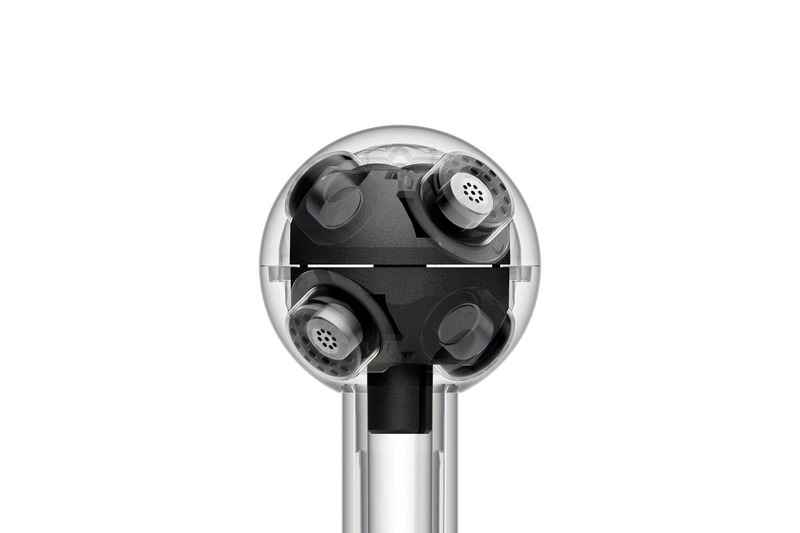
Microphone capsule arrangement
Although it's a compact microphone, what stands out is the spherical part protruding from the main unit. This houses the microphones, with four "omnidirectional microphones" diagonally arranged, pointing diagonally upwards to the front and rear, and diagonally downwards to the front and rear. This mechanism allows it to capture sound from the entire space, including not only sounds from the front and sides but also from above, below, and behind.
The reason it protrudes from the main unit is to keep the microphone away from the smartphone body to prevent sound reflections from disturbing spatial localization. Therefore, the basic way to hold it is with this part pointing upwards.
There is no built-in storage in the unit, and recorded data is saved directly to a smartphone or other device using an app. By toggling a switch on the unit, you can choose which format (Ambisonics (4ch), binaural (2ch), or stereo (2ch)) to record in and output (save) to your smartphone.
While a key selling point of this device is its ability to record immersive audio in "Ambisonics," since 4ch playback requires compatible equipment and software, a 2ch downmixed format, which is easier to handle for general use, is also available.
What is Ambisonics?
To get a bit technical, there are several types of formats used for recording immersive audio. Ambisonics, which this device supports, is a "scene-based" method. Other formats include "channel-based" ones like Auro-3D, and "object-based" ones like Dolby Atmos and DTS:X. While often broadly categorized as spatial audio, each method has its own advantages and disadvantages.
A characteristic of Ambisonics is its ability to physically record sound from a 360-degree spherical space centered around the microphone. In addition to capturing sound movement three-dimensionally, it allows you to rotate the direction of sound (spatial localization) around yourself, much like when you move your head to listen to sounds around you. It can be said to be a method well-suited for VR and similar applications.
Also Supports Eclipsa Audio
The recording mode switch on the unit has two settings: "SPATIAL" and "STEREO." To record, save, or play back Ambisonics audio using the ECM-AX10, you need to use the iOS/Android video recording, audio recording, and editing app "Spatial Audio Video Tool" (hereinafter referred to as SAV Tool).
When the mode switch is set to SPATIAL, recording in Ambisonics or binaural is possible. When recording video or audio using the SAV Tool, Ambisonics is the default, and binaural can also be selected in the app's settings. If you use a video recording app other than the SAV Tool, it will automatically record in binaural.
Conversely, when the mode switch is set to STEREO, it performs standard stereo recording and can be used with any app. Even then, the information from the four microphones is mixed down to 2ch, resulting in higher sound quality than typical microphones.
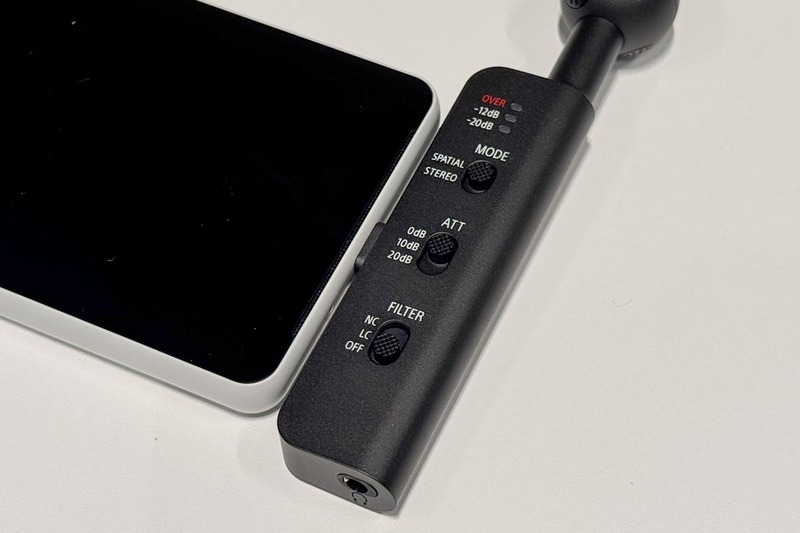
Various settings can be switched with physical switches.
Incidentally, while the ECM-AX10 itself uses a "First Order Ambisonics" (FOA) method with 4ch microphones to capture the general direction of sound, it can also convert the recorded raw data (A-format) into data that decomposes sound components into front/back and up/down (B-format) and output it. If this is imported into music production software (DAW), the data can be handled more deeply, such as adjusting spatial localization.
The conversion uses a DSP and employs advanced signal processing technology used in Higher Order Ambisonics (HOA). Because it achieves both "ideal directivity across a wide band" and "balanced frequency characteristics from low to high frequencies," Sony explains that it "enables high-quality recording with accurate spatial localization, high presence, and immersion."
Furthermore, the SAV Tool supports "Eclipsa Audio," an open-source standard involving Google and Samsung, which can also be uploaded to YouTube. While playback environments are still developing, this is an element that holds promise for future expansion.
Also Supports Binaural Recording Without a Dummy Head Microphone
This device's advantage is not only Ambisonics but also the ability to easily enjoy binaural recording, often used in ASMR, in a compact form factor.
When people think of binaural recording, many likely imagine dummy head microphones, but most of these are large and expensive, making them not easily accessible to everyone.
Binaural recordings are often saved in a 2ch downmixed state, which has the advantage of allowing listeners to enjoy three-dimensional sound even with existing playback devices like headphones.
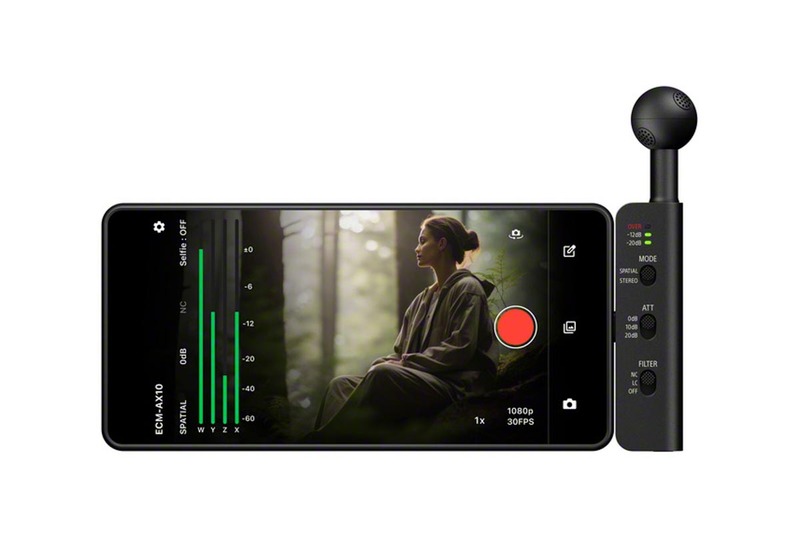
Attached to a smartphone
Compact Yet Highly Configurable
The ECM-AX10 is also highly functional as a microphone, and its ability to record in a highly flexible style is another feature.
The unit is equipped with toggle switches for a "noise cut filter" (for removing background noise) and a "low cut filter" (for reducing low-frequency noise such as wind noise, air conditioning sounds, and vibrations).
While there is an "auto gain control" function that automatically selects the appropriate recording level, if the recorded sound is too loud and risks distortion, you can check the "peak indicator level" (OVER, -12dB, -20dB) and if it reaches OVER (a state where distortion occurs), you can manually adjust the recording volume with the "attenuator (ATT)" switch (0dB, 10dB, 20dB). Choose 20dB for loud sounds, or 0dB if you want to delicately record quiet sounds.
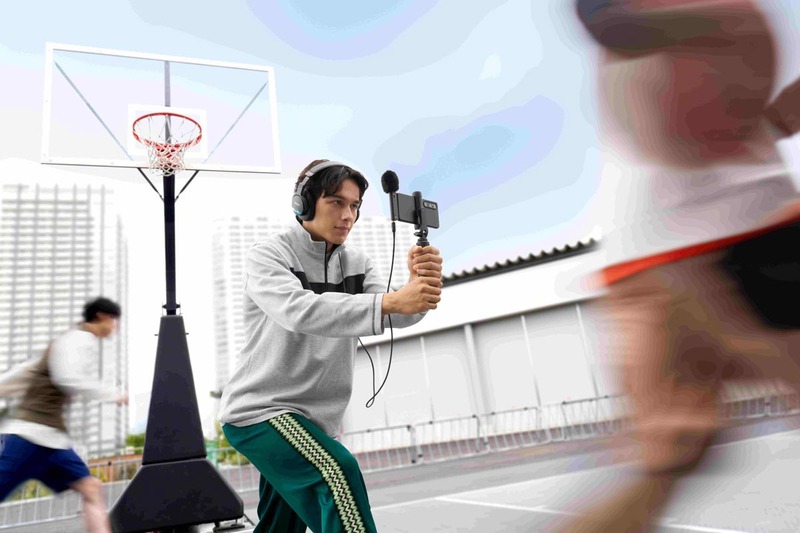
By combining it with an extension cable and microphone holder, active handheld shooting is also possible.
The unit comes with a "windscreen," a "cold shoe mount microphone holder" that can be attached to a smartphone holder or mini tripod's cold shoe, and a 40cm USB-C extension cable. This allows it to be used detached from the smartphone.
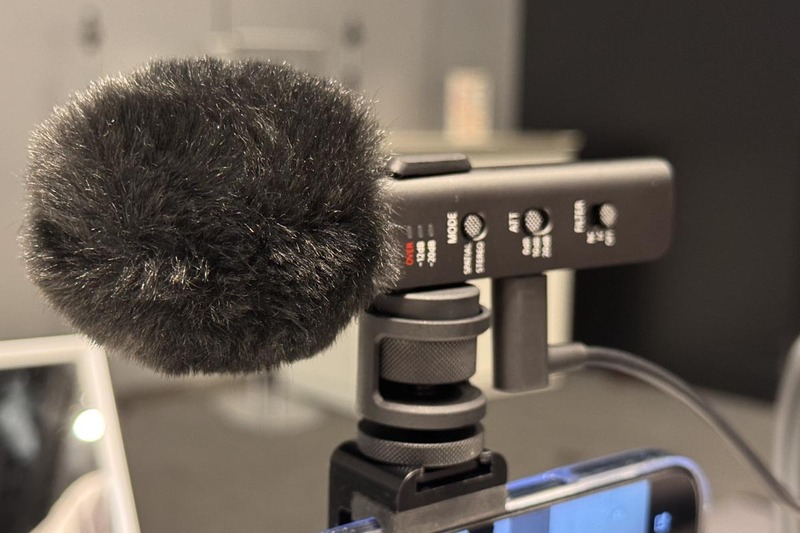
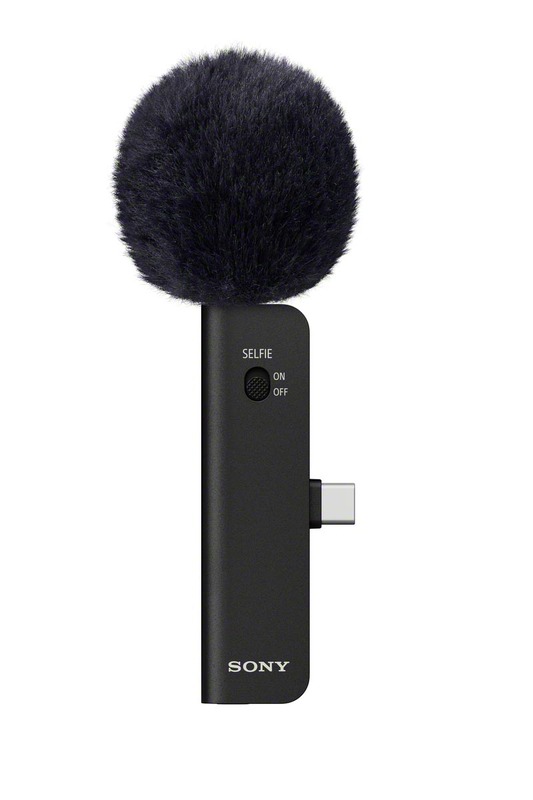
With the windscreen attached.
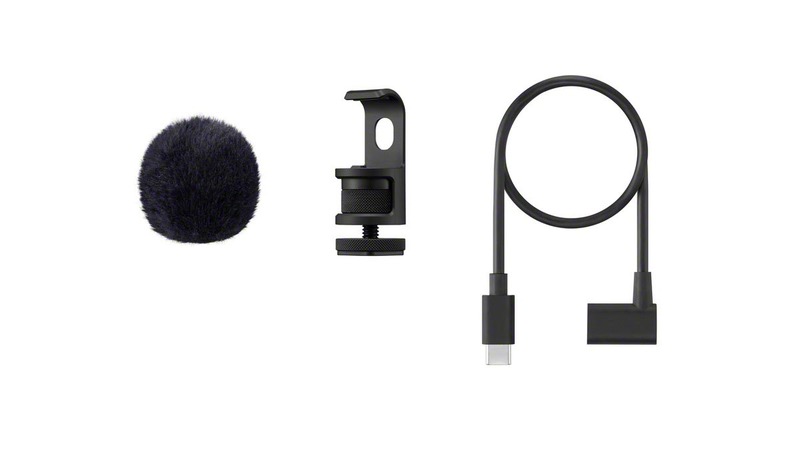
Included accessories. The cable on the right is a relatively rare USB-C extension cable.
Ease of use has also been considered, with a built-in accelerometer that automatically detects whether the smartphone is in portrait or landscape orientation. Furthermore, by toggling the "SELFIE" switch to specify whether to use the front or rear camera during shooting, sound can be recorded without the up/down/left/right orientation being swapped, even if the smartphone camera's orientation changes.
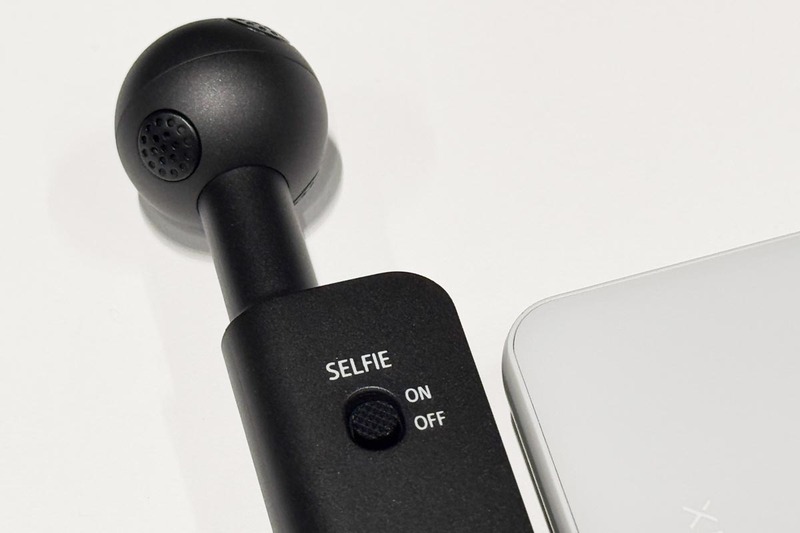
SELFIE switch
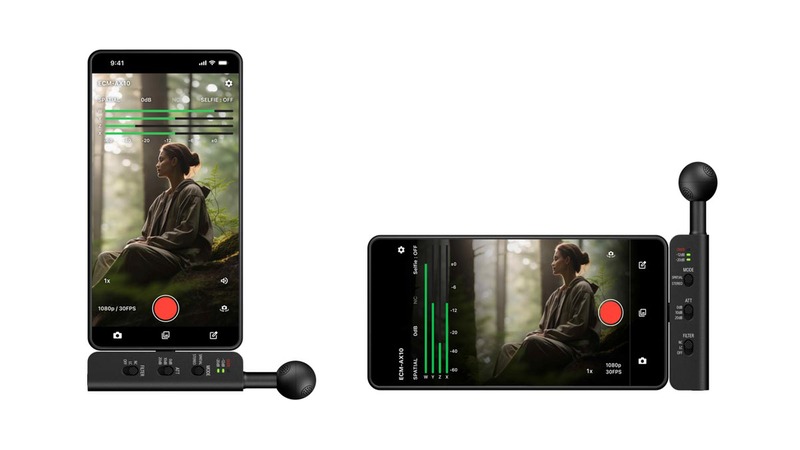
The shooting position (portrait or landscape) is automatically recognized, allowing for recording with correct localization.
Additionally, it features a 3.5mm headphone output, which is convenient for monitoring the recorded sound on the spot. This reduces one concern about whether the sound is being properly captured.
The frequency response is 20Hz to 20kHz, the maximum sound pressure level is 120dB SPL, and recording formats can be selected from 48kHz 32bit (Ambisonics) or 48kHz 16bit/24bit/32bit (binaural and stereo). The unit weighs approximately 24g and is powered by USB from the smartphone.