Studist, a provider of AI manuals, held a press conference to announce "Teachme Studio," a new feature in the Teachme series that enhances Teachme Biz's AI capabilities, along with "CONNECT," a new concept enabling automatic manual updates, and "Teachme Knowledge," a new product. The company aims to strengthen its products with AI as a core assumption to achieve skill transfer and operational improvements that adapt to change, particularly in the manufacturing industry, its main target.
From AI that Creates Manuals to AI that Automatically Updates Them
Since 2013, Studist has been offering "Teachme Biz," a cloud-based manual creation and sharing system for corporations, boasting over 2,000 client companies domestically and internationally, primarily in manufacturing. Recently, the company has been seriously promoting AI integration, improving accuracy to the point where manuals can be automatically generated by simply inputting raw materials. The next goal is "autonomous updating AI" that captures changes in the field and continuously updates automatically.
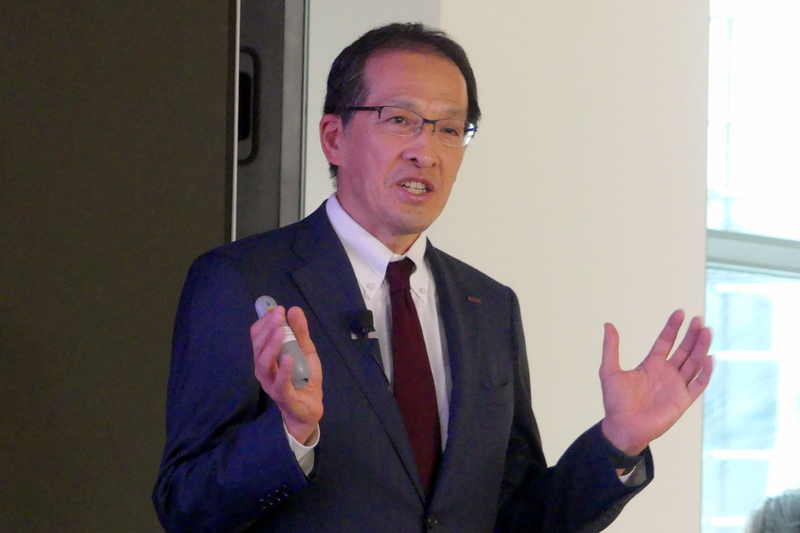
Satoshi Suzuki, Representative Director and CEO of Studist, who spoke at the press conference, cited labor shortages as a social issue behind this automation. The manufacturing industry, Studist's main target, has seen its workforce decrease to three-quarters since 2002. Compared to 2008, the number of young workers has decreased by about 20%, while workers aged 65 and over and foreign laborers have increased. Amidst this, skill transfer has become a major challenge, causing anxiety for many manufacturing companies.
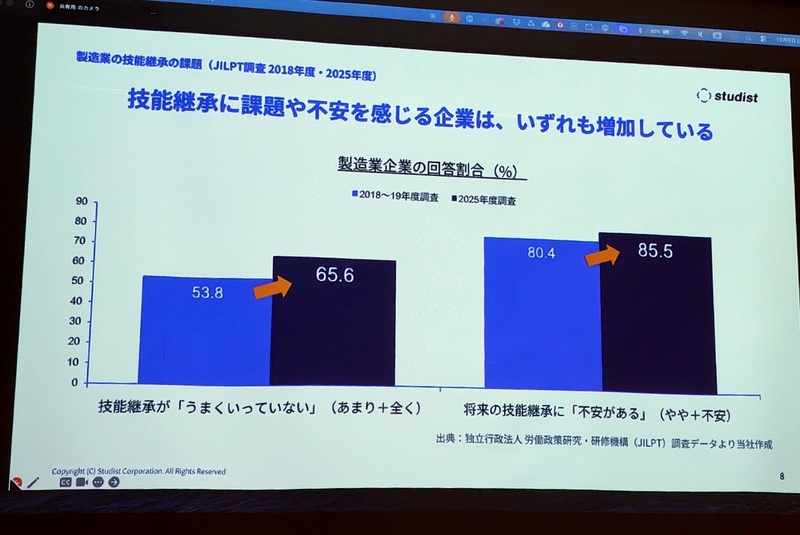
Manufacturing industry feeling anxious about skill transfer
In response, the company advocates the concept of "Lean Operations." Lean Operations is defined as "a series of continuously improved processes, tasks, and actions to reduce waste and maximize results with optimal management resources." A framework is also provided, covering everything from current state visualization to standardization, thorough implementation, and value enhancement.
Customers Don't Want to Create Manuals; They Want to Improve Procedures and Processes
The "Teachme series" is the means to realize this Lean Operations framework, with Teachme Biz being the product used for standardization and thorough implementation. Suzuki stated, "Customers don't want manuals; they want to improve procedures and processes. We knew that skill transfer couldn't be guaranteed by manuals alone. We thought about how to convey skills, not just procedures."
As a product-side means to accelerate Lean Operations, Studist has been working on the aforementioned AI integration for several years. Suzuki said, "We don't want to create products; we want to provide the means to achieve Lean Operations. In that sense, AI is the coolest technology right now."
In June 2024, the company developed Teachme AI, which automates video splitting, subtitling, and text generation for manuals. Subsequently, search and editing support were rolled out, and it was standardized in Teachme Biz from March 2026. In July, Teachme Studio was released, enabling the integration of multiple materials and image support.
Teachme Biz Studio imports scattered information assets from the field and automatically generates manuals. For example, it can significantly speed up the task of integrating a silent work video and a work standard document into a single manual. Suzuki appealed, "Once you use it, you'll feel an immeasurable impact." In fact, within two months of its release, the Studio feature has seen the number of conversations with users increase by approximately 5 times, and the number of users expand by 2.8 times.
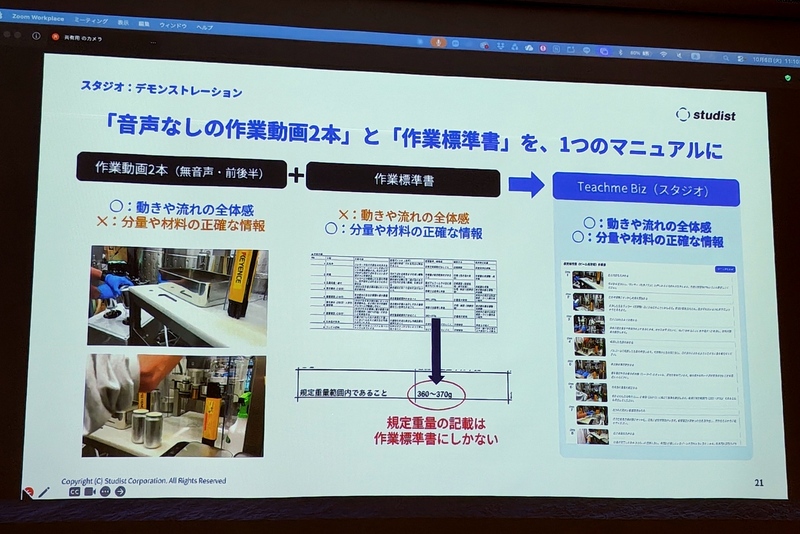
Automatically generating manuals from multiple materials
Product Group Connected to "Teachme Knowledge," the Company Encyclopedia
Even if manual creation and editing become easier, updates remain crucial because on-site operations and knowledge are constantly changing. However, according to Studist's research, the need for updates mostly relies on human awareness, such as on-site observations, inspections, and inventory checks, with automatic detection by systems still being rare. In an already labor-short environment, the burden of humans continuously handling update tasks is too heavy. Suzuki stated, "Unless we aim for a state where updates can be done autonomously, our customers' pain will not be resolved."
AI is also expected to play a role in such automatic updates. It can detect changes, associate them, identify impacts, judge pros and cons, and update. Achieving this requires site-specific knowledge. Furthermore, the current situation is not that such records "don't exist," but rather that they "exist but cannot be used." The three major barriers to information utilization are "cannot find," "cannot understand," and "cannot ask."
"Teachme Knowledge," which launched in October, transforms information dormant in the field into usable assets for the organization. Touted as "the company's encyclopedia," Teachme Knowledge, like Teachme Biz, features AI that summarizes and structures any information simply by inputting it. Users can ask questions and receive answers with sources from accumulated knowledge, and by feeding back insights gained, new notes are added, creating what can be called a "compounding effect of knowledge."
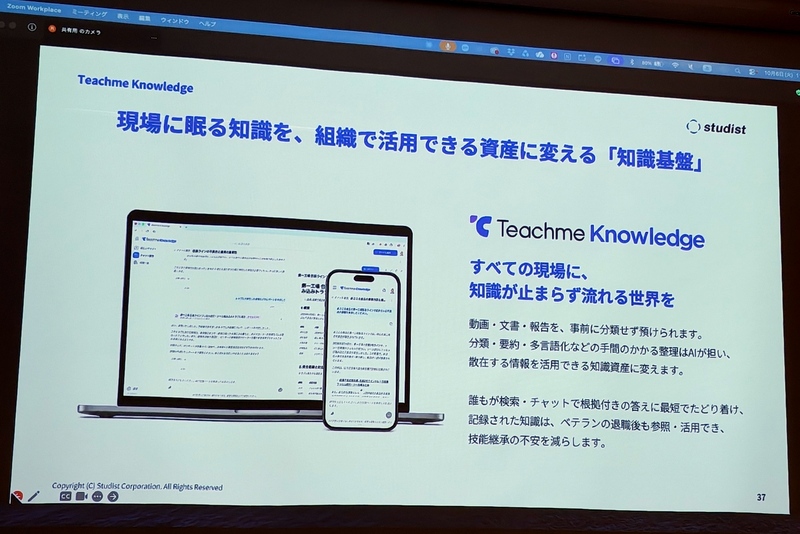
Teachme Knowledge utilizes information dormant in the field
Going forward, Studist will promote "CONNECT," a vision to link various products based on a common data source, in addition to Teachme Biz (for conveying procedures) and Teachme Knowledge (for utilizing knowledge). As the first phase, an integration will be provided where, when new knowledge is entered into Teachme Knowledge, the scope of impact is investigated, and Teachme Biz is notified of potential revision points and their rationale.
Future products to be integrated with CONNECT include Teachme Biz and Teachme Knowledge, as well as "Teachme Process" (process foundation), "Teachme MySkill" (human resource information foundation), "Teachme Check" (work/equipment inspection foundation), and "Teachme Communication" (communication foundation). By linking these products, Studist aims to optimize the entire workplace by improving procedures and processes, enabling record-keeping and inspections, and supporting human growth and deployment. This will achieve "sustainable operational improvement," circulating knowledge generated in the field back into the next round of improvements.
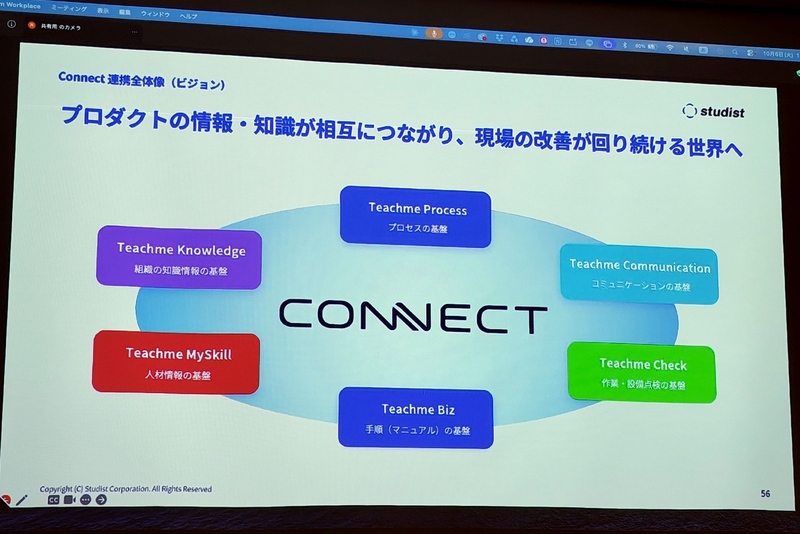
Product integration concept "CONNECT" for achieving sustainable operations