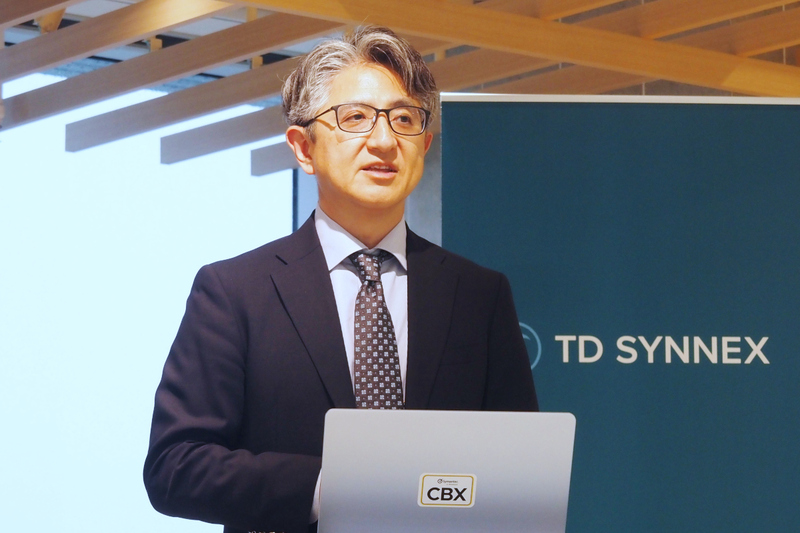
As cyberattacks become more sophisticated and complex, the number of security products companies adopt continues to grow. However, the operational burden of these solutions leads to 'security fatigue' among IT/security personnel, and the anxiety of 'missing potential threats' remains unaddressed.
TD SYNNEX Japan, an IT distributor, has begun offering 'Symantec CBX,' an XDR solution designed to address these challenges faced by companies in Japan. This solution integrates various security functions previously offered by Broadcom-owned Symantec and Carbon Black into a single platform, with AI assisting in threat assessment and incident investigation.
While Broadcom is the developer, Symantec CBX will be offered under a new scheme where TD SYNNEX will fully handle marketing, sales, and after-sales support in the Japanese market. TD SYNNEX is eager to popularize this solution, which incorporates enterprise-level security technology, among small and medium-sized enterprises (SMEs) and smaller companies. Details of the solution and its background were explained at a press briefing on September 7, 2026.
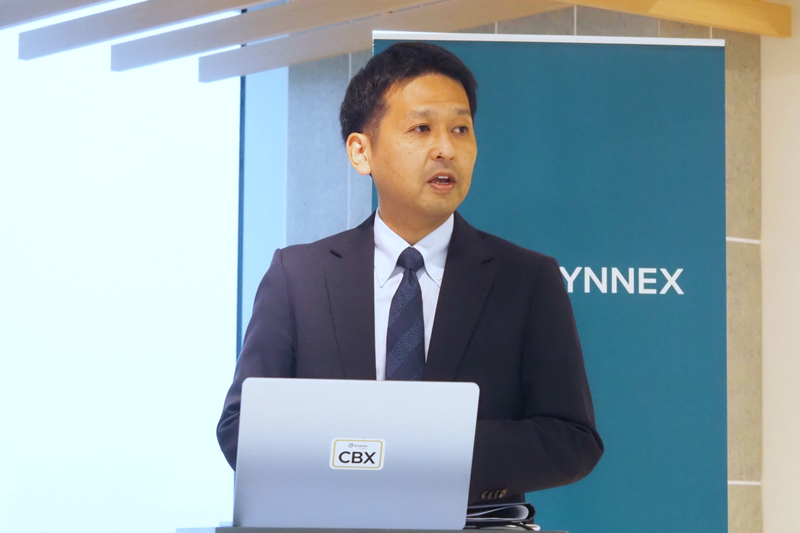
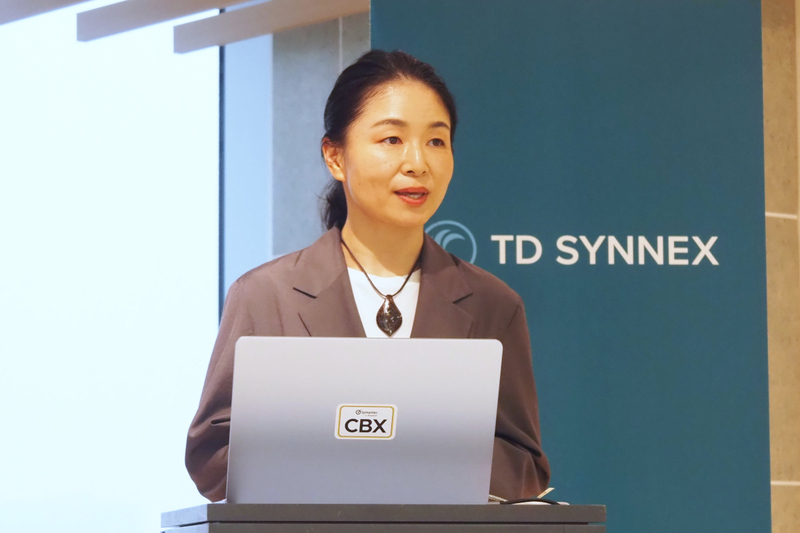
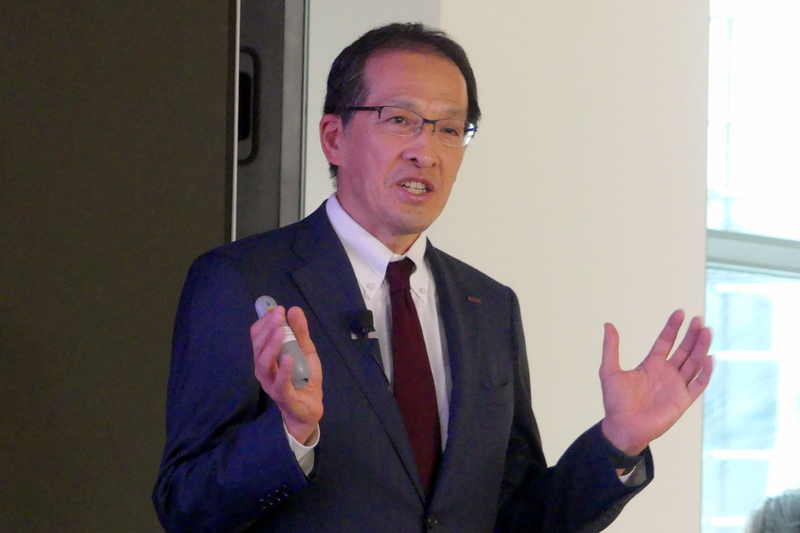
Taro Matsuzawa, Director, Head of Broadcom Business Division and Head of Finance Division, TD SYNNEX; Rieko Yamaguchi, Broadcom Marketing Department, Marketing Division, Marketing & Services Division, TD SYNNEX
XDR Platform Reduces Analyst Workload with “AI-Driven SOC”
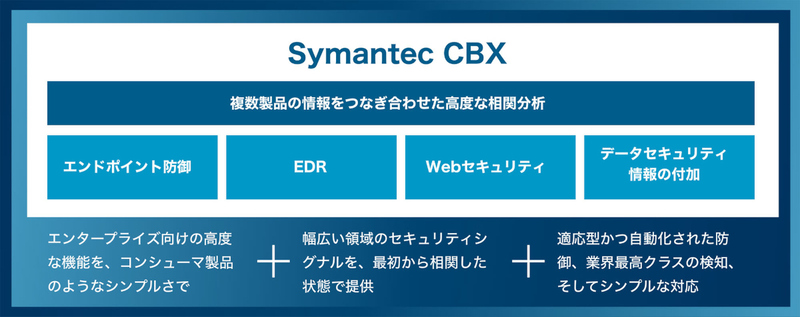
Symantec CBX is an XDR platform solution that provides integrated endpoint protection, web security, and data security functions to enable rapid threat detection and response.
Specifically, a single agent installed on endpoints delivers functions such as Endpoint Protection Platform (EPP), Endpoint Detection and Response (EDR), Secure Web Gateway (SWG), Zero Trust Network Access (ZTNA), and Data Loss Prevention (DLP).
In addition, it features AI-driven cloud XDR capabilities that integrate, visualize, and correlate telemetry and event logs collected by each function. Since the platform is integrated from the outset, complex integrations like those required for SIEM are not necessary.
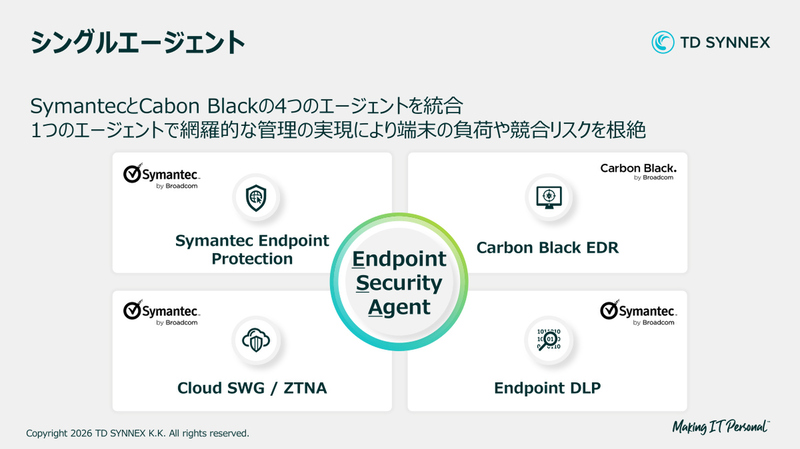
Providing a wide range of security functions through a single agent
Taro Matsuzawa, Director and Head of Broadcom Business Division at TD SYNNEX, explained that Symantec CBX features a 'single agent,' 'AI-driven XDR & SOC,' and 'flexible scalability.'
First, with 'AI-driven XDR & SOC,' AI correlates vast amounts of information collected from endpoints and networks, automatically performing tasks such as threat assessment, summarizing threat content, and prioritizing responses, thereby supporting daily threat monitoring operations.
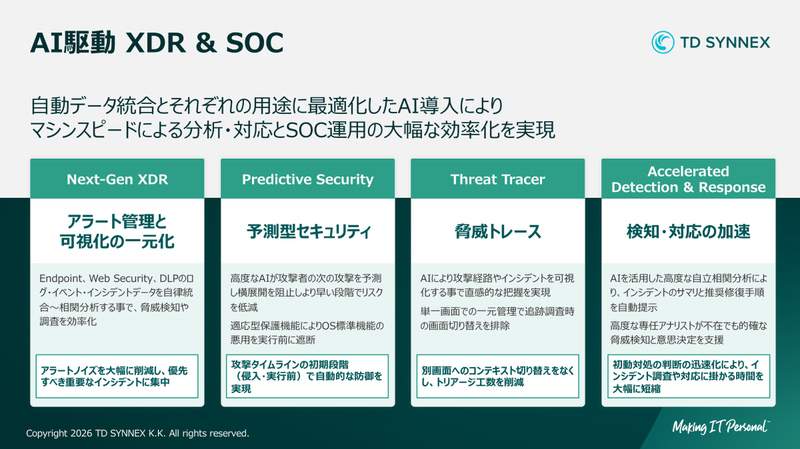
The platform integrates telemetry and event logs, enabling threat visualization and early detection through AI-driven correlation analysis.
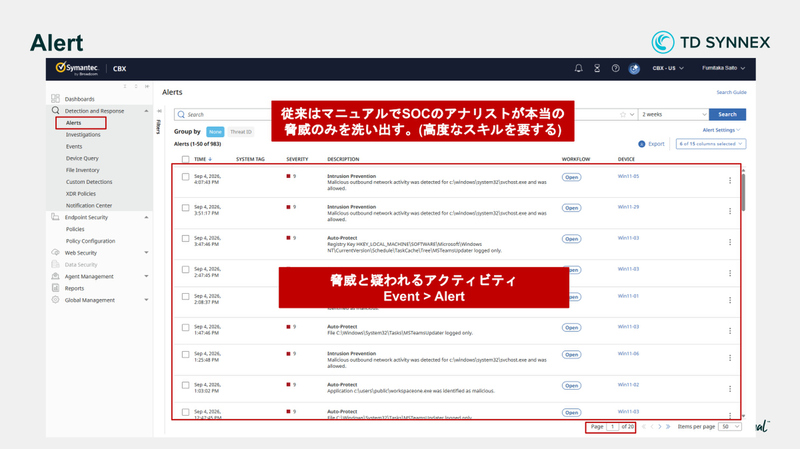
Automatically extracts suspicious activities from a large volume of event logs.
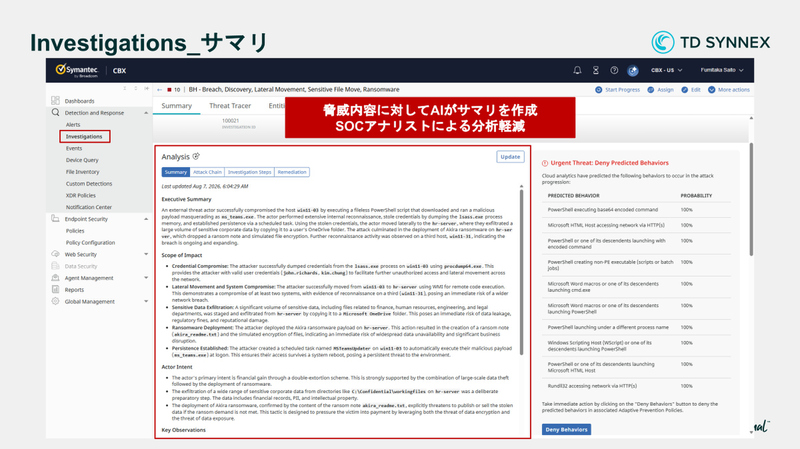
AI also automatically generates summaries of threat content. While this screen is in English, preparations for Japanese language support are underway.
Furthermore, in the event of an incident, the entire attack chain, including the intrusion path and internal spread of infection, as well as the scope of the threat's impact, is graphically visualized, allowing for a quick and intuitive understanding of the overall threat. Additionally, AI specifically suggests actions to be taken to prevent the attack from progressing/spreading or recurring.
It also includes features such as AI predicting and blocking an attacker's 'next attack step,' and 'adaptive protection' that detects hard-to-find attacks by learning normal user behavior, thus enhancing defense through AI automation.
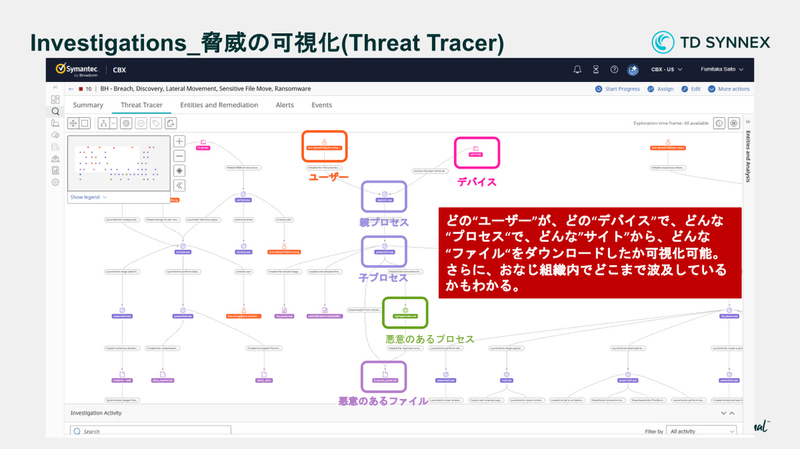
Threat Tracer visualizes threat intrusion paths, affected users/devices/processes/files, and the scope of attack expansion.
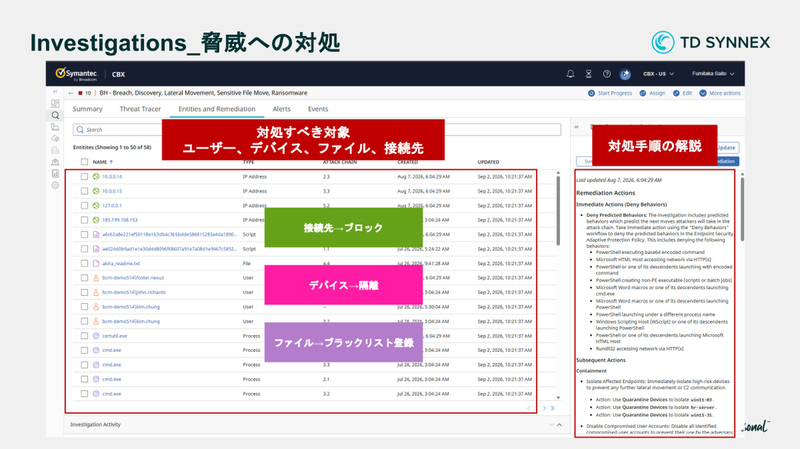
Automatically identifies targets requiring action and provides explanations of response procedures.
Another key feature is 'flexible scalability.' Symantec CBX offers two editions to match the security maturity of adopting companies: 'Symantec CBX Essential,' which allows for a small start with only endpoint security functions (EPP, EDR), and 'Symantec CBX Complete,' which adds entry-level SWG and DLP. Furthermore, upgrades to enterprise versions of SWG and DLP offered under the Symantec brand are also possible.
Even with such phased upgrades, the single agent installed on endpoints remains continuously usable. This means that security can be enhanced with zero-touch as a company's maturity increases.
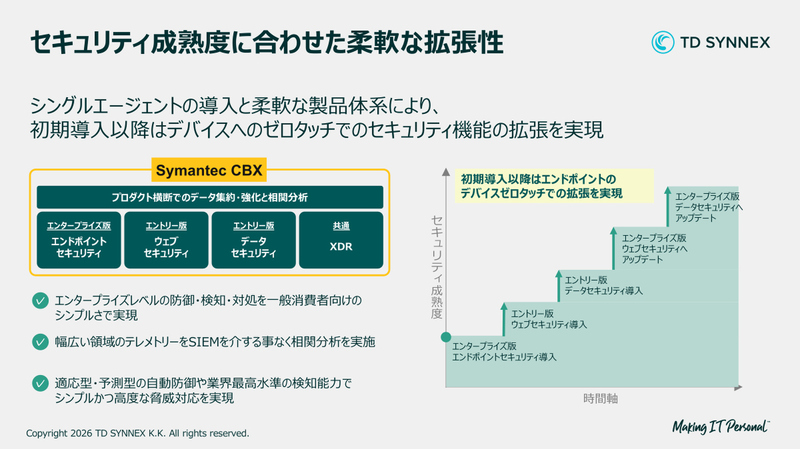
Can be introduced with a small start and gradually expanded in functionality.
Thus, Symantec CBX not only prevents 'alert fatigue' among SOC analysts but also uses AI to assist personnel without advanced skills in making appropriate threat judgments and responding to incidents.
For this reason, Matsuzawa explained that it can be utilized not only by large enterprises operating their own SOCs and MSSPs (Managed Security Service Providers) but also by SMEs and smaller companies that previously couldn't have a SOC due to a lack of highly skilled personnel.
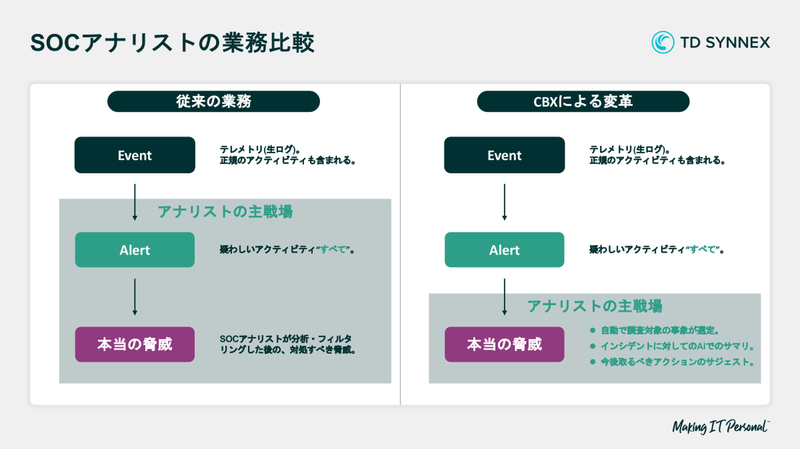
Since it eliminates the need to investigate 'all' suspicious activities as was traditionally done, SOC analysts can focus on incident response.
75% Suffer from “Security Fatigue,” Anxiety of “Missing Threats” Persists Even with More Tools
As background for the need for such products, Rieko Yamaguchi of TD SYNNEX's Broadcom Marketing Department introduced the findings of the research report 'Security Fatigue White Paper 2026.' This survey targeted IT/security personnel and management in Japanese companies (with 300 or more employees) that have implemented multiple security products. The number of valid responses was 410.
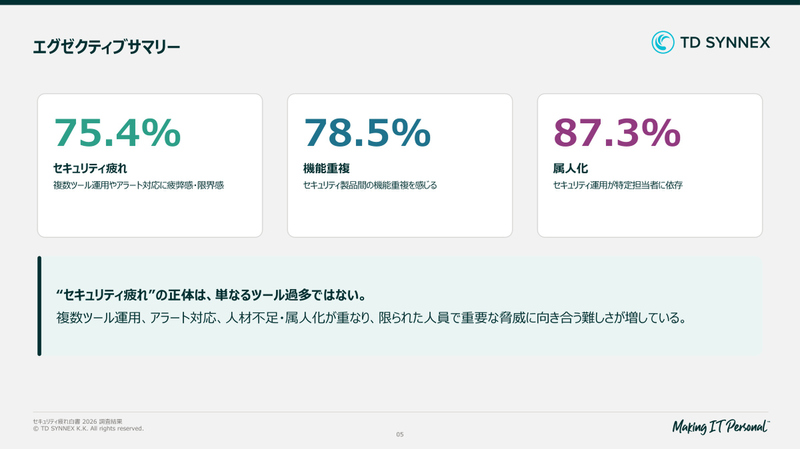
Summary of 'Security Fatigue White Paper 2026'
According to the survey, a staggering 75.4% of respondents reported 'security fatigue' due to exhaustion from operating multiple tools and responding to alerts. The cause is a situation where they 'cannot respond to all threats' due to a large volume of security alerts and false positives. As many as 30.0% of respondents stated that their 'threat response rate is less than 50%.'
Furthermore, a gap was observed: while 80.0% expressed 'confidence' in the visibility of their company's security posture, 75.9% also felt 'anxiety about missing threats.'
Based on these survey results, Yamaguchi summarized the factors contributing to 'security fatigue' as four points: 'tool overload,' 'alert fatigue,' 'visibility gap,' and 'talent shortage/over-reliance on individuals.' She emphasized that simply increasing security tools is not enough; 'simplicity for sustainable management and operation' is also key.
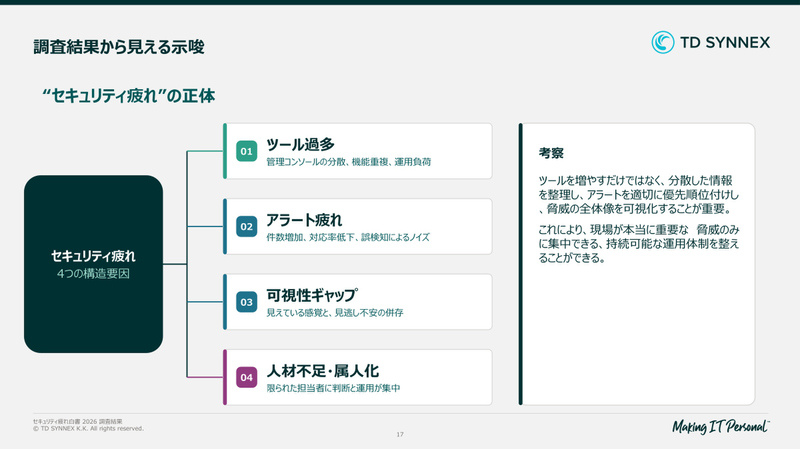
From the survey results, TD SYNNEX analyzes four factors contributing to 'security fatigue.'
TD SYNNEX to Lead Domestic Market Expansion, Targeting SMEs and Smaller Companies
Shigetaka Kunimochi, President and Representative Director of TD SYNNEX Japan, explained that for Symantec CBX, they are adopting a 'new business model and scheme' that differs from traditional product distribution models. This new scheme aims to 'create new value.'
Specifically, the scheme involves TD SYNNEX taking over all Go-to-Market activities in the Japanese market, including marketing, sales, and after-sales support, on behalf of the original manufacturer, Broadcom.
Broadcom has adopted a policy of comprehensively entrusting Go-to-Market activities for Symantec/Carbon Black products in their global expansion to leading vendors in each region (market). TD SYNNEX already plays this role in North and Latin America, and Japan will be the third market to follow.
"As Broadcom, the product developer, we want to allocate resources to product development. Therefore, we entrust marketing, sales, and after-sales support in each country/region to experienced companies, while Broadcom itself focuses on R&D and core corporate marketing. We are aiming for a model that maximizes product development investment and returns," said Kunimochi.
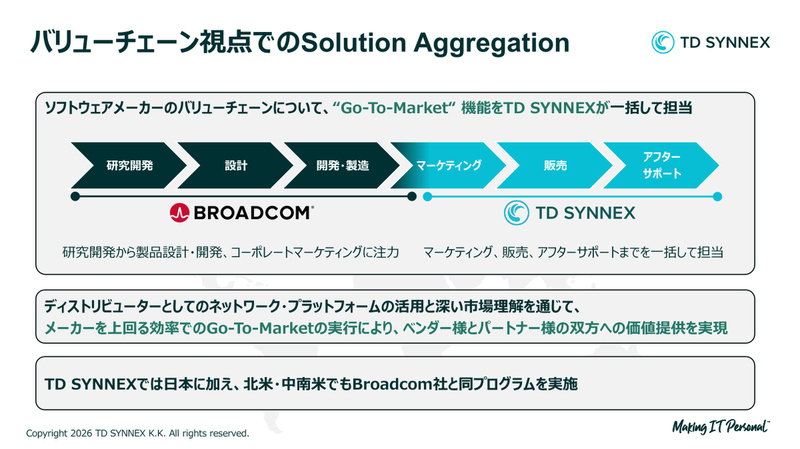
TD SYNNEX will handle marketing, sales, and after-sales support in the domestic market on behalf of the manufacturer, Broadcom.
Meanwhile, this scheme also appears to have benefits for TD SYNNEX. Previously, Broadcom's Symantec/Carbon Black business focused on large enterprises due to sales and support resource constraints in each market. However, with this new scheme, TD SYNNEX can expand its target to SMEs and smaller companies through its own distribution channels.
"Under Broadcom, the strategy was primarily focused on large enterprises, making it difficult to expand usage to a wide range of company sizes. Even estimating from security software market data (2025), the current market share in Japan is less than 5%. Therefore, we aim to leverage TD SYNNEX's distribution channels to expand to mid-sized and even smaller companies," Kunimochi stated.
Kunimochi further emphasized the benefit that SMEs and smaller companies will now be able to utilize the advanced features of Symantec CBX.
"(Symantec/Carbon Black products) were originally developed by Broadcom to meet the requirements of large enterprises. If we can deploy this product (Symantec CBX) to mid-sized or even small and medium-sized companies, everyone will be able to use the (advanced) security features that large enterprises have been utilizing. If that can be achieved, it would be a very meaningful business," Kunimochi remarked.
He also explained that for smaller companies unable to operate their own SOC or conduct security monitoring, a managed service offering by TD SYNNEX and SOC partners is currently being prepared.
Matsuzawa also stated that since TD SYNNEX bears all sales responsibility in the domestic market, "price stability is easier to ensure, making it available in a sustainable manner." This statement is likely made with awareness of the significant licensing changes Broadcom made to VMware products a few years ago, which caused considerable confusion due to increased costs.