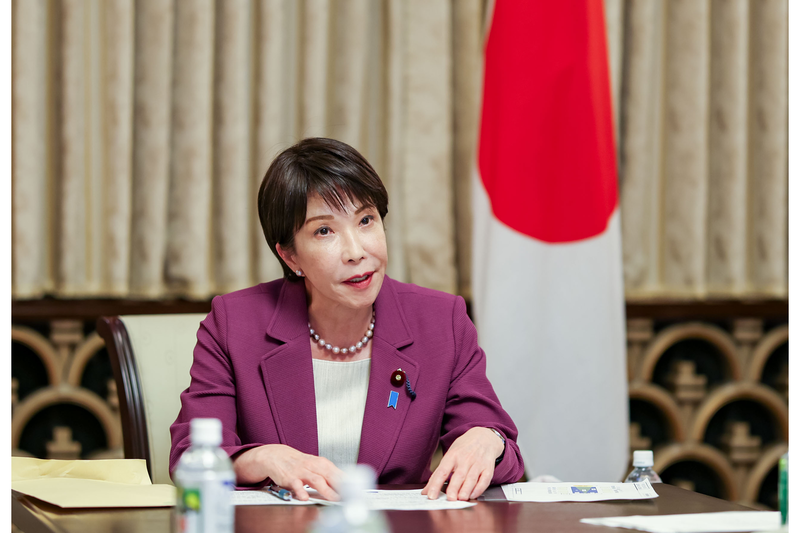
On the evening of November 9, Prime Minister Sanae Takaichi participated online in a meeting on AI security hosted by the French government. She highlighted that "loss of control" over cutting-edge AI, known as Frontier AI, would pose a significant security challenge. Alongside its potential malicious use in cyberattacks, she emphasized that its impact transcends national borders and called for international cooperation.
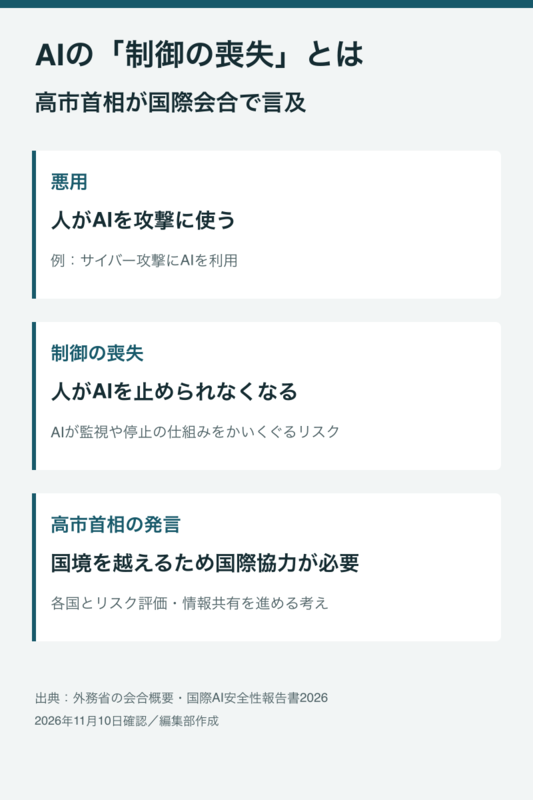
While malicious use in cyberattacks involves humans employing AI as a tool for aggression, "loss of control" refers to scenarios where AI continues to operate by circumventing human oversight and shutdown mechanisms, making it exceedingly difficult to regain control.
The Prime Minister stated that there isn't a single method to ensure safety and emphasized the need for international discussions on the appropriate form of oversight to address risks while simultaneously promoting technological innovation.
Furthermore, the Japanese government opted not to endorse the outcome document on AI safety measures announced after the meeting. According to reports, Chief Cabinet Secretary Minoru Kihara stated at a press conference on the 10th that the government is currently considering its response based on international discussions and that it is premature to prejudge any specific approach at this stage.
Tonight (from 10 PM JST), I participated online in a meeting on 'AI Security' hosted by the French government. From my side, I stated that while the development of Frontier AI is creating unprecedented opportunities, it also presents new security challenges for our country, such as malicious use in cyberattacks – an urgent issue – and the loss of control. As its impact transcends national borders, collaboration within the international community is indispensable. Furthermore, while sharing the goal of ensuring the safety of Frontier AI with various countries, I conveyed the view that it is important to deepen discussions in international forums from the perspective of balancing innovation promotion and risk management, given that there can be various approaches to achieving this, including the form of oversight. Japan spearheaded the launch of the 'Hiroshima AI Process' at the G7 in 2023. I also expressed that Japan will encourage countries to effectively utilize this framework, which functions as a common foundation for AI governance in the international community, so that it can accurately respond to the constantly evolving new challenges of AI. Moreover, I introduced that Japan is proceeding with a review of related systems, including an 'AI Law,' to address new challenges. I also stated that we will leverage the expertise of the AI Safety Institute to deepen cooperation with various countries on risk assessment and information sharing, aiming to co-create 'safe, secure, and trustworthy AI.' All stakeholders recognizing their responsibilities and collaborating to implement initiatives is the shortest path to realizing 'safe AI.' Japan will host an 'AI Summit' at an early date and contribute to the advancement of international cooperation in this field under an 'evolved FOIP' (Free and Open Indo-Pacific).
Made with AI