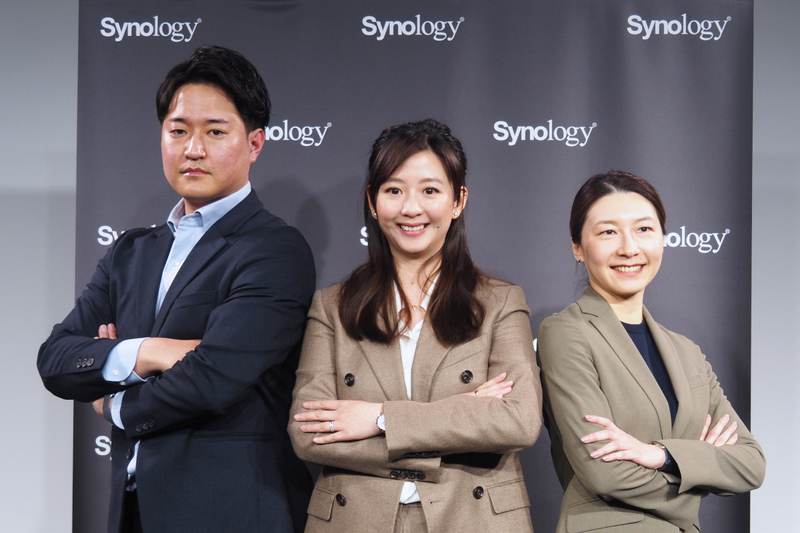
Synology Japan, a provider of NAS, enterprise storage, and backup storage solutions, held a press conference on November 11, 2026, to introduce its latest product and business strategies.
The company emphasized the importance of enterprise data management and protection in the AI era, highlighting current challenges in the corporate data environment that act as barriers, and presenting Synology's latest solutions across four categories.
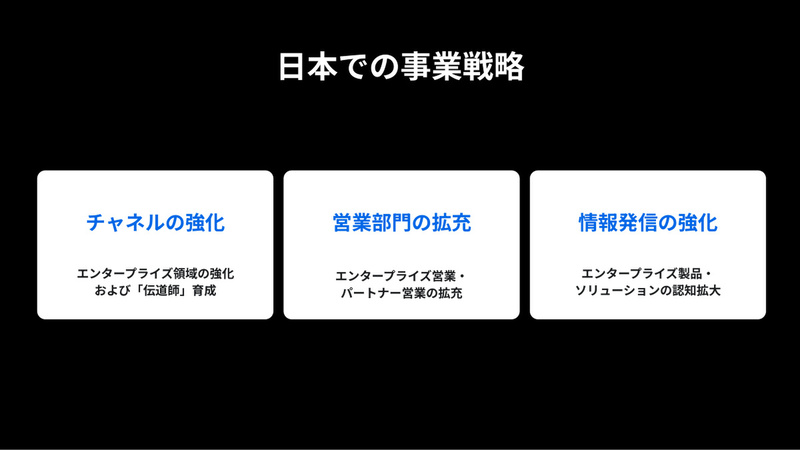
Furthermore, regarding its business strategy in Japan, Synology declared its intention to strengthen and expand its "channels," "sales department," and "information dissemination" to enhance its presence and penetration in the enterprise market.
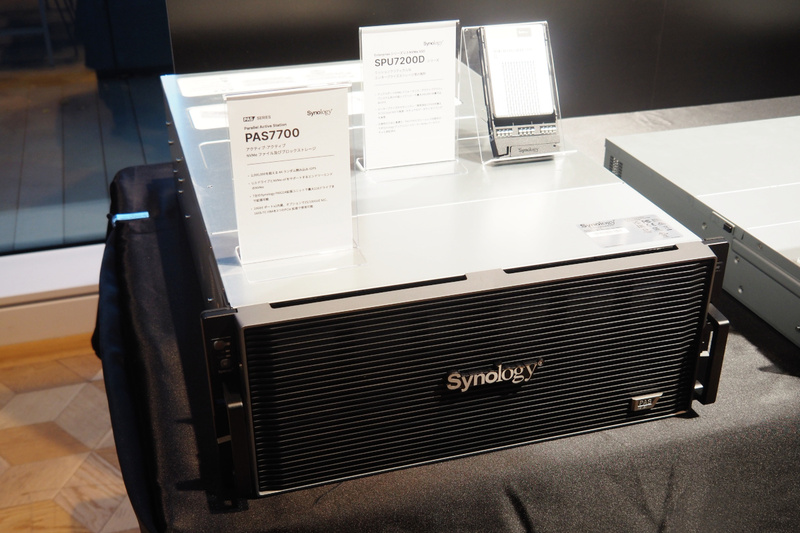
The enterprise-grade NVMe all-flash primary storage "Synology PAS7700" was also exhibited
The Challenge of AI Utilization in Enterprises Lies Not in the Models, But in the Data Environment
Synology is a Taiwanese manufacturer that develops and produces hardware-centric solutions, including NAS, enterprise storage, and backup storage. Currently, over 14 million of its systems are operational worldwide, managing and protecting more than 400 EB (exabytes) of data.
In her opening remarks, Joanne Weng, President of Synology Japan, pointed out that with the advent of the AI era, the volume of data held by enterprises is increasing at an unprecedented rate, and consequently, "the challenges related to data management and protection are also growing significantly."
Under these circumstances, Synology offers one-stop solutions in the areas of "data storage," "business productivity," "data protection," and "video surveillance," and proudly stated, "We have achieved strong results in the Japanese market."
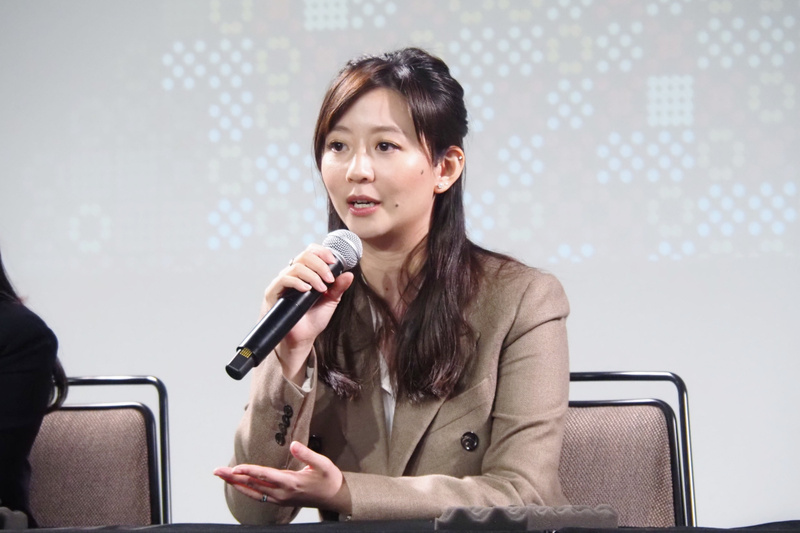
>Joanne Weng, President of Synology Japan
What exactly are these "challenges related to data management and protection in the AI era"?
Joanne Lai, Head of Sales and Marketing at Synology Japan, stated, "While AI models themselves have already reached sufficient performance, many organizations are not adequately prepared regarding the quality of the underlying data for AI processing."
She then listed specific challenges using keywords such as "data silos," "utilization of unstructured data," "data gravity," and "data security and AI governance."
Joanne Lai, Head of Sales and Marketing, Synology Japan
AI can operate more intelligently when it can reference more data within an enterprise. Conversely, if data is fragmented across systems (siloed) or if AI cannot access unstructured data such as emails, chats, videos, and images, its capabilities cannot be fully realized.
Furthermore, migrating all data to the cloud for AI processing is often impractical due to costs, data privacy, and regulatory reasons. "In fact, the more valuable data is to an enterprise, the more likely it is to remain within the company's infrastructure (making cloud upload difficult). We call this 'data gravity,'" explained Lai.
Data security has also become a critical issue due to the frequent occurrence of ransomware attacks and confidential information leaks. The reality of the AI era is that attackers are exploiting AI to discover unknown vulnerabilities and automate/reduce the cost of attacks. On the other hand, companies must also prepare for scenarios where AI agents operating internally might "run wild" and destroy critical data.
"What I want to convey is that no matter how much technology evolves, data will continue to be the foundation of enterprises. That's why it's crucial to leverage AI on a data foundation and manage and protect data in-house. Synology has made this its mission and built a comprehensive solution portfolio," Lai emphasized.
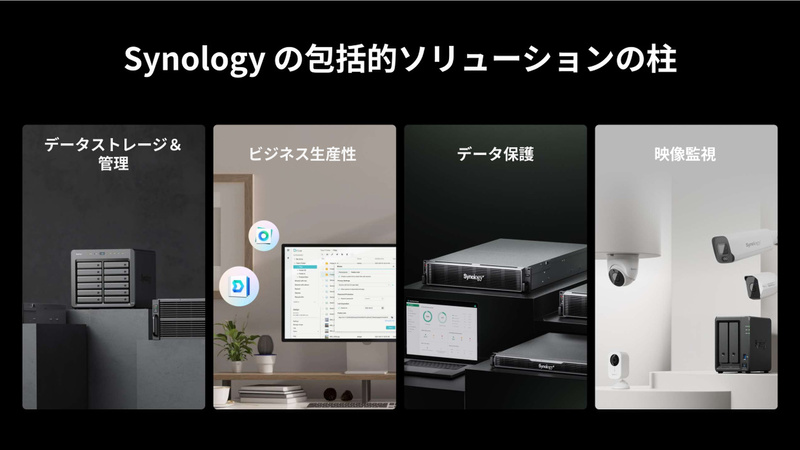
Synology offers comprehensive solutions across four domains (data storage / business productivity / data protection / video surveillance)
According to Lai, Synology's solutions are widely adopted by manufacturing customers in the Japanese market, and recently, their adoption in the medical sector has also been increasing. She explained that the common needs across these industries are "reliable storage and protection of critical data" and "secure data sharing."
Japanese Corporate Survey Reveals "Insufficient Current State" of Data Environment Supporting AI
Ryohei Saito, Sales Account Manager at Synology Japan, analyzed how prepared Japanese companies are to "support AI" based on a corporate survey conducted this year, and introduced Synology's latest solutions addressing these challenges.
Ryohei Saito, Sales Account Manager, Synology Japan
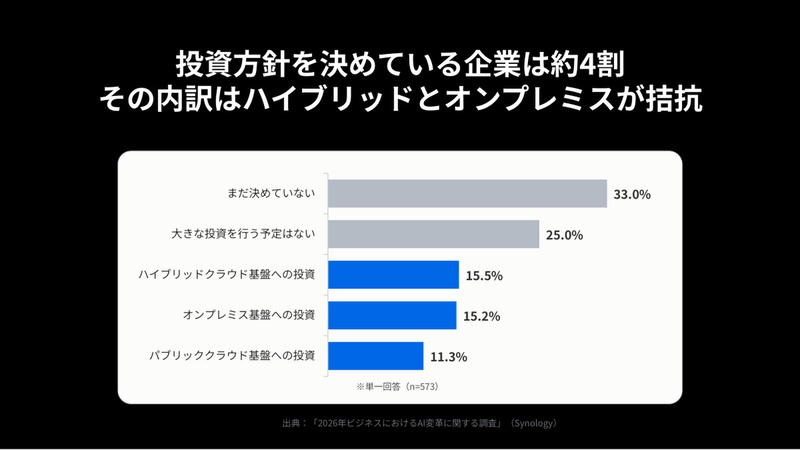
This survey was conducted by Synology Japan targeting 573 IT professionals in Japan. Saito presented the analysis results from three perspectives: "data infrastructure," "cyber resilience," and "AI utilization in the workplace."
Regarding "data infrastructure," approximately 70% of companies recognize that "AI-ready infrastructure is important." The top two priority areas for infrastructure development were "strengthening data security" and "ensuring backup/BCP."
"What's primarily sought is not faster infrastructure, but 'defensible infrastructure.' That the data within it is secure, and can be reliably restored in an emergency. This is the true sentiment of Japanese companies," Saito stated.
Furthermore, when comparing the responses of companies with concrete AI infrastructure investment plans, the intention to invest in "hybrid cloud" and "on-premise" was stronger than in "public cloud." Saito pointed out, "From now on, it will be crucial to decide how much of one's data to manage in-house."
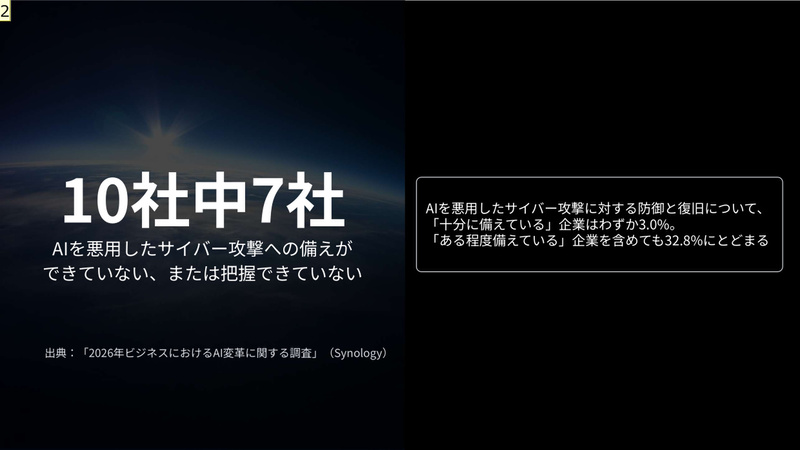
Concerning "cyber resilience," only 3.0% of companies reported being "fully prepared" for cyberattacks exploiting AI, and even including those "somewhat prepared," the figure remained at 32.8%. Similarly, only 43.6% of companies were "very/somewhat confident" in protecting backups from ransomware attacks and quickly resuming operations.
Saito added, "We also found 'fragmentation of defense.'" To achieve rapid resilience (business recovery) against ransomware attacks, the integration of security and data protection (backup) is crucial. However, only about 10% of companies are utilizing integrated platforms for these functions.
"One might think that adding more tools strengthens defenses, but in reality, management becomes complex, and the overall picture is lost in an emergency. The number of tools is not strength. Thinking about protection and recovery in an integrated way – that is the answer going forward," Saito explained.
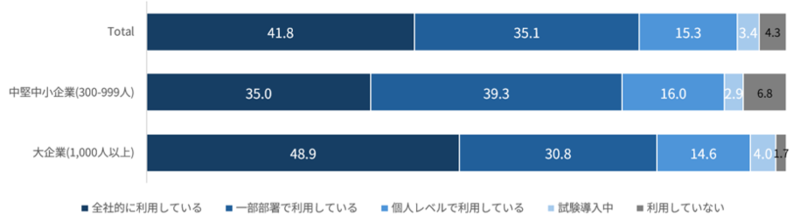
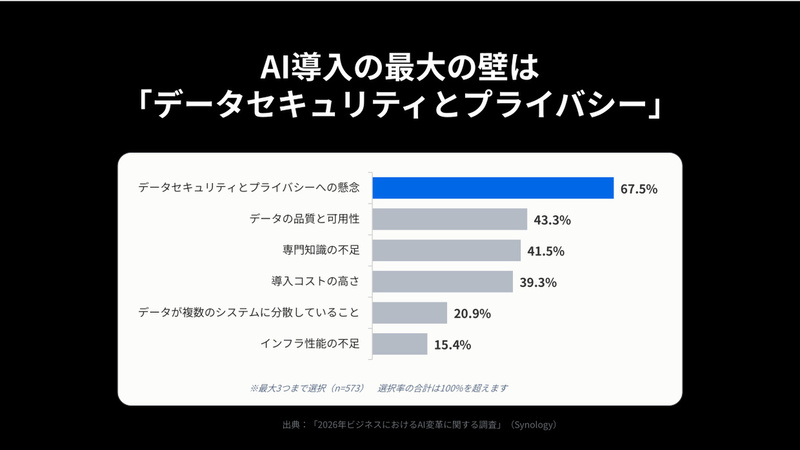
Regarding "AI utilization in the workplace," it was revealed that the biggest hurdle to AI adoption is "concerns about data security and privacy," and only 18.3% of companies apply technical management measures (such as access control and monitoring of token usage) for employee AI use.
Introducing the Latest Solutions in Three Key Areas
In response to the enterprise challenges of the AI era, which were highlighted by Synology's survey, Synology is focusing on three areas: "AI-supporting infrastructure," "reliable and rapid cyber resilience," and "AI utilization with governance." Saito introduced solutions for each area.
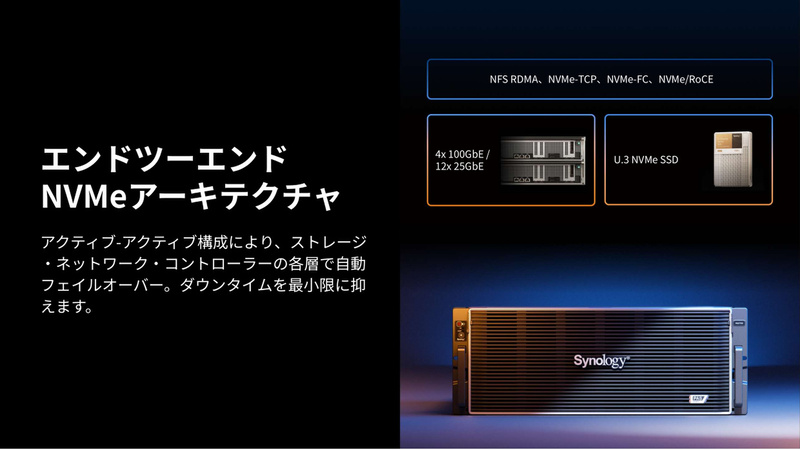
For example, in the "AI infrastructure" domain, Synology offers the PAS7700, an all-flash primary storage solution for AI workloads. With an end-to-end NVMe architecture and active-active configuration, it is suitable for mission-critical enterprise workloads.
Saito also addressed "storage cost efficiency" as an infrastructure challenge in the AI era. The widespread adoption of AI has led to a rapid increase in storage demand, causing flash storage prices to soar and extending lead times for large-capacity HDDs. Therefore, Saito explained that an approach to "efficiently utilize existing storage" is necessary, leveraging features like "Synology Tiering" for automatic storage tiering, and data deduplication/compression technologies.
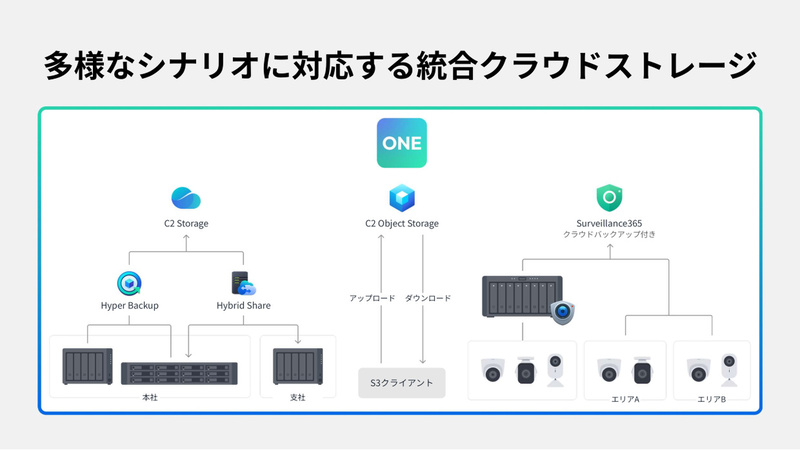
Furthermore, in response to the need for hybrid cloud solutions, Synology introduced its cloud storage service, "C2 OneStorage." This cloud service comprehensively covers multiple uses, including cloud backup for Synology products, surveillance video storage, object storage, and integrated management of multiple sites.
For "cyber resilience," Synology introduced "Synology Active Protect," which enables "3-2-1-1-0 backup."
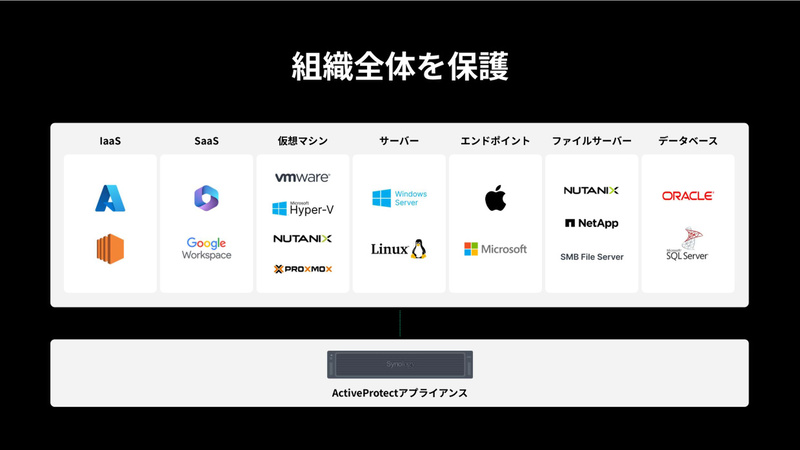
Active Protect is a dedicated data protection appliance that can back up business PCs, virtual servers, databases, cloud instances, and SaaS data collectively. To protect backup data, it incorporates immutable storage and air-gap functionalities. It also supports rapid business recovery through file/system-level restoration.
For "AI utilization with governance," Synology introduced "Synology Office Suite," which allows AI utilization while keeping data in-house. It offers features such as transcription, translation, document refinement and proofreading, presentation generation, and natural language function search.
Synology is also working on AI utilization in physical security, highlighting its flagship AI-powered NVR (Network Video Recorder), the "Synology DVA7400." This device allows for diverse video searches using natural language, tracking specific individuals or vehicles, and area intrusion detection, all while keeping video data on-premise.
*
Finally, Saito touched upon Synology's business strategy in the Japanese market. In recent years, Synology has shown a commitment to approaching the enterprise market, and this will now translate into concrete actions in Japan. The company outlined a policy to strengthen its enterprise market initiatives across all fronts: "sales channels," "sales structure," and "information dissemination."