
On November 23rd JST, Meta's Chief AI Scientist, Alexandre Waang, published an essay on X titled "Superintelligence is Arriving." He expressed the view that "superintelligence," which will significantly surpass human capabilities, is approaching, and argued that humanity's actions over the next year will largely determine its future.
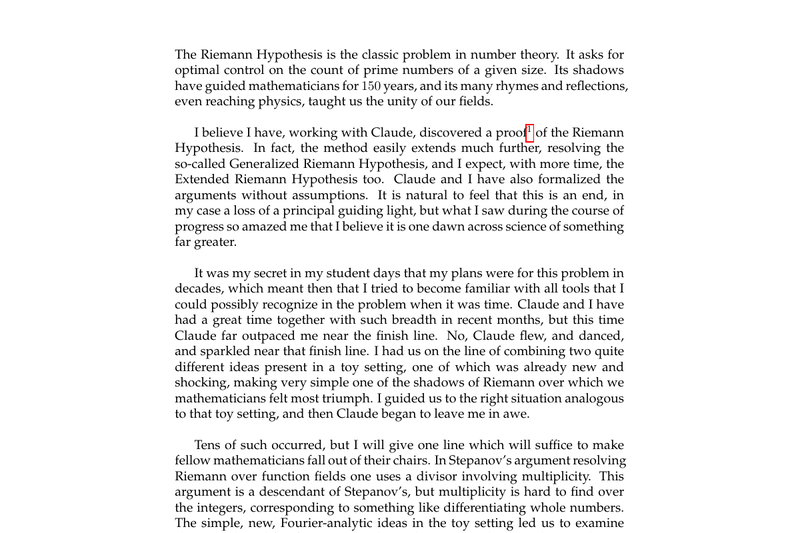
Waang argued that, based on AI's progress in tackling difficult mathematical problems, the remaining obstacles for AI to surpass humans in other fields are becoming less about intelligence itself and more about specialized domain knowledge, experimentation, and data. He cited the proof of the Riemann Hypothesis as a turning point where AI capabilities undergo a significant transformation. Regarding the Riemann Hypothesis, Anthropic mathematician Levent Alpoge announced on November 20th that he had discovered a proof in collaboration with Claude.
AI research itself is also becoming increasingly automated, raising the possibility that AI could enhance its own capabilities. Waang explained that it is difficult to imagine a world where humanity can maintain control over AI that undergoes unrestricted self-improvement or AI that possesses far superior abilities to humans in all fields. He advocated for the need to consider not only safety and alignment technologies but also the overall approach to development.
He also criticized the AI industry's stance of viewing the advent of superintelligence as inevitable and focusing solely on how to build it safely. Instead of surrendering society to AI, he proposed aiming for technologies that empower humans to make their own decisions and act independently.