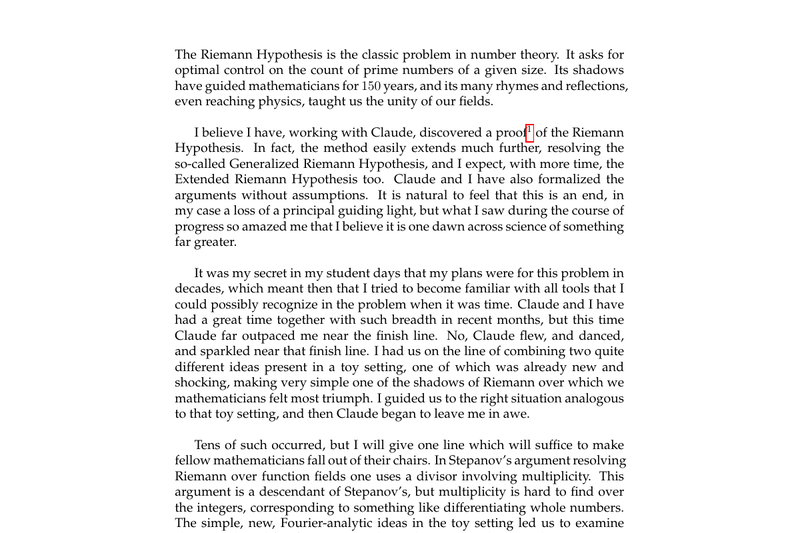
On November 20, Anthropic mathematician Levent Alpoge published a document claiming to have discovered a proof of the Riemann Hypothesis in collaboration with the AI "Claude." On November 21, the communities of proof assistant software "Lean" and mathematical library "Mathlib" issued a joint statement announcing that they had confirmed the correctness of the published formal proof and the proposition being proven.
The Riemann Hypothesis is an 1859 conjecture concerning the distribution of prime numbers. Mathematically, it states that the "non-trivial zeros" of the Riemann zeta function lie on a specific line in the complex plane. Alpoge published a 4-page explanatory document and approximately 17 million lines of Lean-formalized proof code. He also claims to have proven the "Generalized Riemann Hypothesis," an extension of the Riemann Hypothesis, using the same method.
According to the joint statement from Lean and Mathlib, multiple participants were able to successfully build the code, and two independent comparison tools confirmed the consistency between the proposition proven by the code and Mathlib's standard definition of the Riemann Hypothesis. Multiple proof-checking programs also reportedly accepted the proof.
Alpoge has indicated his intention to rewrite the argument in a more easily understandable form, and the work of humans deciphering the theory is still ongoing.

Made with AI