The University of Texas at Dallas announced on November 24 details of its "DNA CODEC" research, which involves storing data in the DNA of living human cells and controlling readout by mixing in "decoy sequences." The research findings were published in the academic journal "Nature Communications" on October 21.
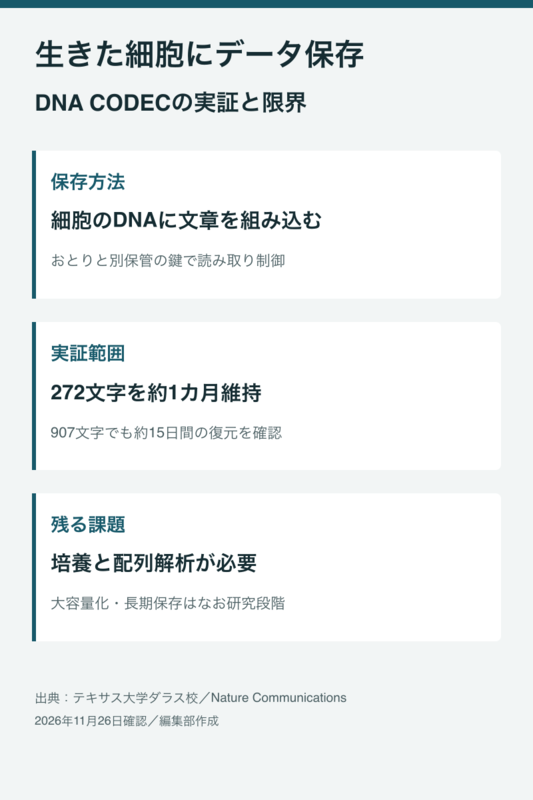
This technology involves converting information, such as text, into DNA base sequences, then reading and restoring it later. Unlike methods that store synthetic DNA in test tubes, DNA CODEC integrates information into the genome of cultured human cells. It utilizes a mechanism where the stored information is also replicated when the cells divide.
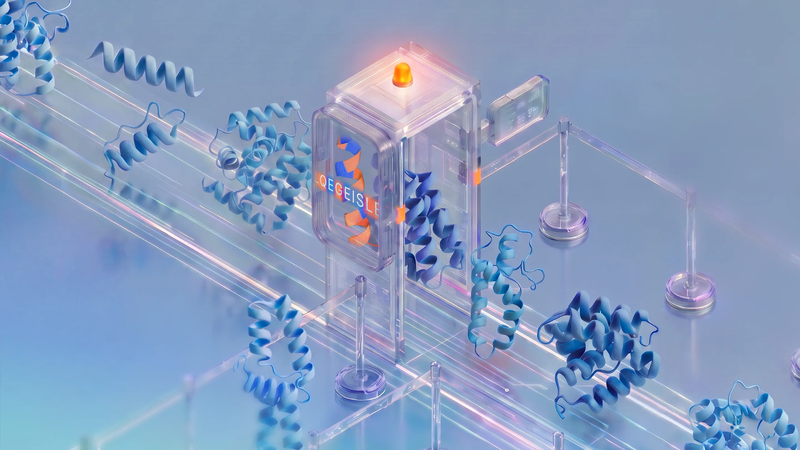
The novelty of this research lies in combining storage using multiple cell populations with readout control via "decoys." Cells containing decoy sequences that closely resemble the actual data are mixed in, making it difficult to distinguish the real information by simply reading the DNA alone. Authorized readers use the sequences of a separately stored "key" cell population and a conversion table to subtract the decoy information and restore the original text.
The research team successfully stored 272 characters in human-derived cultured cells and was able to restore them for approximately one month. In an experiment storing 907 characters, restoration was confirmed for approximately 15 days. However, as the length of the text increases, the amount of sequence readout required also increases, and combining large-capacity storage with error correction mechanisms remains a challenge.
Potential applications include embedding origin and modification history directly into cells used in pharmaceutical manufacturing or cell therapy. However, as reading and writing currently require laboratory procedures and sequence analysis, it will likely take considerable time before this becomes a common storage method.
Made with AI