SoftBank, in collaboration with Susami Town, Wakayama Prefecture, conducted demonstrations on June 29, September 10, and November 11, for technology that utilizes digital twins to remotely perform emergency risk assessments of damaged buildings. As part of the Ministry of Land, Infrastructure, Transport and Tourism's "Smart City Implementation Support Project," the verification was carried out in an area where damage from a Nankai Trough mega-earthquake is anticipated. The targets for the demonstration were the school building and gymnasium of the former Esumi Elementary School, which serves as a disaster prevention base and evacuation shelter in Susami Town.
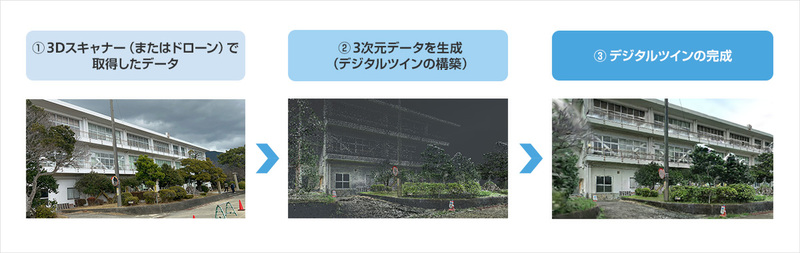
During the demonstration, after simulating cracks in pillars and walls, and building tilting, the structures were converted into 3D data using handheld 3D scanners and drones flying automated routes, then reconstructed as digital twins. Emergency risk assessors confirmed and evaluated the extent of damage and building deformation from a remote location, verifying that all necessary assessment items for reinforced concrete buildings could be checked remotely. The assessment items included overall building subsidence and tilting, damage to pillars, walls, and stairs, and the risk of equipment and finishing materials falling or toppling.
Furthermore, during the "FY2026 Susami Roadside Station Disaster Prevention ICT Drill" held on November 11, the Susami Smart City Promotion Consortium collaborated with local organizations and companies to conduct remote assessment training. Based on the assessment results assumed in the drill, an operation was also confirmed where a disaster prevention drone equipped with a speaker provided voice guidance on whether entry to buildings was permitted. Going forward, the plan is to promote rapid data acquisition after a disaster and the preparation of 3D data during normal times, with an eye towards future automatic assessment by AI and integration with related solutions such as SoraBase.
SoftBank aims to contribute to strengthening local governments' disaster prevention capabilities and building disaster-resilient communities by reducing the burden of on-site surveys, accelerating disaster response, and improving safety. This demonstration highlighted the potential for digital twins to complement on-site verification during disasters and contribute to the efficiency of emergency risk assessments.