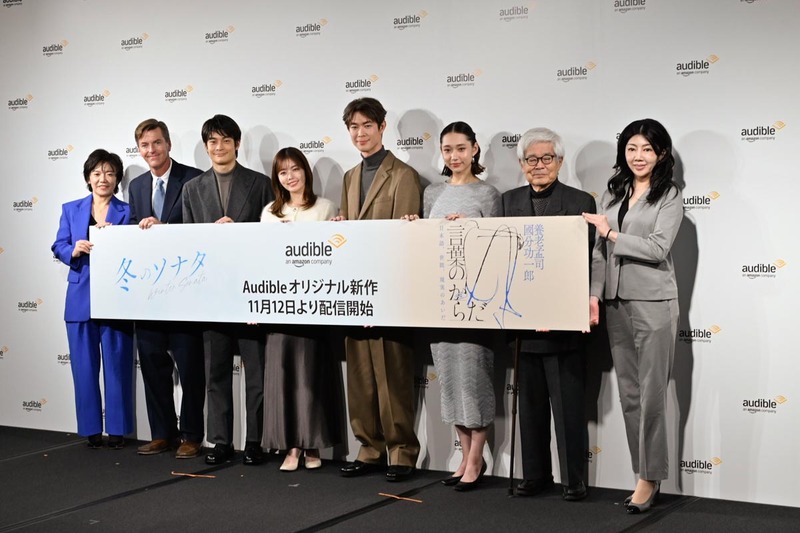
On November 12, the "Audible Original New Releases Presentation" was held at Amazon's new office in Azabudai Hills. US-based Audible, an Amazon subsidiary, operates one of the world's largest audiobook distribution services and is also engaged in producing original audio content.
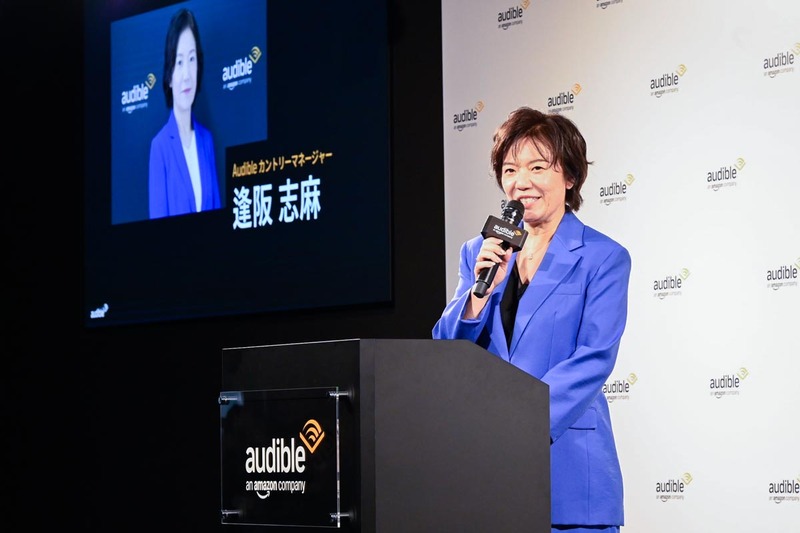
At the beginning of the presentation, Audible Country Manager Shima Osaka took the stage. She outlined the content strategy, established in May this year, focusing on "pioneering new genres" and "expanding the lineup to meet listener demand," before introducing two new works that began streaming that day: Winter Sonata and Kotoba no Karada: Nihongo, Seken, Genjitsu no Aida (The Body of Language: Between Japanese, Society, and Reality).
The audio drama Winter Sonata is the third installment in the "Classic K-Drama Series," which launched in 2026. It will consist of 20 episodes, with three episodes released every Thursday. Audible positions it as "a symbolic work for the first year of our entry into Korean content."
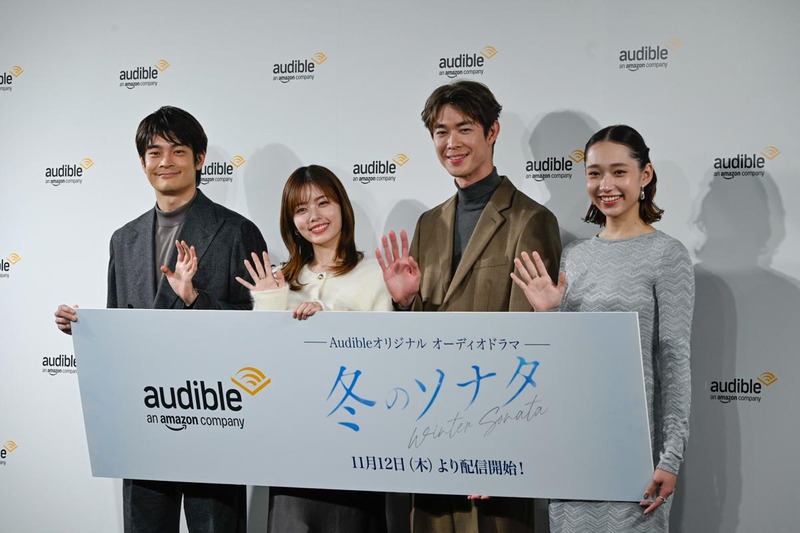
This masterpiece, which became a social phenomenon across Japan in the 2000s, is revived with a multi-cast of talented actors: Fuka Koshiba, Hio Miyazawa, Kai Inowaki, and Ayana Shiramoto. Furthermore, SEVENTEEN's JEONGHAN will perform the insert song "My Memory (Japanese Version)" in Japanese, which will be pre-released in Episode 3, streaming on the same day, ahead of the general soundtrack release on November 26.
The other title, Kotoba no Karada: Nihongo, Seken, Genjitsu no Aida, features a dialogue about "language" between anatomist Takeshi Yoro and philosopher Koichiro Kokubun, narrated by Hisazo Ebizuka and Tomohiro Inoue. This "audio-first work," written by leading authors in collaboration with publishers and released first in audio format, marks the 37th title in Audible's Japanese expansion.
In addition, a real-world initiative to expand the listening experience, the limited-time listening event "Audible STORY HOUSE," was introduced. It will be held from November 27 to December 6 at UPLIGHT COFFEE in Shibuya (2-23-16 Shibuya, Shibuya-ku, Tokyo 150-0002).
This initiative, which has been deployed in the US (e.g., New York) as a temporary bookstore without physical books, allows visitors to easily enjoy various audiobooks using large "story tiles" containing work information.
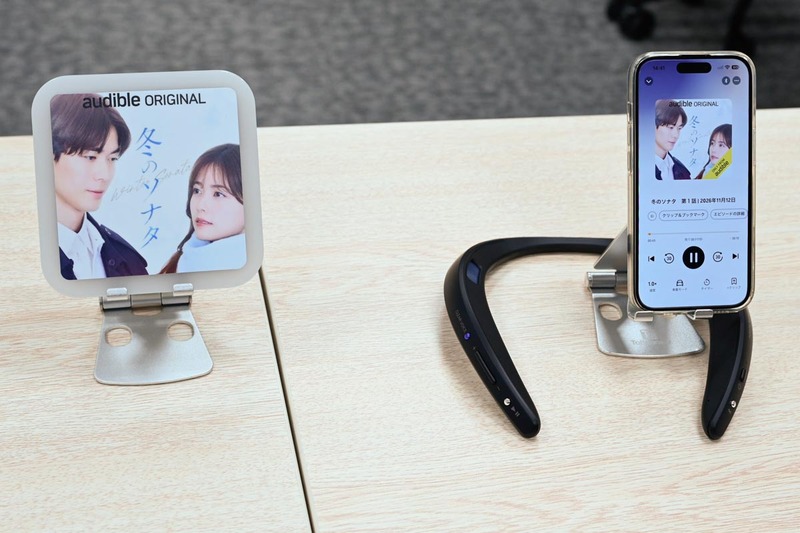
At Audible STORY HOUSE, you can enjoy a listening experience using story tiles.

First, answer questions about yourself using the installed app to receive recommendations for Audible titles.
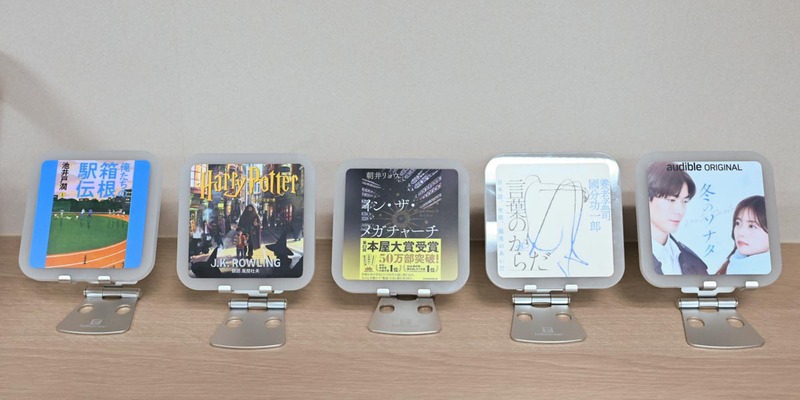
This system allows you to find recommended story titles, enjoy a listening experience, and easily access the recorded works.

Touch a story tile with a smartphone placed there.
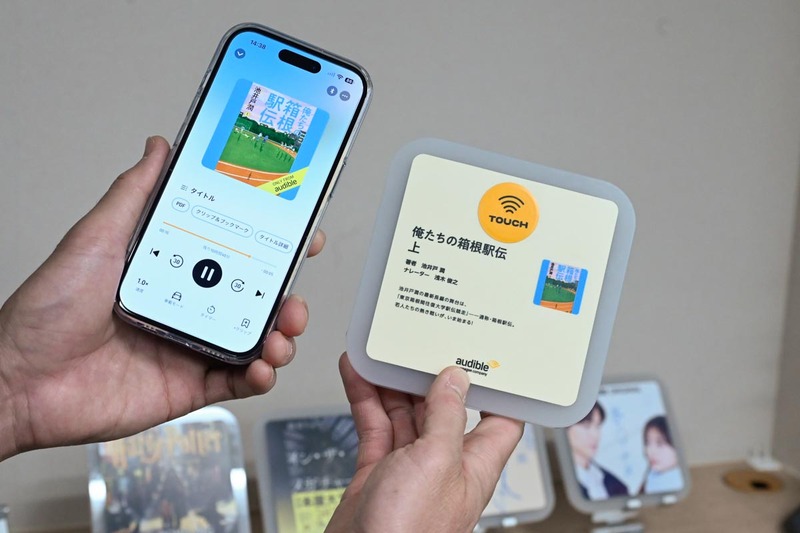
You can easily display the desired content.
Promoting Screen Detox and Digital Fatigue Reduction Through Audio Reading; Japan Sees a Rise in "Listen-and-Read Cycle"
Matthew Thornton, Head of Global Corporate Affairs, presented the latest trends for Audible, which currently operates in 225 countries and regions worldwide.
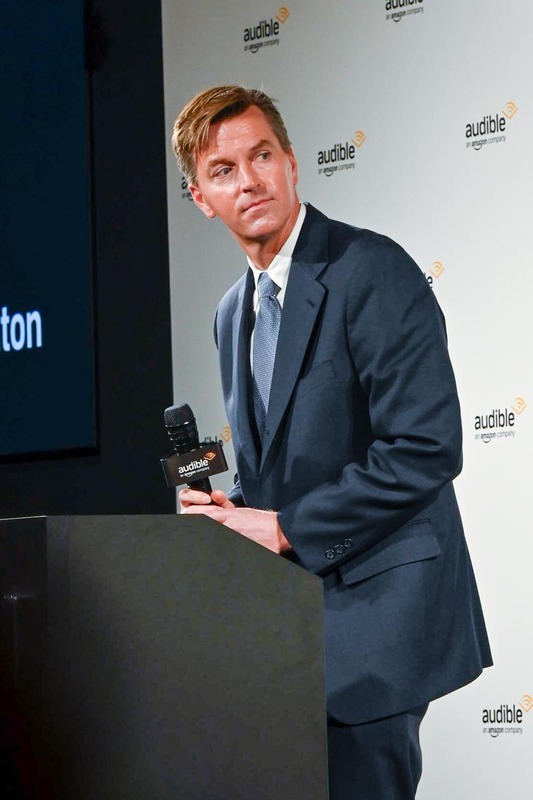
Audible conducts an annual global listening trends survey, and this year, in collaboration with research firm NielsenIQ, it carried out its largest-ever survey in August, targeting approximately 18,000 people across 11 countries.
According to Thornton, about 34% of listeners in the 11 surveyed countries—roughly one in three—reported listening to more audio content than the previous year. Particularly noteworthy is the change in daily habits: approximately 51% of respondents stated that "listening to audio allowed them to consciously step away from screen-based entertainment like smartphones and TVs."
This highlights the current trend of audio content becoming established as a means to alleviate digital fatigue and promote relaxation.
Furthermore, Thornton emphasized the synergistic effect of "listening and reading." He noted that reading habits are expanding through the practice of switching between formats—listening to an audiobook and then rereading it in print or as an e-book, or conversely, re-experiencing a finished book in audio format.
This trend is particularly pronounced in the Japanese market. Over 60% of Japanese audiobook listeners have experienced both "listening before reading" and "reading before listening." Additionally, 14% of Japanese listeners reported having listened to a book they had already read five or more times in audiobook format, the highest percentage among the 11 surveyed countries.
The findings also indicated that audio is not leading to a decline in reading but rather serving as a gateway to deeper engagement with books.
Behind the Scenes of "Unwavering Love" Woven Solely by Voice: The Star-Studded Cast of *Winter Sonata* Gathers!
In the middle of the presentation, the four main cast members of the audio drama Winter Sonata—Fuka Koshiba (Yujin), Hio Miyazawa (Junsang/Min-hyung), Kai Inowaki (Sang-hyuk), and Ayana Shiramoto (Chae-rin)—appeared in winter attire inspired by the drama's world and engaged in a talk session.
Regarding her participation in the timeless masterpiece, beloved in both Japan and Korea for many years, Koshiba, who plays the heroine Yujin, reflected, "Initially, I was very happy, but there was also pressure due to it being a work loved for decades. At the same time, I was very excited about the opportunity to express it in a new audio format."
She described Yujin as "a woman with strong empathy, who possesses both kindness and strength, dedicating herself so much to others that she might break herself in the process."
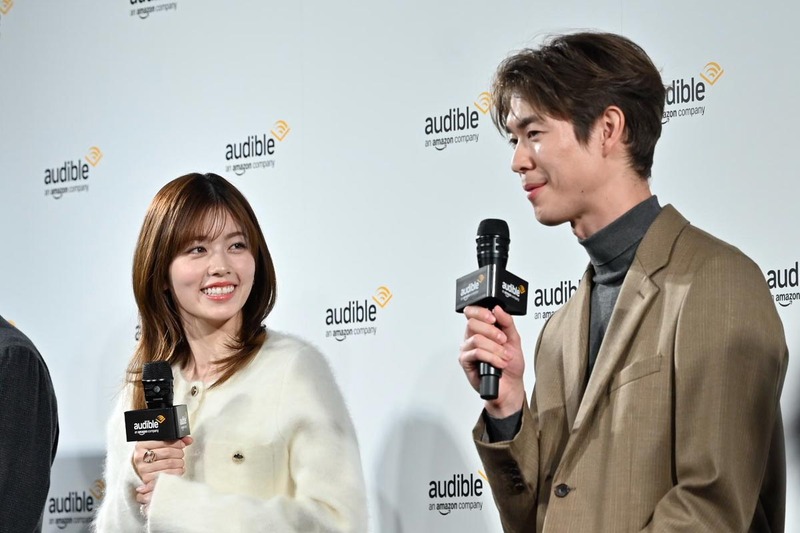
Miyazawa, who was 8 years old when the original drama first aired in Japan, recalled, "I vividly remember the scene of the entire country, including my parents' generation, being swept up in the 'Winter Sonata' boom. The fact that K-dramas are still loved in Japan today is thanks to this work." He thus alluded to the power of the drama.
Miyazawa revealed his secret to playing the dual roles of the quiet high school student Junsang and the sociable Min-hyung, stating that he had numerous remote meetings with the director. "Since their fundamental humanity is the same, I didn't consciously try to change my voice. Instead, by purely focusing my emotions on each scene, a natural transformation occurred."
Inowaki, who plays Sang-hyuk, Yujin's childhood friend who harbors unwavering love for her, described his character as "an 'emotional rollercoaster' who goes out of control due to his overly deep love." He playfully added, "While thinking of Hio-kun, who I've been good friends with for a long time, I acted with irritation during recording (laughs)," drawing laughter from the audience.
Shiramoto, who plays Chae-rin, the romantic rival, revealed her deep affection for the character: "At first glance, she seems like a 'love rival,' but she's a very human woman whose emotional nuances and fluctuations are more apparent than anyone else's. I played her with the thought that at least I wanted to embrace Chae-rin."
During the talk, audio from the transfer student scene in Episode 1 and the famous scene in Episode 10 where Min-hyung likens Yujin to Polaris and pledges his love was unveiled for the first time at the venue. The cast members also heard the completed version for the first time there. Koshiba smiled and said, "Since we couldn't rely on gaze or movement like in video, it was challenging to convey emotions solely through breathing and timing. The director told me, 'Perform monologues as real acting, not narration,' and I was worried if the distinction between dialogue and inner thoughts would be clear, but hearing it now, I'm relieved that it comes across well."
Miyazawa mentioned that unlike his previous solo readings of Haruki Murakami's works, his emotions naturally heightened by reacting to his co-stars' voices. Inowaki reflected, "In just two days of recording, I rushed through decades of life." Shiramoto stated, "Normally, I'm supported by many staff members for costumes and lighting, so expressing solely through voice was a valuable experience." Furthermore, a video message from SEVENTEEN's JEONGHAN, who sings the insert song "My Memory," was also screened.
Finally, Koshiba concluded the lively session by encouraging everyone to "experience their own Winter Sonata, which can be enjoyed solely by ear even during busy times like commutes."
Takeshi Yoro, Turning 89, Comments on the "Weight of Language" in the Age of Generative AI
In the subsequent second part of the talk session, Takeshi Yoro and Motomi Keeling-Miyagawa, Head of Content Japan at Audible, took the stage.
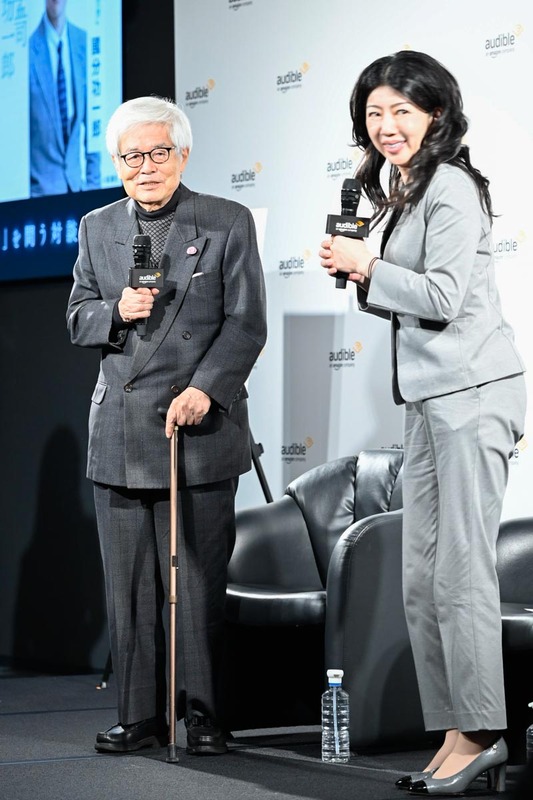
Keeling-Miyagawa explained the background of the project as a new challenge with Yoro, with whom Audible had previously collaborated on best-selling audiobooks and original podcasts. She stated, "Precisely because words are overflowing due to social media and generative AI today, we wanted listeners to experience the very thought process of a dialogue on 'what language is' through audio."
In response, Yoro, who had just celebrated his 89th birthday on November 11, began to speak with unique humor about his long-held questions regarding "language" since his youth.
Yoro reminisced about his childhood, when he lost his father before the age of five and lived with just his mother. He commented, "In those days, children were scolded for 'chattering too much,' and whenever guests came, my mother would speak on my behalf, saying, 'This child thinks this way,' so I thought it was fine to just stay silent." Even as a university student, he was so taciturn that his classmates later expressed surprise, asking, "Are you giving a lecture?"
"Now, even toddlers, let alone elementary school students, speak surprisingly fluently. Precisely because the volume and weight of words in society are expanding, I wanted to know how a philosopher (Koichiro Kokubun), who only has words as a tool, thinks about language," he explained his motivation for the dialogue.
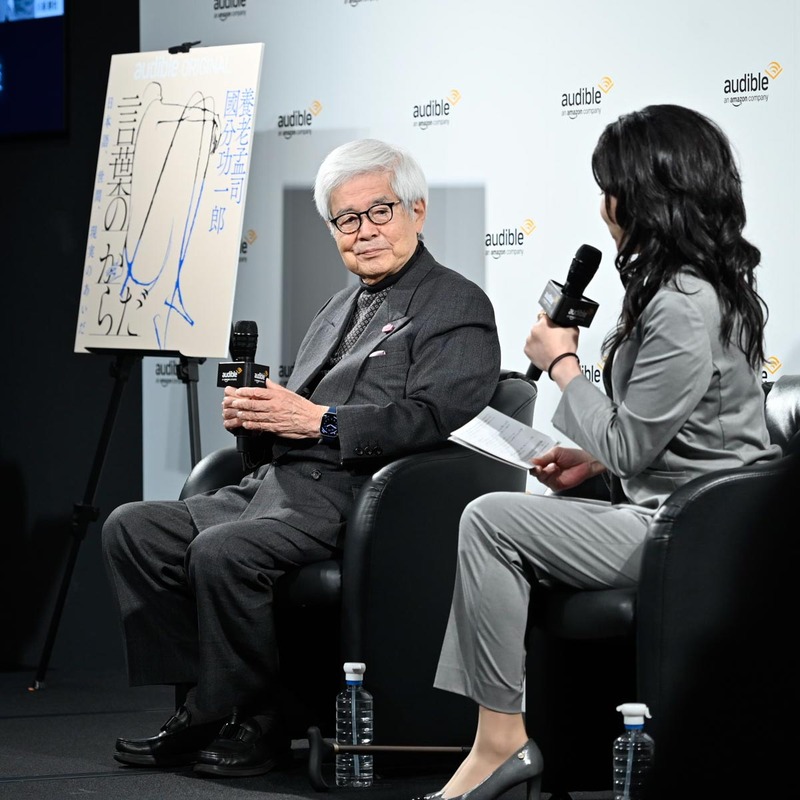
During the session, the topic of "generative AI's language," also touched upon in the work, was discussed.
Yoro stated that in terms of how "modern language" is handled, many people are simply "driving" pre-existing words, and that much of the language generated by AI and prevalent in society reflects this.
In the dialogue, it was pointed out that "the information generated by AI has no grounding, no roots in language. While science starts from reality and lands on words, current AI creates words from words." Yoro drew parallels from his own fields of anatomy and insect collecting, explaining, "There are 'actual things' first—unnamed insects, or unknown cells like T cells and B cells that didn't have names when I was a student—and only when their roles are understood do they get names. The moment a name is given, that object enters the human world."
The act of naming is recognizing an object as information. Yoro's position is that "driving language" is "information processing," not "informatization."
Yoro's quiet words, "The world doesn't move just as you speak," underscored the importance of reclaiming language through one's own body and reality in an age where information and AI threaten to overwhelm reality.