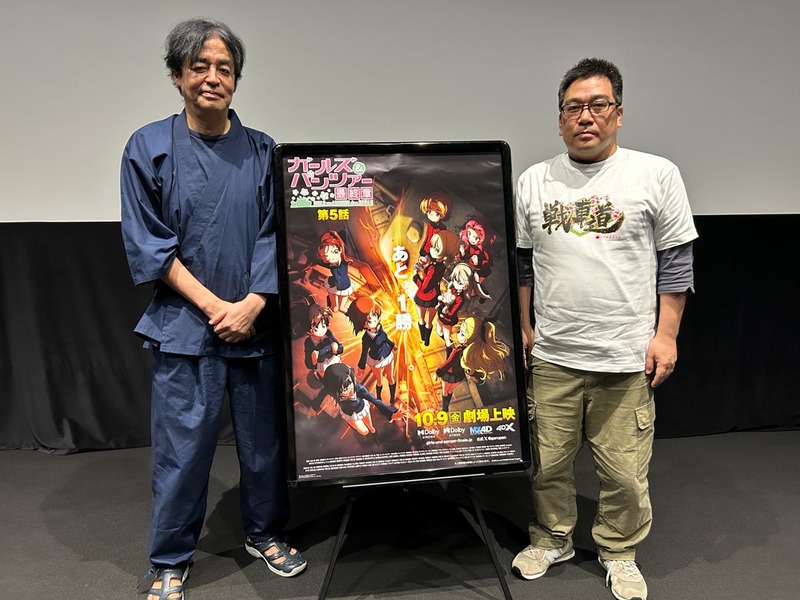
"Girls und Panzer das Finale Episode 5" was released on October 9, 2026. In addition to standard screenings, this film marks the series' first-ever Dolby Cinema release. Including Dolby Atmos, 4DX, and MX4D, a total of five different formats were available from opening day.

"Girls und Panzer das Finale Episode 5" released on Friday, October 9. Distributed by Showgate
In recent years, the number of animated feature films screened in large formats has been on the rise. However, it's rare for a work, even among international live-action films, to offer such a diverse range of formats at its release. I myself have been eagerly anticipating the final product since the information was first announced.
Dolby Cinema allows viewers to simultaneously enjoy the object-based, three-dimensional sound of Dolby Atmos and the wide dynamic range, high-definition visuals of Dolby Vision. I was very curious to see how the details of the tanks, the flashes of explosions and sparks, and the powerful bass would be expressed in the theater.
In a sense, "Girls und Panzer das Finale Episode 5" can be described as a work that condenses the joy of watching Garupan in a theater. So, how did it actually turn out? A preview screening with a Q&A session, offering a glimpse into its appeal, was held at Imagica's Second Screening Room just before the public release. The speakers were sound director Miwa Iwanami and senior supervisor/colorist Mitsuhiro Shoji.
Here, we will introduce the behind-the-scenes production, including the appeal of Dolby Cinema's visuals and sound discussed at the preview, and the trial-and-error creators went through to leverage the format.
A Surprisingly Easy-to-Watch and Listen-to Audio-Visual Experience, Despite Being Rich in Information and Impact
First, let's talk about the impression of the Dolby Cinema version of "Girls und Panzer das Finale Episode 5." From the beginning of the film, I was struck by the beauty of the visuals, with fine lines and intricate details. Even in the everyday scenes in the first half, the focus was sharp, and the meticulously drawn character depictions were impressive. Also, in key moments, such as the texture of metal and highlights on waves, I could feel the rich expression characteristic of HDR (High Dynamic Range).
These meticulously drawn visuals boast extremely high resolution, offering a clarity as if my eyesight had improved. I could grasp the minute elements on screen, and every corner of the scene flowed smoothly into my mind, providing a refreshing sensation.

©GIRLS und PANZER Finale Projekt
Another strength is the harmony of dialogue, music, and sound effects. In the everyday scenes, the balance between the background music and the characters' voices was exquisite, naturally organized and easy to hear without interfering with each other. Action scenes were a contrast, but here, the familiar heavy bass and power of Garupan were palpable. The soundscape, with various sound effects flying around, contained an enormous amount of information, yet each sound was well-organized and perfectly synchronized with the visuals and direction. Perhaps because of this, despite watching intense scenes, it felt surprisingly effortless.
When it comes to large formats, some works are packed with information to the point of being like a spec demo. This often leads to fatigue, but for this film, I experienced a Garupan that was easier to watch and listen to than ever before.
Despite the incredible amount of information, the situation was easy to grasp, and dialogue flowed smoothly into my mind. This allowed me to clear my head and immerse myself in the story itself. That's the kind of appeal I felt the film possessed.
Ultimately, Human Eyes Take Responsibility, Even for Frame-by-Frame Adjustments
Listening to the Q&A session, I realized that this clarity and ease of understanding were achieved through the creators' meticulous attention to detail.
Simply put, it was the HDR visuals, thoroughly refined through trial and error, with an awareness of the intended visuals and sound, highlighting what needed to stand out. And the "subtractive sound design" that clearly conveyed the directorial intent even in chaotic situations. These two points were the essence that made the Dolby Cinema version of "Girls und Panzer das Finale Episode 5" such a magnificent achievement.

Shoji-san first explained Dolby Vision, which supports Dolby Cinema's visuals. A major feature he highlighted was its ability to reproduce "black."
In typical movie theaters, even in completely dark scenes, a faint light can be perceived, preventing a true black. Shoji-san stated that this ability to achieve "complete darkness" is "something truly wonderful and important for us engineers."
Shoji: "When I watch a film in a theater after creating it, I inevitably become aware of the black appearing to float. Although we make adjustments to prevent this, it's something that concerns us engineers. In Dolby Cinema, the wonderful thing is that 0% black is truly 0% black, allowing details in dark areas to be seen clearly without being lost."

©GIRLS und PANZER Finale Projekt
Another point Shoji-san raised was the overwhelming brightness and color.
Dolby Vision adopts HDR (High Dynamic Range), a method that clearly expresses the contrast between light and dark in visuals, enabling extremely bright images and brilliant textures. Shoji-san described this as "whites exceeding 100%." Simultaneously, the range of reproducible colors, their vividness, and the color gamut expand. As a result, it becomes possible to create dramatic images and expressions that enhance immersion, broadening the scope of directorial expression.
According to Shoji-san, Garupan's Dolby Vision visuals were achieved through AI-powered 4K upconversion and high dynamic range processing. However, AI processing alone can potentially lead to unintended changes in detail. Therefore, the task of meticulously checking each cut with human eyes is essential. "Ultimately, we finish it to the correct form with human eyes." This painstaking work supports the quality of the visuals.
In the production of the Dolby Cinema version of "Girls und Panzer das Finale Episode 5," the know-how gained from the already packaged "Girls und Panzer the Movie 10th Anniversary 4K ULTRA HD Blu-ray" was utilized.
Shoji: "During the 4K conversion of the movie version, Director Tsutomu Mizushima requested, 'I want the cannon fire to be spectacular,' but 'I don't want to change the colors of the characters or tanks too much.' Making things brighter can sometimes change character colors, so we considered how to incorporate his intentions while showing the differences from the standard version. What he ultimately requested for the movie version was, 'Please make the inside of the tanks brighter.' (For this film), we followed these interactions from the movie version, proceeding by having him point out areas of concern."
Nevertheless, the adjustments after the Tankery match began were all challenging. The task of enhancing visual quality awaited them, requiring close attention to minute details: how to showcase the intricate details of the tanks, how bright to make them, and whether making them brighter would cause any problems.
©GIRLS und PANZER Finale Projekt
Garupan features a continuous series of powerful action scenes, such as gunfire and explosions, but it's not enough to apply the same tuning just because they are connected scenes. Fine adjustments are required, cut by cut, and even frame by frame. For example, within the flow of the same scene, if something is only lit in certain cuts, it's necessary to cut that scene, apply a different profile to brighten only that part, and then revert once it's gone. This required long and painstaking work.
Shoji: "To create a sense of realism, I tracked the shells and applied effects I created myself. There are scenes where the brightness of the shells is changed frame by frame. It's easy to place bright objects in dark areas, but this time there are also daytime combat scenes, so we had to make the shells appear bright while maintaining the overall brightness of the scene."
If Atmos Makes It Audible, Then the Visuals Must Follow
What was particularly interesting in Shoji-san's talk was the point that HDR conversion of visuals for Dolby Cinema must deeply consider its interplay with sound.
Shoji: "I've had many opportunities to convert various works to HDR and listen to their Dolby Atmos sound, and in most cases, 'unknown sounds' that weren't audible when played in 2ch or 5.1ch would emerge. Having experienced this, I anticipated that Garupan would definitely have many unknown sounds. So, I repeatedly made adjustments with a certain sense of fear, thinking, 'Even the slightest spark, if it's there, must be made prominent,' or 'Otherwise, the visuals will be overshadowed by the Dolby Atmos sound.'"
This means that even if there was only a tiny spark on screen, or if it wasn't visible at all, if the sound clearly conveyed its presence, then that spark had to be made brighter and more prominent on screen to maintain balance.

©GIRLS und PANZER Finale Projekt
Furthermore, distant objects naturally appear less prominent on screen due to atmospheric perspective, but if their sound is audible, they must be made recognizable. Otherwise, it would look like only the sound is playing without a corresponding visual.
Shoji-san's studio, where the Dolby Vision conversion was performed, lacked an environment for listening in Dolby Atmos. He had to compensate for this through imagination, experimenting with "how bright is too bright." Based on this process, he pushed the brightness "to the absolute limit." He believed that only by doing so could the visuals compete with the sound, and that's how he approached the production of this film.
Shoji-san describes the visuals of Garupan as having the following characteristics:
Shoji: "In Garupan, even if you brighten it, details don't get lost; on the contrary, raising the brightness can bring out details. We created the visuals imagining 'what kind of picture won't be overshadowed by the sound' in scenes like inside the tanks, shell fragments, or attacks happening far behind a bridge."
Achieving this requires working backward from the directorial intent. What do they want to show in this scene? To that end, which parts of the screen should be brightened, and which darkened? What should be emphasized is crucial.
Subtractive Sound Design: Narrowing Down Sounds to Clarify What Should Be Heard
Following "das Finale Episode 4," Miwa Iwanami, who handled the Dolby Atmos sound, spoke about the sound design for "Girls und Panzer das Finale Episode 5" as follows:
Iwanami: "From a sound perspective, this film has a lot of metallic sounds, but to avoid sound inflation, a 'subtractive' process was necessary: 'which sounds to let be heard, and which sounds to include.' Mr. Koyama from effects worked very hard. We set our aim on what we wanted to show in that particular cut, discarded what was unnecessary, and highlighted what was essential."
This involves supplementing the information of what the cut aims for and what they want viewers to see, with sound.
Iwanami: "This becomes even clearer in a Dolby Atmos environment, and the separation of sounds itself is excellent. The directorial intent becomes more distinct, making it easier to get into the story and leading to an immersive experience. I believe we've achieved such a sound design."
©GIRLS und PANZER Finale Projekt
In "das Finale Episode 4," a sense of "speed" with sounds moving freely through space was one direction, where the complex movements of tank positions became clear through sound, also serving to aid visual comprehension. In Episode 5 (though details cannot be fully disclosed), a battle unfolds with complex tank movements intertwining within a limited space. How to express this "narrow space" through sound became crucial.
This, of course, required meticulous adjustments. Still, Iwanami-san said, "It was tough, but this is what I wanted to do."

©GIRLS und PANZER Finale Projekt
Iwanami-san was shocked by the Dolby Atmos sound in the 2012 film (2013 in Japan) "Gravity," realizing that Japan was 10 years behind Hollywood. He was eager to "create in this format myself." He explained this by saying, "It's like a racing driver wanting to drive in F1; as an engineer, you naturally want to create sound in the best possible format."
However, that dream didn't come true immediately.
Later, "Girls und Panzer the Movie" became a big topic with screenings like Tachikawa Cinema City's "Gokujo Bakoon Joei" (Extreme Roaring Sound Screening), creating a movement of people going to cinemas "to listen to the sound." Iwanami-san traveled to cinemas across Japan for sound adjustments, even achieving real-time upmix 9.1ch screenings at AEON CINEMA Makuhari, which served as a precursor to Atmos.
"Garupan das Finale" initially screened in 5.1ch, followed by 7.1ch a few weeks later. Afterward, Iwanami-san was involved in the production of the Dolby Atmos version of Garupan, concurrently with "BLAME!," which became Japan's first Dolby Atmos production.
Through the accumulation of these activities, his 13-year aspiration was fulfilled. "Girls und Panzer das Finale Episode 5" could be screened in various large formats from its opening day. He expressed "deep emotion" regarding this.
Incidentally, for Garupan, the Dolby Atmos sound source for Dolby Cinema was created exclusively for theaters, and a separate sound source is produced for streaming and other uses. This means that this particular sound can only be enjoyed during theatrical screenings.
Sound design with a wide dynamic range, conceived with theatrical playback in mind, is a major appeal of this work, alongside its visuals and action.
Recently, even in Hollywood films, with the exception of works by some highly artistic directors, there's a growing trend towards sound design that doesn't utilize too wide a dynamic range. This is because the center of gravity for films is shifting towards streaming.
In Garupan's case, a streaming-compatible format is created separately from the theatrical one, which conversely means there's a sound experience that can only be had in a movie theater.
However, the number of Dolby Cinema screens is limited, and the number of works produced for Dolby Cinema is also increasing. Re-screenings of Dolby Cinema works are almost never done; moreover, there's a current situation where screening slots themselves are narrowed down early on. This means opportunities to get a premium Dolby Cinema-like experience are limited. Garupan is no exception. It will be important to visit the theater immediately after its release and experience as much as possible.
A Film You Absolutely Must See in Theaters
Since the theatrical release in November 2015, Garupan has been a series that has not only highlighted the enjoyment of its visuals and story but also prominently featured "the joy of listening to sound unique to movie theaters" as part of its appeal. It has conveyed the potential of theaters, offered the pleasure of watching the work multiple times in different formats, and provided opportunities to experience the "sound experience" that changes with different theaters.
Today, the existence of theaters with special sound systems, such as Tachikawa Cinema City's Bakoon Joei (Roaring Sound Screening) and Gokuon Joei (Extreme Sound Screening), is widely recognized, but this series was the driving force behind popularizing "the appeal of enjoying films in theaters and appreciating the differences in sound." It fostered a new culture of going to theaters to listen to sound and repeating visits to enjoy the unique characteristics of different theaters.
It is precisely because of this history that the release of "das Finale Episode 5" in various large formats, including Dolby Cinema, from the very beginning, holds special significance.
During the Q&A, Shoji-san also commented that the vastly increased color palette available through Dolby Vision is extremely appealing from a colorist's perspective. He suggested that there's potential for more creative use of color for directorial expression.
Furthermore, Iwanami-san cited "2001: A Space Odyssey," which was made with 70mm film and digital sound and is still compatible with the latest formats, to discuss the archival value of creating works in the high-spec formats of their respective eras. Since Garupan possesses three-dimensional sound information, if something like VR were to be attempted, the sound would follow the viewer's posture.
He emphasized that creating with the best technical formats is crucial for looking towards the future.
"Girls und Panzer das Finale Episode 5" is thus packed with elements that pique the interest of enthusiasts. Nevertheless, even without knowing all this, the quality of the film as entertainment is truly superb. It's certain that a wonderful experience is promised not only to those familiar with Garupan but to anyone, even first-time viewers.
Its appeal should absolutely be savored in high-standard theaters, including Dolby Cinema. I want to visit the theater multiple times to fully appreciate the film, including the differences between the Dolby Cinema version and the standard version.

©GIRLS und PANZER Finale Projekt
©GIRLS und PANZER Finale Projekt

©GIRLS und PANZER Finale Projekt