
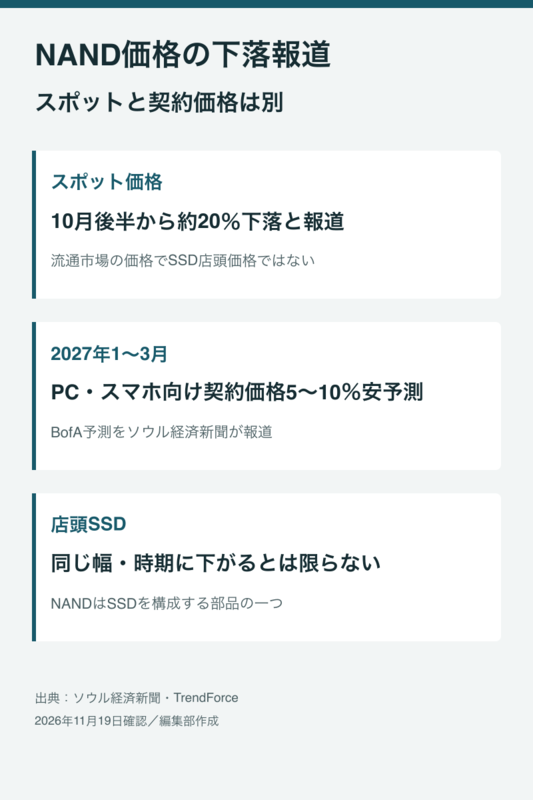
Some NAND flash, a key component of SSDs that has seen continuous price increases, has begun to show signs of price decline. On November 17, South Korea's Seoul Economic Daily reported that transaction prices for NAND flash, the semiconductor used in SSDs and smartphones, have fallen by approximately 20% since late October. This report cited a research report from Bank of America, and research firm TrendForce has also reported similar price declines.
NAND flash is a semiconductor used for data storage in devices like SSDs. The decline was primarily in spot prices for general-purpose NAND flash, mainly for PCs and smartphones, traded short-term between vendors. The price of 512-gigabit products fell to $14.30, a 32% drop from the previous quarter, while 1-terabit products also declined to $24.90, a 19% decrease.
Behind this trend is sluggish sales of PCs and smartphones. As component prices, including memory, have risen, product prices have increased, leading to a widespread trend of consumers delaying replacements. Manufacturers are also reducing component orders and limiting product storage capacities, reportedly weakening NAND demand.
The expansion of market share by Chinese semiconductor manufacturer YMTC in the low-price NAND segment is also contributing to the price decline. As demand decreases, price competition among manufacturers intensifies, leading distributors to sell off inventory at lower prices.
If NAND prices continue to fall, it could potentially impact the prices of consumer SSDs. However, it's important to note that the decline is in inter-vendor transaction prices for semiconductors, and SSDs sold in stores will not necessarily become cheaper by the same percentage immediately.
Made with AI