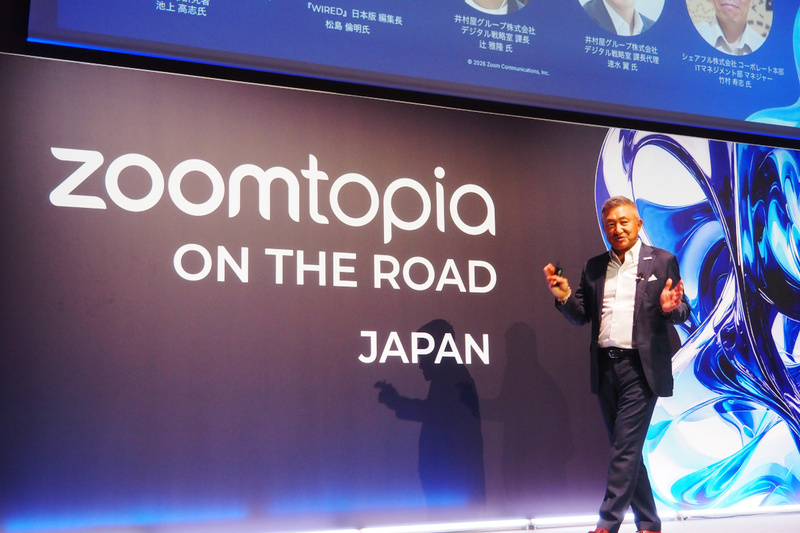

ZVC JAPAN (Zoom) held its annual conference, "Zoomtopia ON THE ROAD 2026 JAPAN," in Tokyo on November 5, 2026.
The event's main theme was "Every Conversation, Towards the Future. ~From Conversation to Completion~." With numerous guest speakers from the business, academic, and sports worlds, Zoom introduced its vision of "From Conversation to Completion," showcasing the latest AI innovations, customer adoption case studies, and product demonstrations.
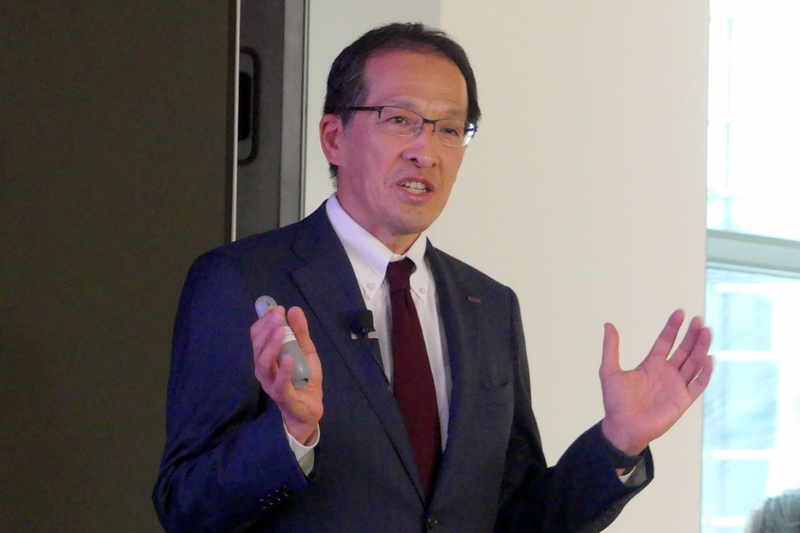
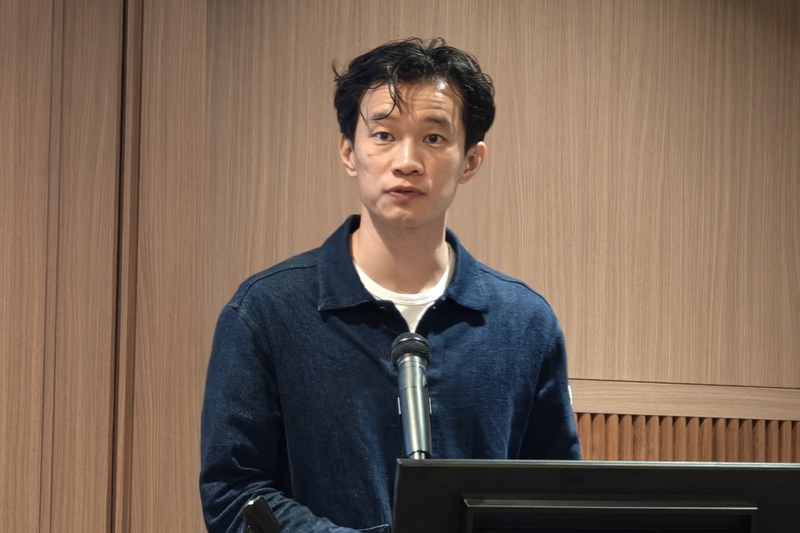
During the opening keynote, ZVC JAPAN Chairman and President Norihiro Shimogaki, along with Xuedong Huang, CTO of Zoom Communications (USA), took the stage. They explained Zoom's unique AI strategy, which centers on "conversations" to achieve highly accurate context understanding and guide tasks to completion.

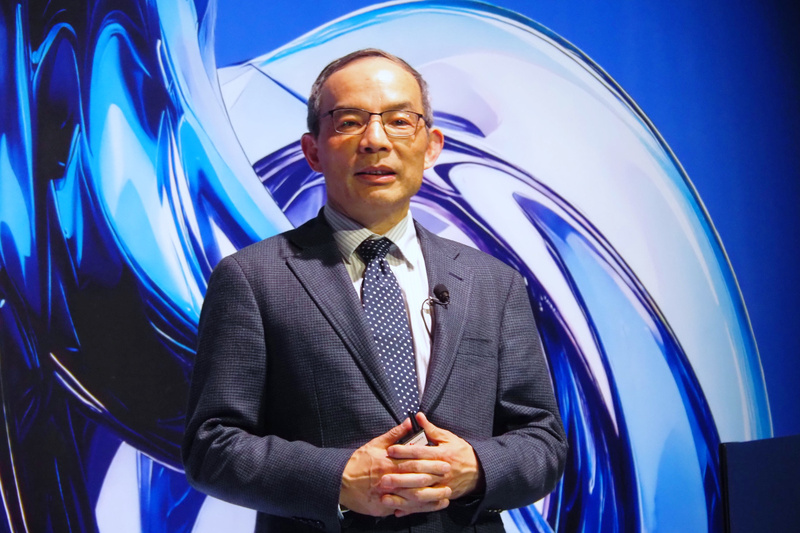
Norihiro Shimogaki, Representative Director, Chairman and President of ZVC JAPAN, and Xuedong Huang, CTO of Zoom Communications
Additionally, guest speakers included NOTA (formerly NOT A HOTEL), which develops co-owned villas, and Global Trust Networks (GTN), a company providing living support services for foreign residents in Japan. They presented how they utilize Zoom solutions in their respective businesses and the results they have achieved.
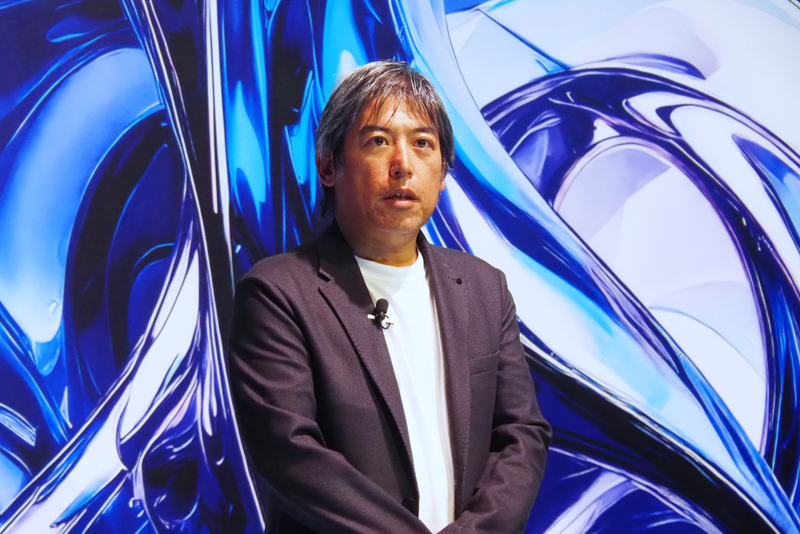
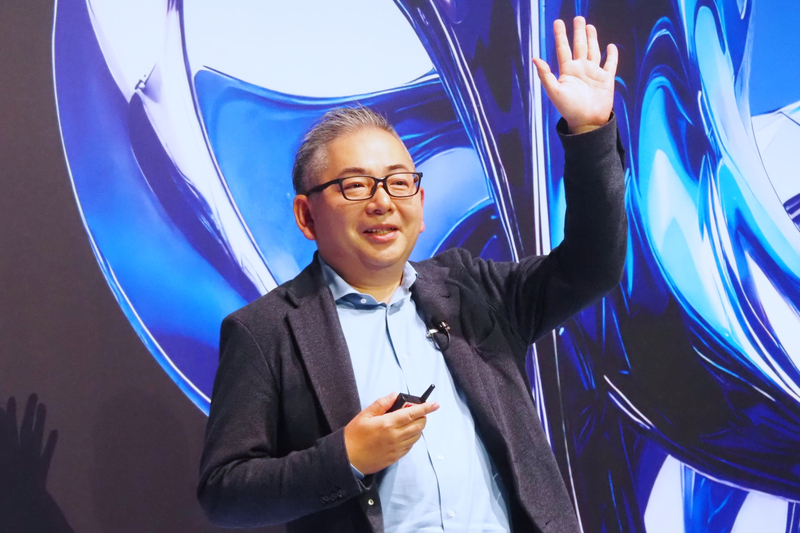
Shigechika Kajiwara, Head of Business Acceleration at NOTA, and Hiroyuki Goto, President and CEO of Global Trust Networks
Zoom: Guiding the Future of Business "From Conversations" Born from Human Connections
ZVC JAPAN Chairman and President Shimogaki explained the meaning behind the event's theme, "Every Conversation, Towards the Future."
Zoom's business primarily focuses on "connecting people" – employees, customers, and society as a whole – across various scenarios such as meetings, phone calls, chats, and contact centers. The moment people connect, conversations begin, and from these conversations, new actions and outcomes emerge.
Currently, Zoom aims to support the post-conversation phase – namely, actions and outcomes – with advanced AI technology, guiding them to a better "completion." This is the meaning of "From Conversation to Completion." And currently, Zoom is concentrating on leveraging AI to extract more value from conversations.
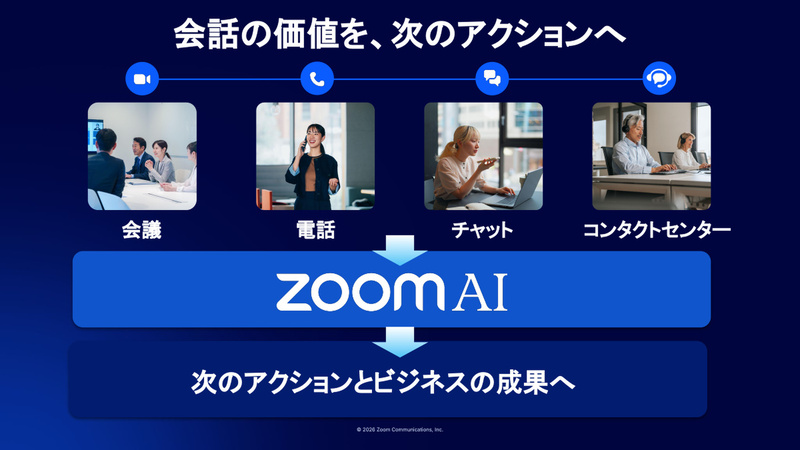
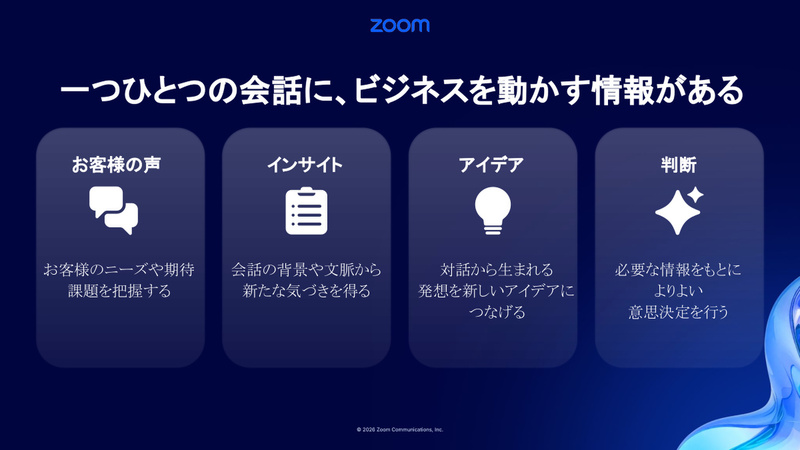
Shimogaki emphasized Zoom's advantage in integrating information from even trivial daily conversations – hints for understanding customer needs and preferences, creative business ideas, and decision-making factors – into a single platform for highly accurate AI processing.
"When we comprehensively view each individual conversation, the 'dots' of information connect. How to transparently link and utilize these for business is a theme for Zoom, and a theme for all of you," Shimogaki stated.
From "AI Teammates" to High-Precision AI APIs: The Rapidly Expanding World of Zoom AI
Xuedong Huang, CTO of Zoom, introduced the characteristics and strengths of Zoom's AI strategy.
Huang first pointed out that while companies worldwide are investing in AI, only a few are actually realizing its effects at scale. This is because AI often fails to fully utilize real-time context from meetings or corporate knowledge embedded in past conversations and documents.
Zoom's AI strategy aims to support advanced decision-making and tasks by supplementing dynamic context from conversations. On a single platform, it records meeting and phone conversations, combining them with a wide range of information including chats, emails, documents, and other knowledge to empower AI.
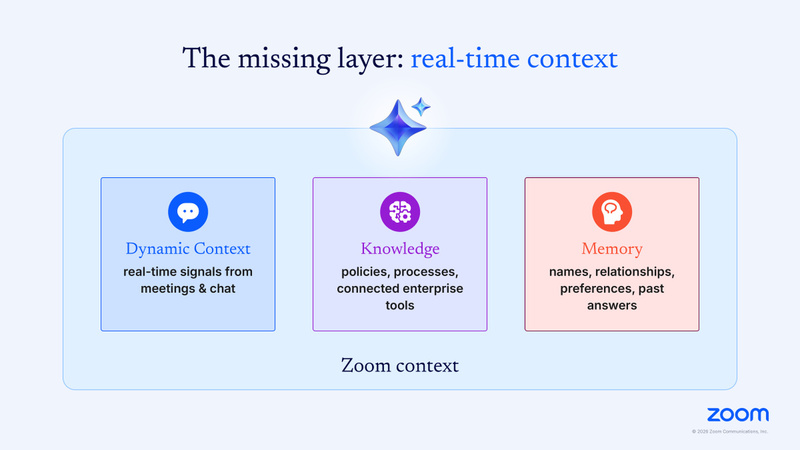
AI leverages all integrated dynamic context from conversations, knowledge from documents and other tools, and its own retained memory.
To realize this AI strategy, Zoom is continuously expanding its AI product lineup, including "Zoom My Notes" for recording and summarizing meeting content, "Zoom ZoomMate" as a dedicated "AI teammate" for users, and "Zoom Virtual Agent" for automating customer interactions via AI voice/chat.
He also introduced that the common AI platform used by all products employs a "federated AI" model, combining multiple AI models. This allows for optimal model selection, achieving, for example, No. 1 accuracy in 9 languages, including Japanese, in the HuggingFace speech-to-text benchmark test (conducted in September 2026).
This high-precision Zoom AI can also be accessed by external applications via the "Zoom AI Services (ZAS)" API, currently offering features such as transcription, summarization, decision-making, translation, and speech synthesis (some in beta). Furthermore, through integration with the open-source AI platform "Onyx," ZAS can be used in on-premise environments without exposing proprietary data externally. He revealed that NASA (National Aeronautics and Space Administration) is one such customer.
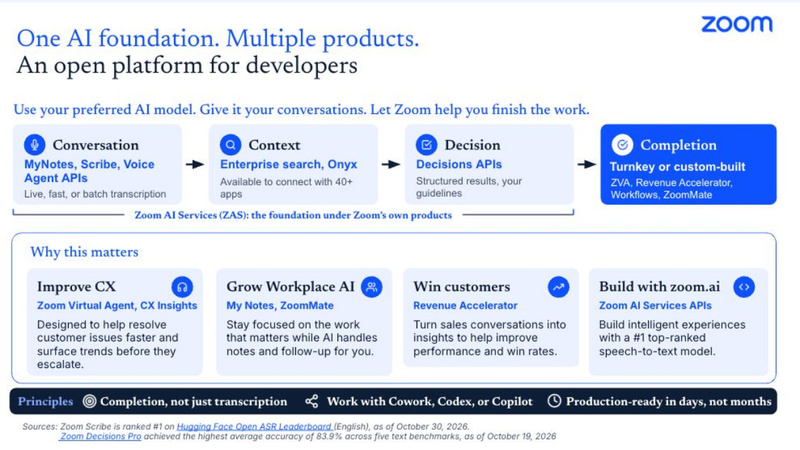
Zoom implements multiple products on a single, open AI platform. It can also be used by external applications via API.
NOTA (NOT A HOTEL): Leveraging Zoom + AI to "Multiply One Person's Productivity by 100"
Shigechika Kajiwara, Head of Business Acceleration at NOTA, introduced how the company utilizes Zoom products to drive company-wide AI adoption.
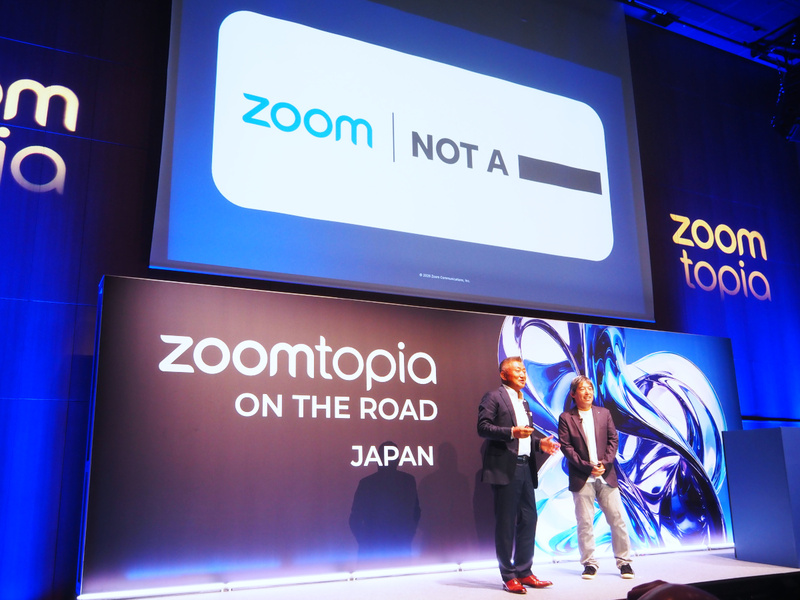
Shigechika Kajiwara, Head of Business Acceleration at NOTA (right)
NOTA is a venture that operates "NOT A HOTEL," a service offering co-owned villas designed by architects. Kajiwara explained that their mission is to "enhance Japan's value" by "transforming unknown lands into new destinations through the power of creativity" and "enabling many people to share experiences previously limited to a few."
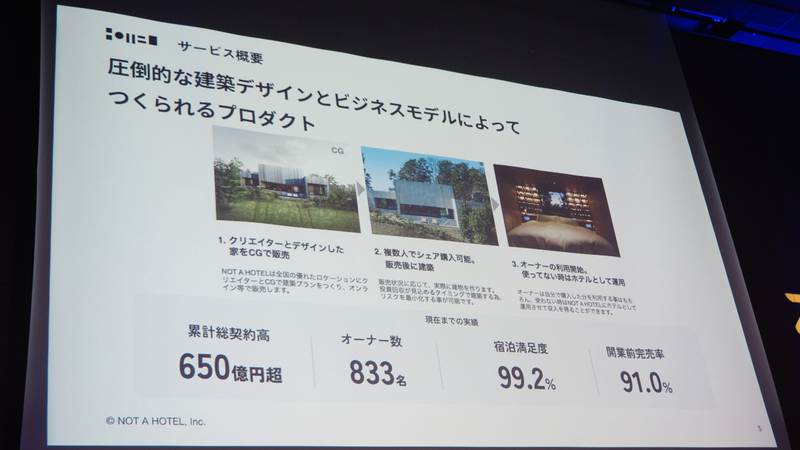
Overview of NOTA (NOT A HOTEL business) services
With the philosophy of "cherishing every customer touchpoint," the company has strived to digitize and analyze conversations at all customer interaction points. They have been using Zoom Phone since their inception and have also adopted Zoom Meetings and Zoom Revenue Accelerator. They digitize conversations with villa guests and business negotiation clients to improve service quality and sales proposal capabilities. They chose Zoom for its "stable voice quality," "rich API functionality," and "platform integration."
To flexibly utilize conversation data, they also leverage Zoom's API. All customer touchpoint "entry points" are via Zoom. Google Cloud Run extracts recording, transcription, and summary data via API, notifying key points to Slack and transcribing customer interaction records to Salesforce. Furthermore, AI automatically analyzes issues and complaints from villa guests, reporting them internally as areas for improvement.
This utilization of Zoom + AI has yielded various results. For example, business negotiation memos and Salesforce input, which previously took tens of minutes per case, are now automated, freeing up more time to focus on customers. They can also ensure reliable handover of negotiation records between inside sales and field sales, and refer to previous records during subsequent negotiations.
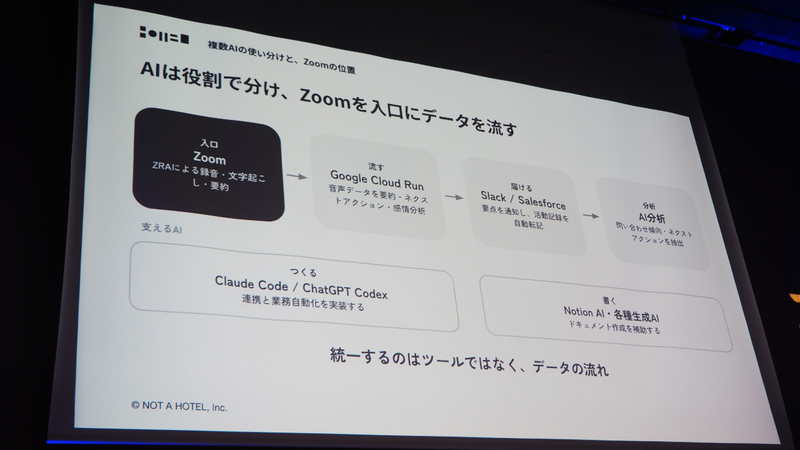
NOTA's differentiated use of multiple AIs and Zoom's positioning
NOTA operates under the slogan "Multiply one person's productivity by 100" rather than reducing staff through AI adoption, and is promoting company-wide AI utilization. For instance, the management team has dedicated AI engineers (FDEs), and various departments such as sales, operations, and development are leveraging AI to achieve results. In the information systems department, all routine tasks have been automated by AI agents, allowing a team of two information systems employees to manage an organization of over 600 employees.
In summary, Kajiwara stated that "AI utilization is not just about introducing a tool. It's about designing a structure and using AI to reform that structure." He also added that voice data, with Zoom as its entry point, will become "the main battlefield for future AI utilization," and expressed his ambition to become "the No. 1 AI company in the hospitality industry" through further AI adoption.
GTN: Enhancing Foreigner Living Support Through "Knowledge Accumulation" and "Multilingual Translation"
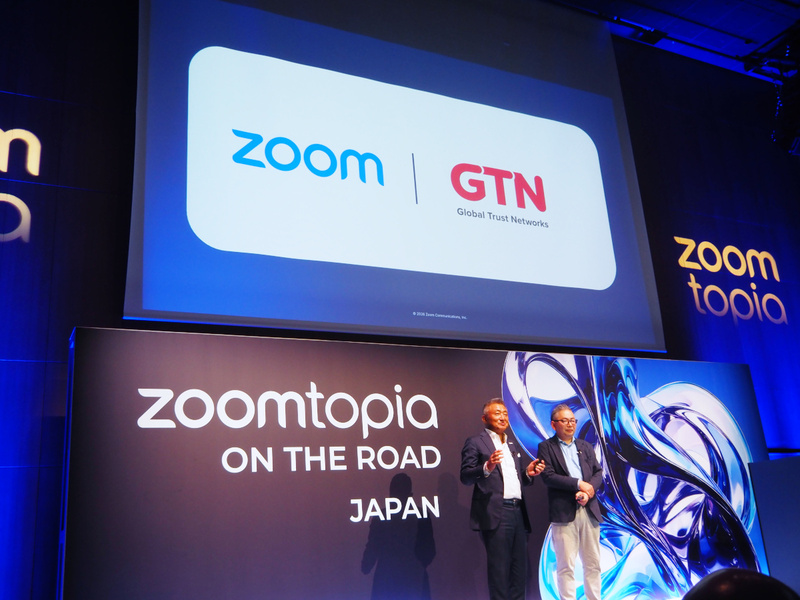
Hiroyuki Goto, President and CEO of Global Trust Networks (GTN) (right)
Hiroyuki Goto, President and CEO of Global Trust Networks (GTN), introduced examples of leveraging Zoom Phone and Zoom's AI for knowledge utilization and improving response quality in consultations for foreign residents.
For 20 years, GTN has provided living support services for foreign residents in Japan. For foreigners living in Japan, lack of trust, language barriers, and insufficient knowledge on the receiving end create hurdles, limiting options in all aspects of life, such as securing housing, communication methods, employment, and finance. This is an unfortunate situation.
Therefore, GTN aims to improve this situation by providing necessary knowledge and trust to both foreign residents and the receiving parties. This initiative originally began from Goto's experience as a student, when he acted as a guarantor for his foreign friends renting housing.
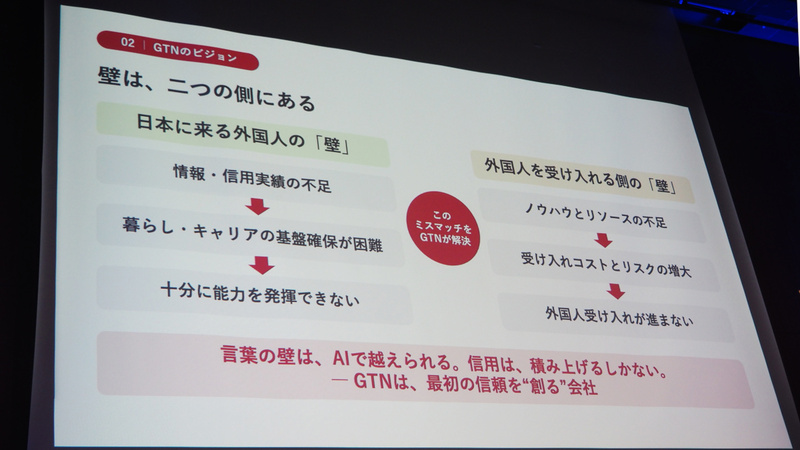
It is pointed out that currently there are "walls" for both foreigners coming to Japan and those receiving them, leading to mismatches that benefit neither side.
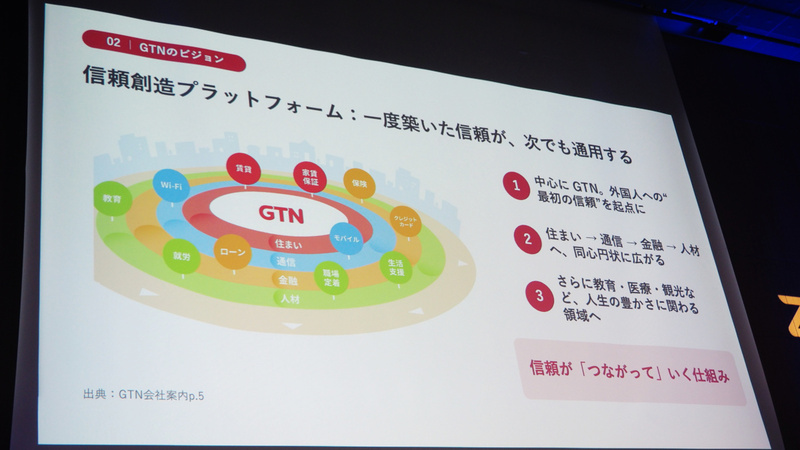
GTN's vision for a "trust creation platform." Building trust through GTN's support services to expand life options.
Over these 20 years, the cumulative number of users/beneficiaries of GTN's services has exceeded 750,000. Currently, they support 25 languages and provide 24/7 living support primarily in four areas: housing, communication, finance, and human resources. The annual number of consultations exceeds 210,000.
"100% of our customers are foreign nationals, from over 180 countries. Nearly one in five of the total foreign working population (2.57 million), or 500,000 customers, are currently involved with our services in some form," Goto explained. "You could say we are 'the company most involved with foreign residents.'"
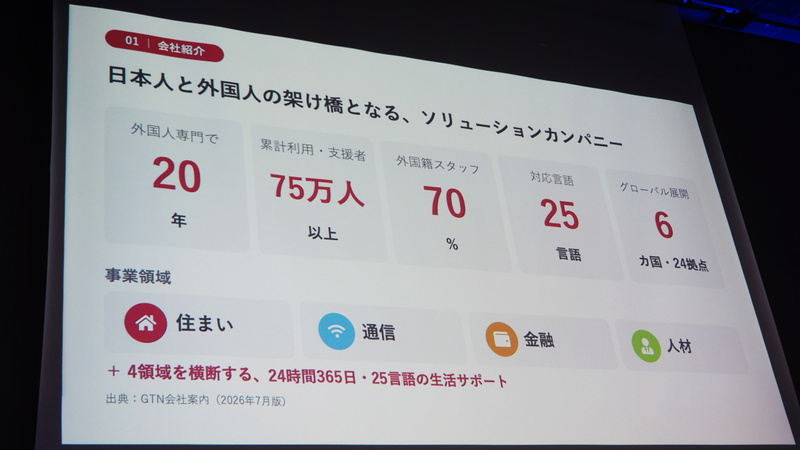
For 20 years, over 750,000 foreign residents have received living support services.
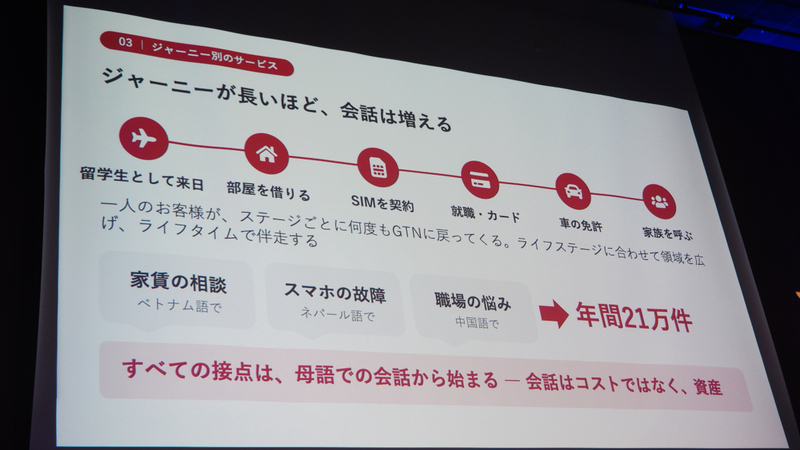
Conversations with customers begin even before their arrival in Japan and recur at each life stage.
Goto highlighted two points where he expects Zoom's AI to be beneficial: "knowledge accumulation/sharing" and "overcoming language barriers."
While GTN has handled various living consultations for 20 years, Goto recalled that "all those conversations disappeared." Contact center calls were recorded but rarely reviewed, and interview records were only individual handwritten notes by staff. The "god-tier responses" of veteran staff remained solely in their heads and could not be shared with other staff. Knowledge that could be shared by all staff and lead to service improvement was not accumulated.
"Therefore, how to turn conversations into knowledge has been our long-standing challenge," Goto stated.
After struggling with this challenge, they arrived at Zoom Phone. Through the use of Zoom Phone, they are now able to "turn conversations into assets" by preserving conversations, learning from them, and utilizing the knowledge.
"What was previously fragmented has now been connected on the Zoom platform, allowing us to output insights and knowledge. The reason we chose Zoom was the ease with which we could connect various services we were using," Goto explained.
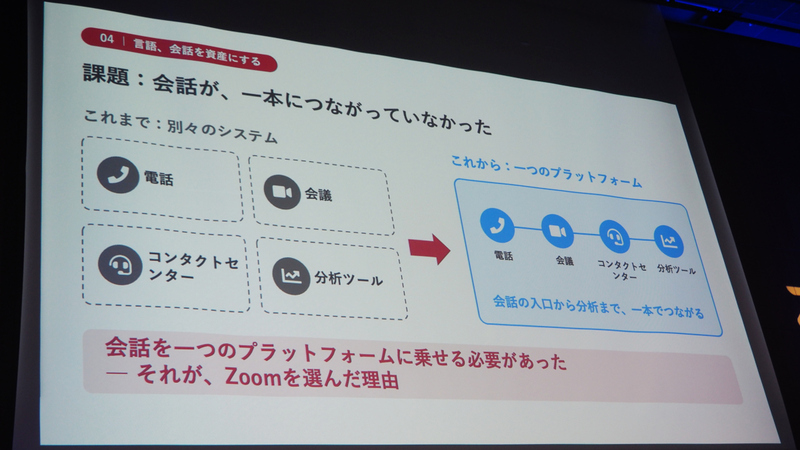
By unifying fragmented tools onto Zoom, flexible utilization of conversation data became possible.
Goto outlined a future vision of "creating the strongest operators." AI learns from the responses of excellent staff, and also learns from past interaction data as knowledge, to provide the highest quality responses. Moreover, with AI, this level of response can be achieved in all languages.
"Our current approach to AI is not about reducing people, but about being able to provide the best possible support to everyone, quickly and at any time," Goto concluded.
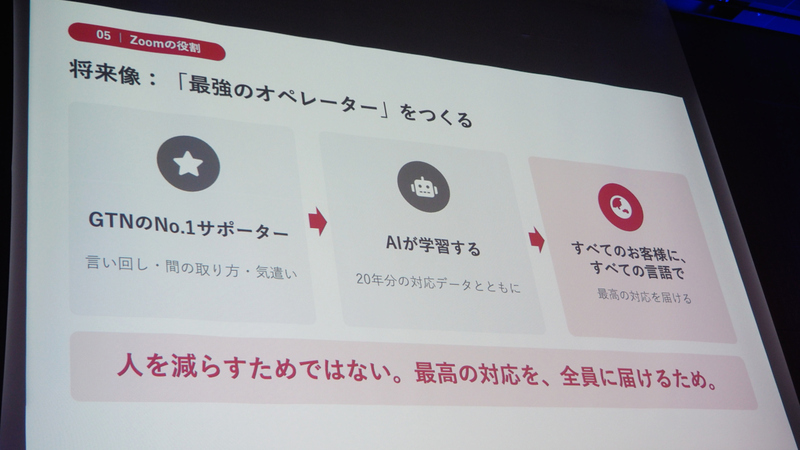
GTN's future vision is to create "the strongest operators" using AI.