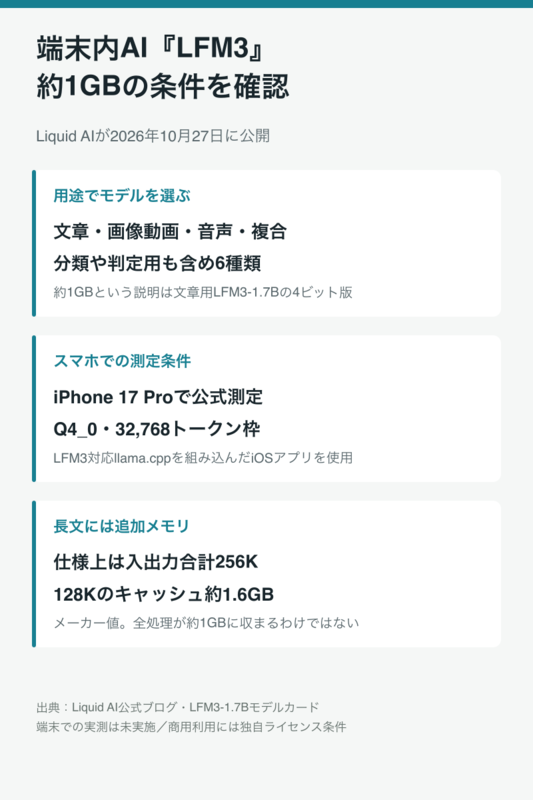
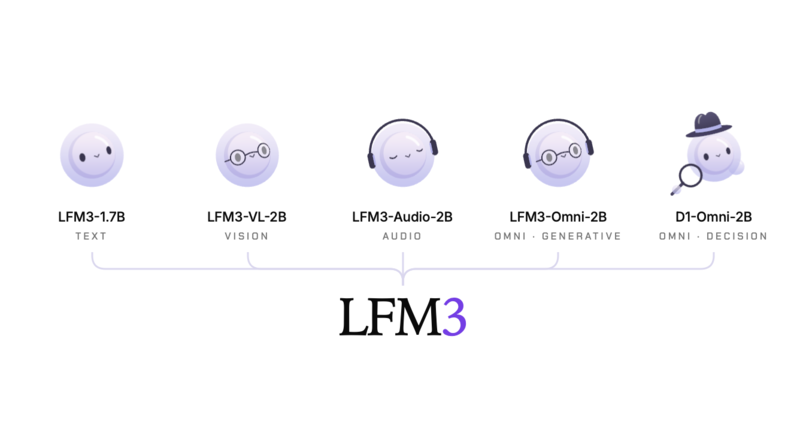
US-based Liquid AI announced on October 27th the "LFM3" series of lightweight AI models, designed to run on smartphone devices like the iPhone 17 Pro. They have released six models supporting text, images, video, and audio, and are distributing the pre-trained models on Hugging Face.
Liquid AI is an AI company founded in 2023, originating from the Massachusetts Institute of Technology (MIT)'s Artificial Intelligence Laboratory. They are researching unique designs that differ from conventional large language models, focusing on developing AI that runs efficiently on smartphones and PCs without relying on massive cloud computing infrastructure.
The core text-based model announced, "LFM3-1.7B," is a small language model with approximately 1.7 billion parameters, supporting 16 languages including Japanese. When data is compressed to 4 bits, the model itself fits into about 1GB, enabling operation on smartphones like the iPhone 17 Pro. While additional memory is required for processing long texts, it supports input/output of up to 256K tokens.
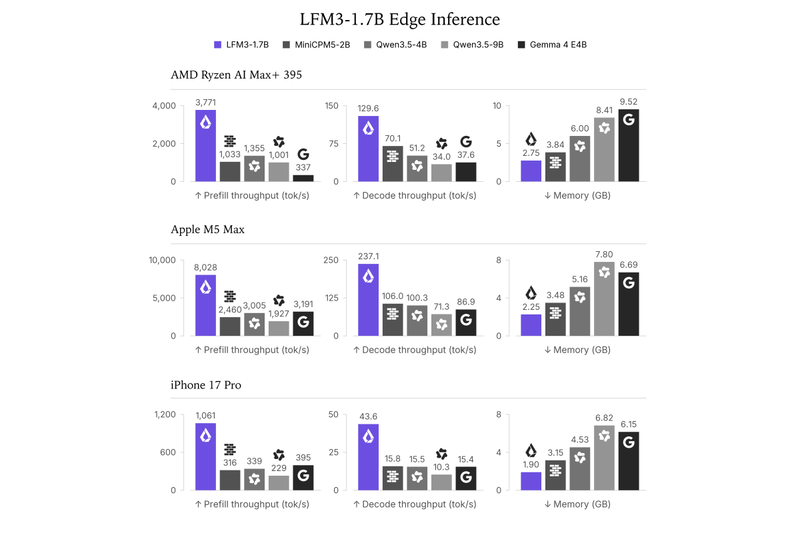
In Liquid AI's stated benchmarks, the model scored 71.39 points in "BFCL V4," which evaluates the appropriate invocation of external tools, surpassing China's Alibaba-affiliated "Qwen3.5-9B" which scored 62.83 points. In "WebArena-Verified," which assesses browser operation, it achieved 38.42 points, also outperforming Qwen3.5-9B's 28.94 points. It is particularly strong in tool operation, designed for AI agents.
On the other hand, it falls short of large-scale models in terms of knowledge and complex reasoning. In "GPQA Diamond," which measures the ability to answer difficult questions, LFM3-1.7B scored 63.37 points, while Qwen3.5-9B scored 80.40 points. In "RULER 128K," which involves extracting information from long texts, it scored 65.56 points compared to 87.11 points, showing a similar gap.
Its strengths lie in tasks that involve making decisions according to fixed procedures and invoking external functions, such as email classification, schedule management, and information extraction from documents. Since the model can be further trained for specific applications, it can be specialized for particular tasks.
LFM3 is released under its proprietary "LFM Open License v1.0," which excludes commercial use by corporations with annual revenues exceeding $10 million from its licensing terms. This model is likely to accelerate the practical implementation of AI agents on general-purpose devices.